Are you planning to import cosmetics to Indonesia? With Indonesia’s beauty market booming, many global brands see Indonesia as a top destination. But before entering, companies must comply with BPOM (Badan Pengawas Obat dan Makanan) regulations and Indonesian customs requirements.
This guide explains how to import cosmetics into Indonesia step by step—from entity setup, licensing, product classification with HS Codes, customs clearance, to tax obligations.
Why Import Cosmetics to Indonesia?
- Indonesia is one of the fastest-growing beauty markets in Southeast Asia.
- High demand for Korean cosmetics, skincare, and premium beauty products.
- Regulatory compliance with BPOM ensures product safety and builds consumer trust.
1. Entity Setup & Import Licensing
Foreign cosmetic brands cannot directly import into Indonesia. Instead, they must appoint a local Importing Company (License Holder).
Importing Company / License Holder must:
- Obtain company deed, domicile certificate, NPWP (tax ID).
- Register NIB (Business Identification Number) via the OSS system.
- NIB also acts as API (Importer Identification Number).
- API-U = General importer.
- API-P = Manufacturer importer (internal use).
- Note: A company cannot hold both API-U and API-P.
Foreign Brand (Principal) must:
- Provide corporate documents.
- Appoint the License Holder officially.
- Share product details for import planning.
2. Product & Supply Chain Planning
Before shipping, brands and license holders must agree on:
- Product specifications, incoterms, pricing.
- HS Code classification for each product type.
- Check LARTAS restrictions, halal requirements, or special permits.
- Conduct export feasibility study (duties, VAT, excise).
HS Code Table for Cosmetics
Import Tax for Cosmetics
| HS Code | Product Description | MFN Duty | VAT (PPN) | Income Tax (PPH) | ATIGA | AKFTA |
|---|---|---|---|---|---|---|
| PERFUMES & FRAGRANCES | ||||||
| 33030000 | Perfumes and toilet waters | 10.00% | 12.00% | 10.00% | 0% | 0% |
| BEAUTY & MAKEUP PREPARATIONS | ||||||
| 33041000 | Lip makeup preparations | 15.00% | 12.00% | 10.00% | 0% | 0% |
| 33042000 | Eye makeup preparations | 10.00% | 12.00% | 2.50% (API) / 7.50% (NON-API) | 0% | 0% |
| 33043000 | Manicure or pedicure preparations | 15.00% | 12.00% | 10.00% | 0% | 0% |
| 33049100 | Powders (compressed or not) | 15.00% | 12.00% | 10.00% | 0% | 0% |
| 33049920 | Anti-acne preparations | 15.00% | 12.00% | 10.00% | 0% | 0% |
| 33049930 | Face/skin creams and lotions | 15.00% | 12.00% | 10.00% | 0% | 0% |
| 33049990 | Other beauty preparations | 15.00% | 12.00% | 10.00% | 0% | 0% |
| HAIR CARE PRODUCTS | ||||||
| 33051010 | Anti-fungal shampoos | 15.00% | 12.00% | 10.00% | 0% | – |
| 33051090 | Other shampoos | 15.00% | 12.00% | 10.00% | 0% | – |
| 33052000 | Hair perming/straightening preparations | 15.00% | 12.00% | 10.00% | 0% | 0% |
| 33053000 | Hair lacquers | 15.00% | 12.00% | 10.00% | 0% | 0% |
| 33059000 | Other hair preparations | 15.00% | 12.00% | 10.00% | 0% | – |
| ORAL & DENTAL HYGIENE | ||||||
| 33061010 | Dental prophylaxis powders/pastes | 15.00% | 12.00% | 10.00% | 0% | 0% |
| 33061090 | Other dentifrices | 15.00% | 12.00% | 10.00% | 0% | 0% |
| 33062000 | Dental floss | 10.00% | 12.00% | 10.00% | 0% | 0% |
| 33069000 | Other oral hygiene products | 15.00% | 12.00% | 10.00% | 0% | 0% |
| PERSONAL CARE & TOILETRIES | ||||||
| 33071000 | Shaving preparations | 15.00% | 12.00% | 10.00% | 0% | 0% |
| 33072000 | Deodorants and antiperspirants | 15.00% | 12.00% | 10.00% | 0% | 0% |
| 33073000 | Bath salts and preparations | 10.00% | 12.00% | 10.00% | 0% | 0% |
| 33079030 | Perfumed papers and tissues | 10.00% | 12.00% | 10.00% | 0% | 0% |
| 33079040 | Other perfumery/cosmetics | 10.00% | 12.00% | 10.00% | 0% | 0% |
| SOAP PRODUCTS | ||||||
| 34011140 | Medicated/disinfectant soap | 10.00% | 12.00% | 10.00% | 0% | 0% |
| 34011150 | Bath soap and other toilet soap | 15.00% | 12.00% | 10.00% | 0% | – |
| 34011190 | Other toilet soap | 15.00% | 12.00% | 7.50% | 0% | – |
| 34011910 | Soap-impregnated felt/nonwovens | 10.00% | 12.00% | 7.50% | 0% | 0% |
| 34011990 | Other soap products | 10.00% | 12.00% | 7.50% | 0% | 0% |
| 34012020 | Soap chips | 5.00% | 12.00% | 2.50% (API) / 7.50% (NON-API) | 0% | – |
| 34012099 | Other soap forms | 10.00% | 12.00% | 7.50% | 0% | – |
| 34013000 | Liquid/cream skin cleansers | 10.00% | 12.00% | 7.50% | 0% | – |
| DISINFECTANTS | ||||||
| 38089490 | Other disinfectants | 5.00% | 12.00% | 2.50% (API) / 7.50% (NON-API) | 0% | 0% |
3. BPOM Cosmetic Registration
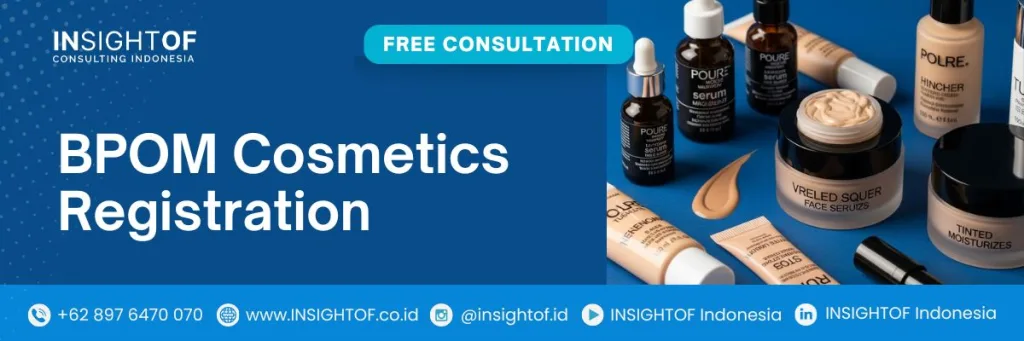
Before importing, all cosmetic products must be registered with BPOM (Badan Pengawas Obat dan Makanan – Indonesia’s National Agency of Drug and Food Control).
License Holder responsibilities:
- Submit product registration application via BPOM Online System (e-BPOM).
- Provide formula details, packaging information, labels, and safety data.
- Ensure labeling complies with Indonesian regulations (INCI names, Bahasa Indonesia instructions, batch number, expiry date).
Processing time: Typically 3–6 months, depending on product type and documentation completeness.
Only after BPOM issues the Notification Number (NA) can the product be imported and distributed in Indonesia.
4. Shipping & Logistics Preparation
Client / Supplier must prepare:
- Commercial Invoice
- Packing List
- Bill of Lading (B/L) or Air Waybill (AWB)
- Certificate of Origin (if required)
- MSDS, SNI certificate, or Halal certificate (if applicable)
License Holder / Broker ensures:
- Cargo manifest submission to Bea Cukai (Customs) before arrival.
- Compliance to avoid fines and shipment delays.
5. Customs Declaration & Clearance (PIB)
Importers must file a PIB (Pemberitahuan Impor Barang) electronically with Customs.
Required documents: Invoice, Packing List, B/L or AWB, API/NIB, NPWP, import permits.
Customs inspection lanes:
- Green Lane → automatic clearance.
- Red Lane → physical inspection.
When approved, Customs issues an SPPB (Surat Pemberitahuan Pengeluaran Barang) for goods release.
6. Payment of Duties & Taxes
When importing cosmetics, taxes and duties apply based on HS Code & CIF value:
- Customs Duty (varies per HS Code)
- VAT (PPN) – 11%
- Import Income Tax (PPh 22) – 2.5–7.5% (or 22% if no API)
- Luxury Tax (if applicable)
Payments are made through the DJBC billing system.
7. Release & Transport
After SPPB issuance:
- Goods can be picked up from port/airport.
- License Holder arranges transport to warehouse or distributor.
- All documents must be kept for audit.
8. Import Reporting & Tax Filing
The License Holder must:
- Submit import realization reports via OSS (if required).
- Keep accounting records.
- File VAT & PPh in regular tax reports.
FAQs About Importing Cosmetics to Indonesia
Can foreign companies import cosmetics directly to Indonesia?
No, only a registered local company with BPOM and API can import.
How long does BPOM registration take?
Typically 3–6 months, depending on product type and documentation.
Do all cosmetics require halal certification?
✅ Optional for now → Cosmetics can still be imported and sold without halal certification.
📅 Future requirement → Under Indonesia’s Halal Product Assurance Law (UU JPH No. 33/2014), halal certification for cosmetics will gradually become mandatory. The implementation phase for cosmetics is expected to be enforced by 2026.
What happens if I misclassify HS Codes?
It may result in incorrect duties, penalties, or delays at Customs.
Conclusion
To successfully import cosmetics to Indonesia, foreign brands must comply with BPOM regulations, use the correct HS Code classification, and appoint a qualified local license holder. With the right partner, your brand can enter Indonesia’s fast-growing beauty market smoothly and legally.
Do you need assistance registering your product in Indonesia?
Contact us today to start your registration process.



.svg/240px-YouTube_social_red_squircle_(2017).svg.png)