Indonesia, with the world’s largest Muslim population, has made halal certification mandatory for all food and beverage products circulating in its market. This obligation is based on Law No. 33 of 2014 on Halal Product Assurance, amended by Law No. 6 of 2023, and implemented by the Halal Product Assurance Organizing Body (BPJPH).
For businesses—local and foreign—halal certification is not just a regulatory step. It ensures consumer trust, legal certainty, and market access in one of Southeast Asia’s most dynamic economies. This article explains the process, requirements, costs, and special rules for imported food.
Background: The Role of BPJPH
BPJPH is the government body responsible for halal product assurance in Indonesia. Its authority includes:
- Establishing norms, standards, procedures, and criteria.
- Overseeing Halal Inspection Bodies (LPH).
- Coordinating with the Indonesian Ulema Council (MUI), Provincial/District MUI, and the Halal Fatwa Committee for halal determination.

BPJPH applies principles of protection, justice, legal certainty, accountability, transparency, and efficiency in implementing halal certification.
Purpose and Objectives of Halal Certification for Food
The halal certification framework for food and beverages aims to:
- Guarantee the halalness of products traded in Indonesia.
- Ensure business operators comply consistently with the Halal Product Assurance System (SJPH).
- Improve business operators’ quality in halal production.
- Strengthen collaboration between stakeholders (BPJPH, LPH, MUI, businesses).
Food Businesses That Must Be Halal Certified
| No. | Type of Products | Classification Code | Details of Product Type |
|---|---|---|---|
| 1 | Milk and its analog ue | 1.1 | Fermented milk and milk products from the enzyme coagulation |
| Plain fermented milk | |||
| Fermented milk or cultured milk | |||
| Fermented milk products without heating | |||
| Fermented milk products with heating | |||
| Acidified milk | |||
| Acidophilus milk | |||
| Colostrum | |||
| Yogurt | |||
| Alternate yoghurt culture | |||
| Kefir | |||
| Kumys | |||
| Milk that is coagulated with rennet | |||
| Fermented milk and other enzyme coagulated milk products | |||
| 1.2 | Condensed milk and its analogue | ||
| Condensed milk | |||
| Evaporated milk | |||
| Sterilized milk | |||
| UHT milk | |||
| Pasteurized milk | |||
| Probiotic milk | |||
| Sour milk | |||
| Evaporated skim milk | |||
| Partially evaporated skim milk | |||
| Evaporated vegetable fat milk / | |||
| evaporated vegetable oil milk | |||
| Sweet condensed milk | |||
| Vegetable fat sweet condensed milk/vegetable oil sweet condensed milk | |||
| Sweetened condensed skim milk | |||
| Sweetened condensed cream | |||
| Sweetened condensed creamer | |||
| Khoa/koya/kova | |||
| Creamer for beverages | |||
| Condensed milk and other condensed milk analogue | |||
| 1.3 | Cream and its kind | ||
| Sterilized cream | |||
| Pasteurized cream | |||
| Half and half | |||
| Whipping cream | |||
| Whipped cream | |||
| Low fat cream | |||
| Coagulated cream | |||
| Cream that are coagulated using enzyme | |||
| Sour cream | |||
| Acidified cream | |||
| Analogue cream | |||
| Vegetable cream | |||
| Other cream and its kind | |||
| 1.4 | Powder milk, powder cream and analogue powder | ||
| Powder milk and powder cream | |||
| Powder milk full cream | |||
| Instant powder milk full cream | |||
| Partially skimmed powder milk | |||
| Skim powder milk | |||
| Mixture of milk and powder cream | |||
| Powder cream | |||
| Buttermilk powder | |||
| Analogue milk and cream powder | |||
| Vegetable fat powder milk/vegetable oil powder milk | |||
| Other powder milk, powder cream and analogue powder | |||
| 1.5 | Cheese and its analogue | ||
| Cheese | |||
| Cheese analogue | |||
| Cheese without ripening (raw cheese) | |||
| Cottage cheese | |||
| Creamed cottage cheese | |||
| Cream cheese | |||
| Mozzarella cheese | |||
| Bocconcini cheese | |||
| Ripened Cheese | |||
| Totally ripened cheese including the crust | |||
| Cheddar cheese | |||
| Edam cheese | |||
| Camembert cheese | |||
| Bath cheese | |||
| Bondard cheese | |||
| Bougon cheese | |||
| Bouquet des moines cheese | |||
| Blue cheese | |||
| Brick cheese | |||
| Gouda cheese | |||
| Havarti cheese | |||
| Brie cheese | |||
| Parmesan cheese | |||
| Swiss Cheese | |||
| Other ripened cheese | |||
| Ripened cheese crust | |||
| Powder cheese (for reconstitution, for example in processing of cheese sauce) | |||
| Whey cheese | |||
| Plain processed cheese | |||
| Flavored processed cheese | |||
| Processed cheese with the addition of fruit, vegetables, or meat | |||
| Cheese analogue (vegetable fat cheese) | |||
| Whey protein cheese | |||
| Other cheese and cheese analogue | |||
| 1.6 | Other cheese and cheese analogue | ||
| Dairy ice cream | |||
| Ice cream | |||
| Ice milk | |||
| Ice cream premix | |||
| Ice milk premix | |||
| Milk premix | |||
| Flavored yoghurt | |||
| Junket/sweet custard | |||
| Dulce de leche/sweet caramel milk | |||
| Dairy mousse | |||
| Milk pudding powder | |||
| Other milk based dessert | |||
| 1.7 | Whey and whey product, except whey cheese | ||
| Whey | |||
| Sour whey | |||
| Whey powder | |||
| Demineralized whey powder | |||
| Permeate whey powder | |||
| Other whey and whey product, except whey cheese | |||
| 1.8 | Other milk and its analogue products | ||
| 2 | Fat, oil, and oil emulsion | 2.1 | Fat and oil (edible) |
| Anhydrous milk fat (AMF), butter oil | |||
| Ghee | |||
| Vegetable fat and oil | |||
| Virgin oil | |||
| Ekstra virgin olive oil | |||
| Virgin olive oil | |||
| Candlenut oil | |||
| Canola oil | |||
| Soybean oil | |||
| Frying oil | |||
| Frying fat | |||
| Cooking oil | |||
| Salad oil | |||
| Fat powder | |||
| Vegetable ghee | |||
| Shortening | |||
| Butter oil substitute | |||
| Refined bleached deodorized palm kernel oil/RBDPKO | |||
| Minyak kelapa sawit (refined bleacheddeodorized palm | |||
| oil/RBDPO) | |||
| Refined bleached deodorized palm olein | |||
| Refined bleached deodorized plam stearin/rbdps | |||
| Palm cooking oil | |||
| Unrefined coconut oil/crude coconut oil | |||
| Refined bleached deodorized coconut oil | |||
| Refined bleached deodorized peanut oil/Refined bleached deodorized groundnut oil | |||
| Refined bleached deodorized corn oil | |||
| Refined bleached deodorized candlenut/Lumbang oil | |||
| Refined bleached deodorizedcsoybean oil | |||
| Refined bleached deodorizedolive oil | |||
| Refined bleacheddeodorized safflower oil | |||
| Refined bleacheddeodorized sunflower oil | |||
| Refined bleached deodorized rice bran oil | |||
| Refined bleacheddeodorized cottonseed oil | |||
| Rapeseed oil (turnip rape oil/colza oil/ravisonoil/sarson oil/toria oil) | |||
| Rapeseed oil – low erucic acid (low erucic acid turnip rape oil/low erucic acid colza oil/canola oil) | |||
| Mustardseed oil (refined | |||
| bleached deodorized | |||
| mustardseed oil) | |||
| Sesame oil | |||
| Flaxseed oil/flax oil/linseedoil | |||
| Oleoresin | |||
| Essential oil | |||
| Animal fat fresh/dry | |||
| Prime beef fat (premier juice or oleo stock) | |||
| Edible beef fat | |||
| Dripping or edible tallow from cattle, sheep, goat, buffalo | |||
| Secunda beef fat | |||
| Suet (melting of the fat tissue of kidney, loin, or caul of beef, goat, or lamb) | |||
| Fish oil | |||
| Fat powder | |||
| Other fat and oil (edible) | |||
| 2.2 | Fat emulsion, mainly water in oil emulsion type | ||
| Butter and butter concentrate | |||
| Butter | |||
| Recombined butter | |||
| Margarine | |||
| Blends of butter and margarine | |||
| Cream margarine, margarine spread (fat spread), margarine compound, bread compound, bakery compound | |||
| “Minarin” or” halvarine” (fat emulsion in | |||
| solid or semi-solid form) | |||
| Pan release | |||
| Other fat emulsion, mainly water in oil emulsion type | |||
| 2.3 | Fat emulsion, oil in water emulsion type, including mixed products of fat emulsions with flavors | ||
| Non-dairy toppings, fillings, frostings | |||
| Non dairy whipped cream | |||
| Other fat emulsion, oil in water emulsion type, including mixed products of fat emulsions with flavors | |||
| 2.4 | Fat based desserts, not including milk- based dessert | ||
| Melorin non-dairy ice cream | |||
| Non-dairy mousse | |||
| Other fat based desserts, not including milk based dessert | |||
| 2.5 | Other fat, oil, and oil emulsion | ||
| 3 | Edible ice, including sherbet and sorbet | 3.1 | Edible ice |
| Ice cubes for sale/public consumption | |||
| Frozen product made from water and sugar | |||
| Ice stick | |||
| Fruit ice | |||
| Coconut milk-based ice cream | |||
| Coconut milk-based ice stick | |||
| Frozen product made from mungbean starch or other starch | |||
| Sorbet | |||
| Sherbet | |||
| Shaved ice | |||
| Mix shaved ice dessert | |||
| Flavored ice | |||
| Milk contained ice | |||
| Milk flavored ice | |||
| Ice premix powder | |||
| Liquid ice premix | |||
| Liquid preparations to be consumed in a frozen state | |||
| Other edible ice | |||
| 3.2 | Other edible ice, including sherbet and sorbet | ||
| 4 | Fruits and vegetables by processing and adding food additives | 4.1 | Processed fruit |
| Fresh whole fruit with processed and food-additives-added surface | |||
| Mixed dried fruit | |||
| Coconut milk powder | |||
| Coconut milk in packaging | |||
| Fruit flour | |||
| Pickled fruit | |||
| Fruit salad seasoning | |||
| Fruit in packaging | |||
| Fruit cocktail in packaging | |||
| Fruit jam | |||
| Fruit jelly | |||
| Marmelade | |||
| Fruit based spread products (such as: chutney) | |||
| Mango chutney | |||
| Coated fruit | |||
| Sugary fruit | |||
| Crystalized fruit | |||
| Sugary fruit skin | |||
| Fruit pulp | |||
| Fruit puree | |||
| Fruit paste | |||
| Fruit sauce | |||
| Fruit topping | |||
| Tamarind concentrate | |||
| Tamarind powder | |||
| Fruit bars | |||
| Candied fruit | |||
| Javanese spicy fruit salad sauce | |||
| Nata in packaging | |||
| Jelly | |||
| Seaweed extract powder | |||
| Seaweed extract in paper form | |||
| Carrageenan powder | |||
| Jelly powder | |||
| Flavored pudding mix | |||
| Mitsumame | |||
| No. | Type of Product | Classification Code | Detailed Type of Product |
| Dried and smoked banana | |||
| Processed green grass jelly | |||
| Black grass jelly | |||
| Fermented fruit products | |||
| Fruit pickle | |||
| Tempoyak (a lactic acid fermented durian) | |||
| Fruit products for pastry filling | |||
| Cooked fruit | |||
| Fruit Chips | |||
| Simulated fruit chips | |||
| Fruit/vegetable dodol | |||
| Fruit/vegetable lempok | |||
| Fruit wajik | |||
| Other processed fruit | |||
| 4.2 | Fresh vegetables, seaweed, nuts, and beans that are processed and given food additives | ||
| Processed vegetables, seaweed, nuts, and beans with food additives | |||
| Frozen french fries | |||
| Frozen potato fritters | |||
| Flavored Nori | |||
| Dried salted vegetable | |||
| “Kuaci” (Dried products obtained from watermelon seeds, machete seeds, dried sunflower seeds and added salt.) | |||
| Cooked “melinjo” (Gnetum gnemon) | |||
| chips (local cracker) | |||
| Cooked dog fruit (Archidendron pauciflorum) chips (local cracker) | |||
| Potato flakes | |||
| Tomato flour/dried tomato pulp/dried tomato paste | |||
| Red beet flour | |||
| Moringa leaves flour with food additives | |||
| Vegetables and seaweed in vinegar, oil, salty solution, or soy sauce | |||
| No. | Type of Product | Classification Code | Detailed Type of Product |
| Mushrooms in olive oil or in other vegetable oil | |||
| Salted vegetable | |||
| Salted mushroom | |||
| Sweet pickle | |||
| Ginger pickle | |||
| Packaged vegetables | |||
| Tomatoes in packaging | |||
| Sweet corn in packaging | |||
| Carrot in packaging | |||
| Mushroom in packaging | |||
| Green bean in packaging | |||
| Asparagus in packaging | |||
| Bamboo shoots in packaging | |||
| Green peas in packaging | |||
| Roots/tubers/legumes in packaging | |||
| Packaged sweetened seaweed | |||
| Aloe vera in packaging | |||
| Puree and spread products of vegetables, nuts, and grains | |||
| Tomato puree | |||
| Peanut butter | |||
| Spread of peanuts | |||
| Spread contains nuts | |||
| Vegetable jam | |||
| Raw materials and pulp of vegetables, nuts, and grains (such as: desserts and vegetables sauce, sugary vegetables) | |||
| Tomatoes paste | |||
| Tuber paste | |||
| Jelly products that are not ready for consumption | |||
| Products of fermented vegetables and seaweed | |||
| No. | Type of Product | Classification Code | Detailed Type of Product |
| Pickle (fermentation) | |||
| Mustard greens | |||
| Sauerkraut | |||
| Fermented mushroom | |||
| Kimchi | |||
| Gochujang | |||
| Cooked vegetables and seaweed | |||
| Spinach chips | |||
| Button mushroom chips | |||
| Getuk (local dessert, a product from cassava) | |||
| Vegetable tsukudani (vegetable that is boiled in soy sauce) | |||
| Dog fruit (Archidendron pauciflorum) crackers | |||
| Other fresh vegetables, seaweed, nuts, and beans that are processed and given food additives | |||
| 4.3 | Other fruit and vegetable products that are processed and given food additives | ||
| 5 | Confectionary/ candy and chocolate | 5.1 | Cocoa and chocolate products, including chocolate substitutes. |
| Cocoa liquor | |||
| Cocoa powder | |||
| Cocoa butter | |||
| Cake cocoa | |||
| Cocoa dust/ cocoa bean fraction from the process of peeling and separating the skin of cocoa beans | |||
| Drinking cocoa | |||
| Drinking chocolate | |||
| Instant cocoa | |||
| Instant chocolate | |||
| Chocolate powder | |||
| Chocolate paste (oil based) | |||
| Chocolate paste (water based) | |||
| No. | Type of Product | Classification Code | Detailed Type of Product |
| Chocolate bar | |||
| Chocolate chip | |||
| Cream chocolate | |||
| Dark chocolate, semisweet, bittersweet chocolate | |||
| Sweet chocolate | |||
| Dark chocolate couverture | |||
| Milk chocolate | |||
| Milk chocolate couverture | |||
| White chocolate | |||
| White chocolate couverture | |||
| Chocolate sprinkle | |||
| Milk chocolate sprinkle | |||
| Chocolate bonbon | |||
| Praline | |||
| Truffles | |||
| Filled chocolate | |||
| Flavored chocolate | |||
| Flavored chocolate | |||
| Chocolate for lamination | |||
| Composite chocolate | |||
| Compound chocolate | |||
| Compound chocolate sprinkle | |||
| Imitation chocolate | |||
| Lauric cocoa butter replacer/substitute CBS lauric | |||
| Non-lauric cocoa butter replacer/substitute CBS non-lauric | |||
| Carob coatings | |||
| Deffated wheat germ coating | |||
| No. | Type of Product | Classification Code | Detailed Type of Product |
| Other cocoa and chocolate products, including chocolate substitutes | |||
| 5.2 | Confectionery/candy includes hard and soft confectionery/hard and soft candy, nougats, etc. | ||
| Hard candy/boiled sweet | |||
| Pastilles | |||
| Pressed candy/lozenges | |||
| Candy filled with milk | |||
| Soft candy | |||
| Caramelized candy | |||
| Fudge | |||
| Licorice | |||
| Toffee | |||
| Krokant/brittles | |||
| Marshmallow | |||
| Starch jelly | |||
| Jelly and gelatin confectionery | |||
| Cotton candy | |||
| Gulali (local sweet, a paste dough from heated sugar and water, and molded into various shapes) | |||
| Nut brittles | |||
| Raw marzipan, base almond paste | |||
| Marzipan, almond paste | |||
| Other confectionery/candy includes hard and soft confectionery/hard | |||
| and soft candy, nougats, and similar products | |||
| 5.3 | Bubble gum | ||
| 5.4 | Sugars for decoration | ||
| Icing | |||
| Frosting | |||
| Chocolate sauce/topping/spread | |||
| Sweet sauce/topping/spread | |||
| No. | Type of Product | Classification Code | Detailed Type of Product |
| Non-fruit sauce/topping/spread | |||
| Sugar based topping | |||
| Other sugars for decoration | |||
| 5.5 | Other confectionary/candy and chocolate | ||
| 6 | Cereals and cereal products that are derivative products of cereal seeds, roots and tubers, nuts and pith with processing and adding food additives | 6.1 | Processed grain |
| Instant rice | |||
| Rice chip | |||
| Instant porridge | |||
| Instant oats | |||
| Other processed grains | |||
| 6.2 | Flour and starch added with food additives | ||
| Rice flour added with food additives | |||
| Glutinous rice flour added with food additives | |||
| Corn flour added with food additives | |||
| Peeled mungbean flour added with food additives | |||
| Mungbean flour added with food additives | |||
| Red bean flour added with food additives | |||
| Soybean flour added with food additives | |||
| Semolina durum wheat | |||
| Durum wheat flour | |||
| Whole durum wheat semolina and whole durum wheat flour | |||
| Pearl millet flour added with food additives | |||
| Sorghum flour added with food additives | |||
| Wheat flour | |||
| Self-raising wheat flour | |||
| No. | Type of Product | Classification Code | Detailed Type of Product |
| Modified wheat flour | |||
| Wheat gluten powder | |||
| Wheat flour with protein addition | |||
| Wholemeal wheat flour | |||
| Fine bran | |||
| Cassava flour added with food additives | |||
| Mocaf flour | |||
| Other tuber flour (potato flour, sweet potato flour, arrowroot flour, canna flour, etc) | |||
| Palm flour added with food additives | |||
| Konjac flour | |||
| Maida flour | |||
| “Hanjeli” (Coix lacryma-Jobi) flour (local flour) added with food | |||
| additives | |||
| “Porang” (Amorphophallus muelleri) flour (local flour) added | |||
| with food additives | |||
| “Suweg”(Amorphophallus | |||
| campanulatus) flour (local flour) added with food additives | |||
| Inulin | |||
| “Iles-iles” (Amorphophallus | |||
| muelleri) flour (local flour) | |||
| Arrowroot starch | |||
| Corn starch or maizen | |||
| Sago starch | |||
| Mungbean starch | |||
| Tapioca/cassava starch | |||
| Dextrin | |||
| Maltodextrin | |||
| Modified starch | |||
| Pre-gelatinized starch | |||
| Other flour and starch added with food additives | |||
| 6.3 | Breakfast cereals, including rolled oats | ||
| No. | Type of Product | Classification Code | Detailed Type of Product |
| Bulgur | |||
| Meal | |||
| Wheat germ meal | |||
| Oatmeal | |||
| Degermed corn meal | |||
| Corn rice | |||
| Ready to eat cereal | |||
| Whole grain ready to eat cereal | |||
| Cereal drink powder | |||
| Degermed corn grits | |||
| Gari (cassava granules) | |||
| Granola | |||
| Malt extract | |||
| Other breakfast cereals, | |||
| including rolled oats | |||
| 6.4 | Pasta and noodles as well as similar products (such as: rice | ||
| paper, rice vermicelli, soybean | |||
| pasta and soybean noodles) | |||
| Uncooked wet noodles | |||
| Other uncooked wet noodles | |||
| Skin of dumpling/”risol”/spring | |||
| roll/”siomay”/dim sum | |||
| Dumpling/pasties/spring | |||
| roll/”risol”/samosa | |||
| Dried kuetiaw (dried flat rice | |||
| noodles) | |||
| Processed pasta product | |||
| Whole wheat pasta | |||
| Wheat and soybean pasta product | |||
| Vegetable noodle product | |||
| Other pasta | |||
| Wheat and soybean noodle product | |||
| Vegetable noodle product | |||
| Instant pasta | |||
| No. | Type of Product | Classification Code | Detailed Type of Product |
| Other instant pasta | |||
| Dried noodle | |||
| Seasoned instant vermicelli | |||
| Instant “kuetiaw” (flat rice noodles) | |||
| Instant macaroni | |||
| Cooked wet noodles | |||
| Other cooked wet noodles | |||
| Instant noodle | |||
| Other instant noodle | |||
| “Mie soa” (dried noodles from wheat | |||
| flour added with other raw material | |||
| and white color) | |||
| Uncooked crackers | |||
| Other pasta and noodle as well as | |||
| similar products (such as: rice | |||
| paper, rice vermicelli, soybean | |||
| pasta and soybean noodles) | |||
| 6.5 | Cereal and starch-based dessert | ||
| (such as: rice pudding flour, | |||
| tapioca pudding flour) | |||
| Cereal and starch-based dessert | |||
| (such as: rice pudding flour, tapioca | |||
| pudding flour) | |||
| Pearl typed sago | |||
| Cereal and starch-based dessert | |||
| premix | |||
| Other cereal and starch-based | |||
| dessert (such as: rice pudding | |||
| flour, tapioca pudding flour) | |||
| 6.6 | Flour for dough (such as for | ||
| surface coating of fish or chicken | |||
| meat) | |||
| Coating flour | |||
| Seasoning flour | |||
| Flour for vegetables fritter | |||
| Flour for dough of meat ball | |||
| Other flour for dough | |||
| 6.7 | Soybean products | ||
| Soy juice powder | |||
| Soy drink powder | |||
| Soy juice concentrate | |||
| No. | Type of Product | Classification Code | Detailed Type of Product |
| A thin layer of soy liquid | |||
| Semi-dried tofu | |||
| Semi-dried tofu that is processed with thick sauce | |||
| Deep-fried semi-dried tofu | |||
| Other semi-dried tofu | |||
| Dried tofu | |||
| Tofu | |||
| “Tauco” (fermented soybean paste) | |||
| Fermented soybean | |||
| “Dou chi” (Chinese fermented black | |||
| bean) | |||
| “Natto”(Japanese fermented soybean) | |||
| Fermented tofu | |||
| Soybean protein product | |||
| Soybean texturized vegetable protein (TVP) | |||
| Soybean Isolated Soy Protein (ISP) | |||
| Soybean hydrolyzed vegetable protein (HVP) | |||
| Frukto-oligosakarida (FOS) | |||
| Galakto-oligosakarida (GOS) | |||
| Other soybean products | |||
| 6.8 | Other cereals and cereal products that are derivative products of cereal seeds, roots and tubers, nuts and pith with processing and adding food additives | ||
| 7 | Bakery products | 7.1 | Unsweetened bread and bakery products |
| Bread and cadet bread (roll) | |||
| White bread | |||
| Bread added with other food ingredients | |||
| White bread without skin | |||
| Rye bread | |||
| Pumpernickel bread | |||
| No. | Type of Product | Classification Code | Detailed Type of Product |
| Bread with fruits/raisins/chocochips | |||
| Whole wheat bread | |||
| Mix of flour and fine bran | |||
| Baguette/pain courant francais | |||
| Malt bread | |||
| Whole wheat cadet bread | |||
| Milk cadet bread | |||
| Wheat germ bread | |||
| Meal bread | |||
| Whole meal bread | |||
| Quick bread | |||
| Shortened bread | |||
| Bagel | |||
| Pita bread | |||
| Canai bread (flatbread) | |||
| Lace pancake | |||
| Maryam bread (Round thin-shaped bread) | |||
| Crouton | |||
| Bread for stuffing | |||
| “Mantao” (steam bun without filling) | |||
| “Bakpao/Pao” (Steam bun filled with | |||
| meat, mung bean or others) | |||
| Steam bun | |||
| Other unsweetened bread and bakery products | |||
| 7.2 | Special bakery products (sweet, salty, savory) | ||
| Cake | |||
| Butter cake | |||
| Cheesecake | |||
| Pound cake or quatre quarts | |||
| Brownies | |||
| No. | Type of Product | Classification Code | Detailed Type of Product |
| Pie | |||
| Stuffed pie | |||
| “Bolu kukus” (Indonesian Steamed Cake) | |||
| Egg roll | |||
| Crepes | |||
| Pastry | |||
| Sweet bread | |||
| Stuffed bread | |||
| Scone | |||
| Doughnut | |||
| American muffin | |||
| English muffin | |||
| Roti buaya (Crocodile-shaped bread/ local bread) | |||
| Kue tambang (a deep fried rope-shaped snack made of flour and other | |||
| ingredients) | |||
| Waffle | |||
| “Stroopwafel” (Dutch cookies) | |||
| Pancake | |||
| “Bakpia” (local snack) | |||
| “Bolu emprit” (local snack) | |||
| Other special bakery products (sweet, salty, savory) | |||
| 7.3 | Traditional wet/semi-wet cakes that are made from rice and others | ||
| “Dodol/jenang/gelamai” (local snack) | |||
| ”Mochi” (Japanese delicacies). | |||
| “Wajik/wajit”(local snack) | |||
| “Teuck/tteok”(Korean delicacies) | |||
| Rice cake | |||
| “Nagasari/Banana cake” (local snack) | |||
| “Putu ayu”(local snack) | |||
| “Kue mangkok”(local snack) | |||
| “Jongkong kelapa muda” (local snack) | |||
| No. | Type of Product | Classification Code | Detailed Type of Product |
| “Talam ebi” (local snack) | |||
| “Kue lapis” (local snack) | |||
| “Juadah kering/mayang papan” (local snack) | |||
| “Petah” (local snack) | |||
| “Amparan tatak pisang (local snack) | |||
| “Lampu-lampu” (local snack) | |||
| “Pisang hijau (local snack) | |||
| “Temo coe” (local snakc) | |||
| “Lemper ayam” (local snack) | |||
| “Semar mendem” (local snack) | |||
| “Jadah manten” (local snack) | |||
| “Kue ku” (local snack) | |||
| “Legondo” (local snack) | |||
| “Onde-onde” (local snack) | |||
| “Seri muka” (local snack) | |||
| “Kekicak/gegicak” (local snack) | |||
| “Lalampa” (local snack) | |||
| “Katrisolo” (local snack) | |||
| “Lapek bugis” (local snack) | |||
| Ombus-ombus | |||
| Legomoro | |||
| Eclairs | |||
| “Lapis legit” (layer cake) | |||
| “Bika ambon” (local snack) | |||
| “Serabi” (local snack) | |||
| “Pukis” (local snack) | |||
| “Apem” (local snack) | |||
| “Kue mangkok” (local snack) | |||
| “Kue cucur” (local snack) | |||
| Other traditional delicacies | |||
| 7.4 | Dried snack | ||
| No. | Type of Product | Classification Code | Detailed Type of Product |
| Cookies | |||
| Soft cookies | |||
| Sweet cookies | |||
| Oatmeal cookies | |||
| “Nastar” (Pineapple jam-filled cookies) | |||
| “Kastengel” (Cheese cookies) | |||
| “Putri salju” (Snow white cookies) | |||
| “Bagelen” (Sweet dried bread) | |||
| Other dried snacks | |||
| 7.5 | Ready to eat pudding | ||
| Milk pudding | |||
| Fruit pudding | |||
| Flavored pudding | |||
| Other ready to eat puddings | |||
| 7.6 | Other bakery products | ||
| 8 | Meat products and meat processed products | 8.1 | Fresh slaughtered meat, poultry meat and mammal meat |
| Mammal carcass | |||
| Carcass | |||
| Half carcass | |||
| Quarter carcass | |||
| Hind quarter/leg quarter | |||
| Forequarter | |||
| Hindquarter | |||
| Short ribs | |||
| Prime ribs | |||
| Poultry or mammals leg | |||
| Poultry or mammals shoulder | |||
| Non-carcass mammals parts | |||
| Offal | |||
| Innards | |||
| No. | Type of Product | Classification Code | Detailed Type of Product |
| Rack | |||
| Breast | |||
| Foreshank | |||
| Half poultry | |||
| Front quarter/breast quarter | |||
| Whole back | |||
| Tail | |||
| Back | |||
| Stripped back | |||
| Full breast | |||
| Wishbone | |||
| Trimmed breast | |||
| Half trimmed breast | |||
| Wing | |||
| Head | |||
| Neck | |||
| Feet or claws | |||
| Poultry or mammal giblets | |||
| Poultry or mammal meat | |||
| Poultry or mammal chilled meat | |||
| Poultry or mammal frozen meat | |||
| Poultry or mammal dried meat | |||
| Rib meat | |||
| Meat parting types | |||
| Rib eye | |||
| Cuberoll | |||
| Brisket | |||
| Shin and shank | |||
| Shank/foreshank | |||
| Flank | |||
| No. | Type of Product | Classification Code | Detailed Type of Product |
| Mammal tenderloin | |||
| Mammal striploin/sirloin | |||
| Mammal has (tenderloin) | |||
| Mammal loin | |||
| Topside | |||
| Riverside | |||
| Eye round | |||
| Rump | |||
| Round | |||
| Chuck tender | |||
| Chuck | |||
| Blade | |||
| Boneless meat that is sold in bulk packing | |||
| Tetelan (Acquired portion of meat, fat and tendon during trimming of meat in prime cut making or from bone after the meat | |||
| (prime cut) is obtained) | |||
| Fat | |||
| Patties | |||
| Raw sausages | |||
| Minced meat | |||
| Ground meat | |||
| Parting of poultry meat and slaughtered animal meat that are removed from their bones, mechanically grinded and shaped (with or without coating) | |||
| Mechanically deboned meat (MDM) | |||
| Desinewed minced meat (DMM) | |||
| Other fresh slaughtered of meat, poultry meat and mammal meat | |||
| 8.2 | Processed products of meat, poultry meat, and slaughtered mammals meat in whole or parting form | ||
| Processed products of meat, poultry meat, and slaughtered mammals meat in whole or parting form that is cured (including salted process) without heat treatment | |||
| No. | Type of Product | Classification Code | Detailed Type of Product |
| Marinated meat | |||
| Marinated mammal meat | |||
| Marinated poultry meat | |||
| Smoked meat | |||
| Meat jerky | |||
| Fermented meat | |||
| Daging cangkuk (Jambi’s traditional meat | |||
| dish) | |||
| Cooked cured mammal shoulder | |||
| Seasoned processed meat | |||
| Packaged meat and gravy | |||
| Canned meat | |||
| Meat floss | |||
| Processed products of meat, poultry | |||
| meat, and slaughtered mammals meat | |||
| in whole or parting form that is cured | |||
| (including salted process) and dried | |||
| without heating treatment | |||
| Products of meat, poultry meat, and | |||
| slaughtered mammals meat in whole or | |||
| parting form that is fermented without | |||
| heating treatment | |||
| Corned meat | |||
| Products of meat, poultry meat, and | |||
| slaughtered mammal meat in whole or | |||
| parting form that is processed by | |||
| heating treatment | |||
| Cooked thigh meat of slaughtered | |||
| mammal (curing) | |||
| Cooked cured shoulder of slaughtered | |||
| mammal | |||
| Rendang made from slaughtered | |||
| products of mammals/poultry | |||
| Stew made from slaughtered products of | |||
| mammals/poultry | |||
| Seasoned processed meat | |||
| Packaged meat and gravy | |||
| Canned meat | |||
| “Sup konro” (local dish, rib soup | |||
| Makassar style) | |||
| No. | Type of Product | Classification Code | Detailed Type of Product |
| “Kaledo” (local dish) | |||
| Tengkleng (local dish) | |||
| “Rawon” (local dish, black soup) | |||
| Meat/marrow/rib/tetelan soto | |||
| Meat/marrow/rib/”tetelan” soup | |||
| Grilled ribs | |||
| “Asam-asam iga” (local dish) | |||
| “Iga penyet” (local dish, Javanese beef rib) | |||
| “Ayam penyet” (local dish, spicy chicken) | |||
| Steak | |||
| Skin/hide crackers | |||
| Lung crackers | |||
| Meat, poultry meat and slaughtered | |||
| mammals meat-based crackers | |||
| Fried chicken intestine. | |||
| Processed products of meat, poultry | |||
| and slaughtered mammals meat in | |||
| frozen whole or parting form | |||
| (processed, stored, or traded in frozen | |||
| form) | |||
| Chicken katsu | |||
| Chicken karage | |||
| Fried chicken | |||
| Frozen chicken strip | |||
| Chicken cordon bleu | |||
| Fried chicken skin | |||
| Frozen packaged cut of meat with sauce | |||
| Frozen seasoned processed meat | |||
| “Pindang daging” (local dish, beef stew) | |||
| “Empal daging” (local dish, Sundanese | |||
| bruised fried meat) | |||
| Meat satay | |||
| Other processed products of meat, | |||
| poultry meat, and slaughtered | |||
| mammals meat in whole or parting | |||
| form | |||
| No. | Type of Product | Classification Code | Detailed Type of Product |
| 8.3 | Processed products of meat, poultry meat, and slaughtered mammals | ||
| meat that are grinded | |||
| Products of meat, poultry meat, and | |||
| slaughtered mammals meat that are | |||
| grinded, without heating treatment | |||
| Meat, poultry meat, and slaughtered | |||
| mammal meat that are grinded and | |||
| cured (including salted process) | |||
| without heating treatment | |||
| Smoked sausages (all kinds of | |||
| smoked sausages from halal | |||
| animal) | |||
| Meat sausages (all kinds of meat | |||
| sausages from halal animal) | |||
| Non-sterilization corned meat | |||
| Meat, poultry meat, and slaughtered | |||
| mammals meat that are grinded, | |||
| fermented without heating treatment | |||
| Salami (coarse ground meat that is | |||
| fermented with bacterial starter with | |||
| or without the addition of other food | |||
| ingredients) | |||
| Meat, poultry meat, and slaughtered | |||
| mammal meat that are grinded and | |||
| processed with heating treatment | |||
| Pastrami | |||
| Meat pate | |||
| Meat ball | |||
| Seasoned minced meat | |||
| Soft roast patties | |||
| Brawn and head cheese | |||
| Sterilization corned meat | |||
| Cooked luncheon | |||
| Meat pasta | |||
| Non-casing meat sausage | |||
| Ready-to-eat meat sausage | |||
| Terrines (mixture of cooked meat | |||
| minced) | |||
| Meat roulade | |||
| Seasoned processed grinded meat | |||
| Cut meat/minced meat/ground meat | |||
| with sauce in the package | |||
| No. | Type of Product | Classification Code | Detailed Type of Product |
| Pepperoni | |||
| Meat, poultry meat, and slaughtered mammals meat that are grinded, processed and frozen | |||
| “Dragon leg” made from | |||
| poultry/mammal meat | |||
| Patty/meat burger | |||
| Chicken nuggets | |||
| Meat nuggets | |||
| Smoked chicken breast | |||
| Meat dumpling | |||
| Gyoza/swikiau/meat kuotieh” (Japanese/Chinese pan-fried dumpling) “ | |||
| Keecho/heecho (chicken meat covered with tofu skin) | |||
| Egg wrapped with meat | |||
| Collagen sausage casing | |||
| Sausage casing from co-extrusion collagen | |||
| Natural sausage casing | |||
| Cellulose sausage casing | |||
| Plastic sausage casing | |||
| Other processed products of meat, poultry meat, and slaughtered mammals meat that are grinded | |||
| 8.4 | Processed by-products of the meat industry | ||
| Gelatin | |||
| Collagen | |||
| Chondroitin | |||
| Glucosamine | |||
| Flour of bone | |||
| Flour of meat | |||
| Meat/bone broth | |||
| Meat extract | |||
| Other processed by-products of the meat industry | |||
| No. | Type of Product | Classification Code | Detailed Type of Product |
| 8.5 | Other meat products and meat processed products | ||
| 9 | Fish and fishery products include mollusks, crustaceans and echinoderms by processing and adding food additives | 9.1 | Fish and other fishery products including mollusks, crustaceans and echinoderms, which have undergone processing |
| Frozen fish, fish fillets and fishery products including mollusks, crustaceans and echinoderms | |||
| Frozen grilled eel | |||
| Frozen boiled fish “pempek” (Palembang ‘s traditional fish | |||
| processed product) | |||
| Frozen fish ball | |||
| Frozen breaded fish, fish fillet, and fisheries products, including Mollusca, Crustacean, Echinodermata | |||
| Frozen breaded stick, fillet, and ground of fish meat | |||
| Frozen breaded shrimp | |||
| Frozen fish/shrimp/squid/oyster nuggets | |||
| Frozen fish minced products with cream, including Mollusca, Crustacean, and Echinodermata. | |||
| Cooked and/or fried fish and fishery products, including Mollusca, Crustacean, and | |||
| Echinodermata. | |||
| Steamed or boiled fish and fish products | |||
| “Ikan pindang” (ocal dish, fish is | |||
| cooked by boiling salt water) | |||
| “Ikan presto” (local dish, soft bones fish) | |||
| Canned fish | |||
| Fish tofu | |||
| Fish pickel | |||
| “Kaki naga” made from fish | |||
| ingredients | |||
| Fish cake/”Kamaboko” | |||
| (Boiled/steamed) | |||
| Fish bakwan (local fish cake; boiled/steamed). | |||
| Fish tempura | |||
| Imitation crab stick | |||
| No. | Type of Product | Classification Code | Detailed Type of Product |
| Fish floss | |||
| Filled milkfish | |||
| Fish dim sum | |||
| Fish dumplings | |||
| “Tekwan ikan” (local dish, boiled | |||
| ground fresh fish meat) | |||
| “Pepes ikan” (local dish, steamed fish with banana leaves) | |||
| Combination fish sausage | |||
| “Ekado” (Japanese dish) | |||
| Fish roulade | |||
| Fish burger | |||
| “Tsukudani” (Japanese dish) | |||
| “Terasi” (local seasoning, fermented | |||
| fish or shrimp paste) | |||
| Cooked fish eggs | |||
| Processed seasoned fish | |||
| Steamed squid/cuttlefish/shrimp cake | |||
| Shrimp/fish dim sum | |||
| Mollusks/crustaceans/echinoderms meatball | |||
| Shrimp sausage | |||
| Cold boiled crab meat | |||
| Popcorn shrimp | |||
| Fish/mollusks/crustaceans/ec hinoderms meatballs (dry) | |||
| Fish cake/”kamaboko” (fried/grilled) | |||
| Stir-fried chili sauce with shrimp (Shrimp fried chili-sauce – Sambal | |||
| goreng udang) | |||
| Stir-fried chili sauce with fish (Fish fried chili sauce – Sambal goreng ikan) | |||
| Fried fish skin chips | |||
| Fish “pempek” (fried/grilled) (Palembang ‘s traditional fish dish) | |||
| Crispy fish | |||
| Fish chips | |||
| Eel chips | |||
| No. | Type of Product | Classification Code | Detailed Type of Product |
| Fish tortillas | |||
| Tuna “rendang” (West Sumatera’s | |||
| traditional dish) | |||
| “Kaki naga or dragon leg” (local dish) | |||
| Clam “rendang” | |||
| Fish and fishery products including mollusk, crustaceans, and echinoderms that being smoked, dried, fermented, and/or salted | |||
| Fish, shrimp, mollusca crackers (raw) | |||
| Raw fish skin crackers | |||
| Fish jerky | |||
| Shrimp/fish terasi | |||
| Fish paste | |||
| “Bekasam/bekasang” (local dish, | |||
| fermented fish or fish offal) | |||
| “Rusip” (local dish, fermented | |||
| anchovy) | |||
| “Masin”(local dish, fermented fresh | |||
| small shrimp) | |||
| “Sashimi” (Japanese dish) | |||
| Fish flour | |||
| Sea urchin gonand paste | |||
| “Ebi furai” (Japanese dish) | |||
| “Ebi katsu” (Japanese dish, shrimp cutlet) | |||
| Other fish and other fishery products including mollusks, crustaceans and echinoderms, which have undergone processing | |||
| 9.2 | Semi-durable fish and fishery products including mollusca, crustaceans and echinoderms | ||
| Rollmops | |||
| Sea gel | |||
| Aspic fish | |||
| Fish and fishery products, including mollusca, crustaceans, and echinoderms that are processed into pickle, and/or immersed in | |||
| salt solution | |||
| The substitutes for salmon eggs, caviar, and other fish egg products | |||
| No. | Type of Product | Classification Code | Detailed Type of Product |
| Caviar | |||
| Red caviar | |||
| Golden caviar | |||
| Caviar substitute | |||
| Shrimp paste | |||
| Preserved fish and fishery products, | |||
| including canned or fermented fish | |||
| and fishery products, including | |||
| mollusca, crustaceans, and | |||
| echinoderms | |||
| Ready-to-eat sausage of | |||
| fish/mollusca/ | |||
| crustaceans/echinoderms | |||
| Ready-to-eat processed | |||
| fish/mollusca/ | |||
| crustaceans/echinoderms | |||
| Packaged tuna | |||
| Packaged shrimp | |||
| Packaged shells | |||
| Packaged sterilized crab meat | |||
| Packaged pasteurized crab meat | |||
| Packaged oysters | |||
| Packaged salmon | |||
| Sardines and mackerel in cans | |||
| Packaged squids | |||
| Packaged cuttlefishes | |||
| Packaged fish | |||
| Packaged fish processed | |||
| Other semi-durable fish and fishery | |||
| products including mollusca, | |||
| crustaceans and echinoderms | |||
| 9.3 | Other fish and fishery products | ||
| include mollusks, crustaceans and | |||
| echinoderms by processing and | |||
| adding food additives | |||
| 10 | Processed | 10.1 | Processed egg product |
| egg and | |||
| 10.2 | Mixed liquid egg/liquid egg premix | ||
| processed | |||
| egg | |||
| Frozen mixed egg/frozen egg premix | |||
| products | |||
| No. | Type of Product | Classification Code | Detailed Type of Product |
| Whole egg flour | |||
| Egg white flour | |||
| Egg yolk flour | |||
| Fully cooked/half cooked egg with | |||
| food additive | |||
| “Pindang egg” (traditional style egg | |||
| processing ) with food additive | |||
| Fermented egg | |||
| Mixed egg flour/egg flour premix | |||
| Egg “rendang” | |||
| Other mixed liquid egg/liquid | |||
| egg premix | |||
| 10.3 | Preserved egg, including traditional | ||
| preserved egg products using | |||
| alkalis, salt, and canning method | |||
| Sterile processed egg | |||
| Black egg (“pidan/pitan/bitan”) | |||
| Salted egg with food additive | |||
| addition | |||
| “Hulidan” (Other style of preserved | |||
| egg) | |||
| “Dsaudan” (Other style of preserved | |||
| egg) | |||
| Egg-based desserts (such as: | |||
| custard) | |||
| Kaya jam | |||
| Custard flour with egg | |||
| “Egg Martabak” (Egg crepes filled | |||
| with spices and pieces of meat) | |||
| Other preserved egg, including | |||
| traditional preserved egg products | |||
| using alkalis, salt, and canning | |||
| method | |||
| 10.4 | Other processed egg products | ||
| 11 | Sugar | 11.1 | Raw sugar and refined sugar |
| and | |||
| Raw sugar | |||
| sweetene | |||
| rs, | |||
| including | Refined crystal sugar | ||
| honey | |||
| No. | Type of Product | Classification Code | Detailed Type of Product |
| Dextrose anhydrous | |||
| Dextrose monohydrate | |||
| Fructose | |||
| Sugar powder (icing sugar) | |||
| Dextrose powder (icing dextrose) | |||
| Soft white sugar | |||
| Glucose | |||
| Dry glucose syrup | |||
| Glucose syrup | |||
| Lactose | |||
| White crystalline sugar or granulated sugar | |||
| Other raw sugar and refined sugar | |||
| 11.2 | Palm sugar | ||
| Coconut sugar block | |||
| Coconut sugar powder | |||
| Coconut sugar liquid | |||
| Palm sugar block | |||
| Palm sugar powder | |||
| Palm sugar liquid | |||
| Palmyra palm sugar block | |||
| Palmyra palm sugar powder | |||
| Palmyra palm sugar liquid | |||
| Nipa palm sugar block | |||
| Nipa palm sugar powder | |||
| Nipa palm sugar liquid | |||
| Other palm sugar | |||
| 11.3 | Sugar solutions and syrup, as well as invent sugar (some), including treacle and molasses | ||
| Inverted sugar | |||
| High fructose syrup | |||
| High fructose glucose syrup | |||
| No. | Type of Product | Classification Code | Detailed Type of Product |
| Corn syrup | |||
| Cane syrup | |||
| Liquid sucrose sugar | |||
| Other sugar solutions and syrup, as well as invent sugar (some), including treacle and molasses | |||
| 11.4 | Sugar and other syrups (such as: xylose, maple syrup, decorative sugar) | ||
| Gula hias | |||
| Maple syrup | |||
| Sorghum syrup | |||
| Table syrup | |||
| Chocolate syrup | |||
| Fruit syrup | |||
| Flavored syrup | |||
| Flavored watery syrup | |||
| Tea syrup | |||
| Coffee syrup | |||
| Agave syrup | |||
| Other sugar and other syrups (such as: xylose, maple syrup, decorative | |||
| sugar) | |||
| 11.5 | Honey | ||
| Honey powder | |||
| Honey liquid with food additive | |||
| Honey liquid with addition other ingredients | |||
| 11.6 | Other sugar product and sweetener including honey | ||
| 12 | Salt, spice, sup, sauce, salad, as well as protein products | 12.1 | Salt with food additive |
| Mixed salt | |||
| Seasoned salt | |||
| Iodized salt | |||
| Other salt with food additives | |||
| No. | Type of Product | Classification Code | Detailed Type of Product |
| 12.2 | Seasonings and condiments | ||
| Herbs and spices powder | |||
| Fennel powder | |||
| Chicory root | |||
| Mustard seed powder | |||
| Chili pulp | |||
| Chili powder | |||
| Pepper powder | |||
| Cloves powder | |||
| Fenugreek powder | |||
| Fenugreek powder | |||
| Mace powder | |||
| Ginger pulp | |||
| Ginger powder | |||
| Black caraway powder | |||
| White caraway powder | |||
| Cardamom powder | |||
| Cinnamon powder | |||
| “Kencur” ( Kaempferia galanga) | |||
| powder | |||
| Coriander powder | |||
| Nutmeg powder | |||
| Paprika powder | |||
| Sweet paprika powder | |||
| Wasabi | |||
| Five spice powder | |||
| Ready-to-use seasoning | |||
| Beef extract seasoning | |||
| Beef flavored seasoning | |||
| Chicken extract seasoning | |||
| Shrimp extract seasoning | |||
| Squid extract seasoning | |||
| No. | Type of Product | Classification Code | Detailed Type of Product |
| Meat extract pasta seasoning (such as: beef and chicken extract pasta seasoning) | |||
| Fish flavored seasoning | |||
| Shrimp flavored seasoning | |||
| Chicken flavored seasoning | |||
| Powder/block/cubes/paste of chicken/beef, shrimp/cheese extract | |||
| Various instant cooking seasoning | |||
| Other flavoring seasoning | |||
| Other seasoning | |||
| Other condiment | |||
| 12.3 | Mustard/mustard sauce | ||
| 12.4 | Soup and broth | ||
| Essence of chicken | |||
| Broth and consommé | |||
| Instant soup | |||
| Instant pasta soup (such as: instant macaroni soup) | |||
| Instant cream soup | |||
| Instant pasta cream soup (such as: instant macaroni cream soup) | |||
| Other soup and broth | |||
| 12.5 | Sauces and similar products | ||
| Mayonais, mayonnaise | |||
| Salad dressing (such as: thousand island, blue cheese, burger dressing, caesar pouring sauce) Tar tar sauce | |||
| Saus tar tar (tar tar sauce) | |||
| French dressing (italian dressing, | |||
| Sandwich spread | |||
| Chili paste | |||
| Chili sauce | |||
| Peanut sauce | |||
| No. | Type of Product | Classification Code | Detailed Type of Product |
| Cheese sauce | |||
| Radish sauce | |||
| Barbeque sauce | |||
| Pizza sauce | |||
| Spaghetti sauce | |||
| Oyster sauce | |||
| Marinated sauce | |||
| Tomato sauce | |||
| Sweet and sour sauce | |||
| Worchester sauce | |||
| Teriyaki sauce | |||
| Topping sauce | |||
| Salsa sauce | |||
| White sauce (cream based) | |||
| Mixing for sauces, gravies, dressings | |||
| Fish sauce | |||
| Clear oyster sauce | |||
| Other sauce and similar products | |||
| 12.6 | Spreads products for salads (such as: macaroni salad, potato salad) and sandwiches, not including chocolate and nut-based spreads | ||
| Spreads/sauces | |||
| 12.7 | Seasonings and condiments made of soybean | ||
| Miso | |||
| Soy sauce | |||
| Salty soy sauce | |||
| Non-fermented salty soy sauce/hydrolysate | |||
| Hydrolyzed vegetable protein sauce | |||
| Other soy sauces | |||
| Sweet soy sauce | |||
| Dried soy sauce/soy sauce powder (Fermented soy sauce powder) | |||
| No. | Type of Product | Classification Code | Detailed Type of Product |
| Hot soy sauce | |||
| Seasoning soy sauce | |||
| Hydrolyzed vegetable protein blend sauce | |||
| Mushroom broth | |||
| Protein products | |||
| Other seasonings and condiments made of soybean | |||
| 12.8 | Wheat protein products | ||
| Hydrolyzed vegetable protein (HVP, ISP, soy concentrated protein | |||
| /SCP/protein concentrate protein) | |||
| Gluten processed products salt, spice, soup, sauce, salad, and | |||
| protein products | |||
| Other wheat protein products | |||
| 12.9 | Other products of salt, spice, soup, salad, and protein products | ||
| 13 | Processed food for special nutrition needs | 13.1 | Infant formulas, advanced formulas, and growth formulas |
| Infant formula | |||
| Advanced formula | |||
| Growth formula | |||
| 13.2 | Infant formula for Special Medical Purpose Food (PKMK) | ||
| Processed food for medical purposes, especially for babies and children | |||
| PKMK for patients with metabolic disorders (inborn errors of | |||
| metabolism) | |||
| PKMK for patients with metabolic disorders Isovaleric Acidemia | |||
| PKMK for patients with metabolic disorders Tyrosinernia | |||
| PKMK for patients with metabolic disorders Phenylketonuria (PKU) | |||
| PKMK for patients with Maple Syrup Urine Disease (MSUD) metabolic | |||
| disorders | |||
| PKMK for nutritional support for children at risk of growth failure, malnutrition or poor nutrition | |||
| No. | Type of Product | Classification Code | Detailed Type of Product |
| PKMK for premature babies | |||
| PKMK for supplementary nutrition of breast milk (Human Milk | |||
| Fortifier/HMF) | |||
| PKMK for patients allergic to dairy milk protein | |||
| PKMK for a ketogenic diet | |||
| PKMK for lactose intolerant infants | |||
| PKMK for malabsorption patients | |||
| PKMK for patients with chronic liver disease | |||
| PKMK for patients with inflammatory bowel disease | |||
| 13.3 | Food for infants and kids during growth period | ||
| Complementary feeding of breastfeeding (MP-ASI) | |||
| The main complementary feeding (MP-ASI) | |||
| Snacks of complementary feeding (MP-ASI) | |||
| 13.4 | Processed food for medical | ||
| purposes (PKMK) especially for adults | |||
| PKMK for people with diabetes | |||
| PKMK for patients with chronic kidney disease | |||
| PKMK for patients with chronic liver disease | |||
| PKMK for nutritional support for malnourished adult patients | |||
| PKMK for the ketogenic diet | |||
| 13.5 | Dietary processed food for weight control | ||
| 13.6 | Special dietary processed food, excluding products from categories 13.1, 13.2, 13.3, 13.4, dan 13.5 | ||
| Beverages specifically for pregnant women and/or nursing mothers | |||
| Sports drinks | |||
| Supplementary food for sportsmen | |||
| Other special dietary processed food | |||
| 13.7 | Other processed food for special nutrition needs | ||
| 14 | Ready-to-eat snacks | 14.1 | Processed foods made from potatoes, tubers, cereals, flour or starch |
| No. | Type of Product | Classification Code | Detailed Type of Product |
| Potato chips | |||
| “Gadung chips” (local potato, | |||
| diascorea hispida) | |||
| Rice crackers (senbei) | |||
| Sandwich crackers | |||
| Flavor crackers | |||
| Cassava chips | |||
| “Dakak-dakak” (local chip, typical | |||
| West Sumatran cassava chips) | |||
| “Lanting/karang kaliang” (local chip, | |||
| cassava based snack) | |||
| Sweet potato chips | |||
| Tempe chips | |||
| Fermented peanut meal chips | |||
| Tofu/bean curd product chips | |||
| Taro chips | |||
| Simulated snack | |||
| “Kecimpring:”(local chip, fried snacks | |||
| from cassava) | |||
| “Opak” (local chips, roasted snacks | |||
| from rice flour or cassava or other tubers) | |||
| “Simping” (local chips, typical West | |||
| Java snacks from tapioca) | |||
| “Slondok” (local chips, snack from cassava flour or tapioca mixed with | |||
| other starch or ingredients) | |||
| “Pilus” (local snacks from extruded | |||
| product of tapioca mixed with other starch or ingredients and spices | |||
| Popcorn | |||
| ”Marning jagung” (local snack from | |||
| corn) | |||
| “Jipang jagung” (local snack from | |||
| extruded product of corn) | |||
| “Jipang beras” (local snack from rice | |||
| and/or glutinous rice) | |||
| “Jipang melinjo” (local snack from extruded product of “melinjo” | |||
| (Gnetum gnemon) ) | |||
| “Kerupuk beras” (local cracker from | |||
| rice flour or glutinous rice flour) | |||
| “Kerupuk karak” (local cracker from | |||
| cooked rice) | |||
| “Kerupuk intip” (local craker from the | |||
| result of cooked rice that sticks to the bottom of the container) | |||
| “Rengginang/batiah” (local snack | |||
| from cooked glutinous rice) | |||
| “Patilo/rengginang singkong” (local | |||
| snack from cooked cassava) | |||
| “Rempeyek” (local crackers from rice flour and peanut or mung bean or fish or other ingredients) | |||
| No. | Type of Product | Classification Code | Detailed Type of Product |
| Extruder product snacks | |||
| Fried “emping melinjo” (local cracker from | |||
| (Gnetum gnemon) crackers | |||
| Snacks in the form of bars | |||
| “Malkist” (biscuit from wheat flour | |||
| and/or non-fermented wheat flour and coated with sugar) | |||
| Biscuit | |||
| Non-flour biscuit | |||
| “Marie”(sweet biscuit) | |||
| Coated sweet biscuit | |||
| Layer/Sandwich biscuit | |||
| Cereal bar biscuit with filling (biskuit bar sereal isi) | |||
| Biskuit with chocolate cream | |||
| Wafer | |||
| Wafer roll/wafer stick | |||
| Coated wafer | |||
| Crackers | |||
| Cream crackers | |||
| Water biscuit | |||
| Krekers soda | |||
| Traditional snacks | |||
| Other processed foods made from potatoes, tubers, cereals, flour or starch | |||
| 14.2 | Processed nuts, including coated nuts and nut mixes (for example with dried fruit) | ||
| Roasted unshelled peanuts | |||
| Fried peanuts | |||
| Other fried nuts | |||
| Garlic flavor fried peanuts | |||
| Roasted peanuts | |||
| Other roasted nuts | |||
| “Kacang atom/sukro” (fried or roasted | |||
| flour mix coated peanut) | |||
| Other fried or roasted flour mix coated nuts | |||
| No. | Type of Product | Classification Code | Detailed Type of Product |
| “Kacang telur” (fried flour and egg coated | |||
| peanuts) | |||
| “Kacang goyang” (sugary dough coated | |||
| peanuts) | |||
| “Jipang/kipang kacang” (peanuts or nuts | |||
| based snacks) | |||
| Coated peanut | |||
| Other processed nuts, including coated nuts and nut mixes (for example with dried fruit) | |||
| 14.3 | Fish-based snacks | ||
| Crackers from fishery products | |||
| “Rempeyek ikan” (local snack fish flake brittle) | |||
| “Sumpia udang” (local snack, dried and | |||
| smaller shrimp spring rolls) | |||
| Fish-based snack | |||
| 14.4 | Other ready-to-eat snacks | ||
| 15 | Ready-to- eat food | 15.1 | Rice-based ready meals |
| 15.2 | Noodles/vermicelli-based ready meals | ||
| 15.3 | Potato-based ready meals | ||
| 15.4 | Pasta-based ready meals | ||
| 15.5 | Tuber-based ready meals | ||
| 15.6 | Bread-based ready meals | ||
| 15.7 | Soup-based ready meals | ||
| 15.8 | Vegetable-based ready meals | ||
| 15.9 | Other ready-to-eat food | ||
| 16 | Food and beverages providers with processing | 16.1 | Restaurant |
| 16.2 | Canteen/Cafeteria | ||
| 16.3 | Small restaurant | ||
| 16.4 | Food stall | ||
| 16.5 | Food outlet | ||
| 16.6 | Catering | ||
| 16.7 | Other food and beverages providers with processing | ||
| 17 | Food additives | 17.1 | Antifoaming agent |
| Calcium alginate | |||
| No. | Type of Product | Classification Code | Detailed Type of Product |
| 17.2 | Anticaking agent | ||
| Tricalcium orthophosphate | |||
| Powdered cellulose | |||
| Salts of oleic acid with calcium, potassium, and sodium (Ca, K, Na) | |||
| 17.3 | Antioxidant | ||
| Ascorbic acid | |||
| Sodium ascorbate | |||
| Calcium ascorbate | |||
| Potassium ascorbate | |||
| Ascorbyl palmitate | |||
| Ascorbyl stearate | |||
| Tocopherol | |||
| Erythorbic acid | |||
| Sodium erythorbate | |||
| Rosemary extract | |||
| 17.4 | Emulsifying salt | ||
| Sodium dihydrogen citrate | |||
| Trisodium citrate | |||
| Potassium dihydrogen citrate | |||
| Tripotassium citrate | |||
| Dicalcium diphosphate | |||
| Acetic and fatty acid esters of glycerol | |||
| Lactic and fatty acid esters of glycerol | |||
| Citric and fatty acid esters of glycerol | |||
| Diacetyltartaric and fatty acid esters of glycerol | |||
| 17.5 | Humectant | ||
| No. | Type of Product | Classification Code | Detailed Type of Product |
| Sodium lactate | |||
| Potassium lactate | |||
| Glycerol | |||
| Polydextroses | |||
| Triacetin | |||
| 17.6 | Glazing agent | ||
| Pullulan | |||
| Other glazing agent | |||
| 17.7 | Sweetener | ||
| Sorbitol | |||
| Mannitol | |||
| Inositol | |||
| Nectar agave | |||
| Stevia and its derivatived products | |||
| Tagatosa | |||
| Isomalt/Isomaltitol | |||
| Thaumatin | |||
| Steviol glycosides | |||
| Maltitol | |||
| Lactitol | |||
| Silitol (xylitol) | |||
| Erythritol | |||
| Acesulfame potassium | |||
| Aspartame | |||
| Cyclamic acid | |||
| Sucralose/Trichlorogalactosucrose | |||
| Neotame | |||
| 17.8 | Carrier | ||
| Sucrose acetatae isobutyrate | |||
| Triethyl citrate | |||
| No. | Type of Product | Classification Code | Detailed Type of Product |
| 17.9 | Gelling agent | ||
| Processed eucheuma seaweed | |||
| Jelly flour | |||
| Carboxymethyl cellulose (CMC) | |||
| Gellan gum | |||
| 17.1 | Foaming agent | ||
| Quillaia Extract (Type 1) | |||
| Quillaia Extract (Type 2) | |||
| 17.11 | Acidity regulator | ||
| Lactic acid | |||
| Potassium lactate | |||
| Calcium lactate | |||
| Malic acid | |||
| Fumaric acid | |||
| Citric acid | |||
| Citric acid and its salts | |||
| Tartaric acid and potassium hydrogen tartrate | |||
| Tartaric acid | |||
| Potassium hydrogen tartrate | |||
| Potassium hydrogen tartrate | |||
| Sodium malate | |||
| Calcium DL-malate | |||
| Adipic acid and its salts | |||
| Adipic acid | |||
| Adipic sodium | |||
| Adipic potassium | |||
| Calcium sulphate | |||
| Glucono delta lactone | |||
| No. | Type of Product | Classification Code | Detailed Type of Product |
| 17.12 | Preservative | ||
| Nisin | |||
| Natamycin | |||
| Lysozyme hydrochloride | |||
| 17.13 | Raising agent | ||
| Starch acetate | |||
| 17.14 | Emulsifier | ||
| Lecithins | |||
| Pectins | |||
| Beta glucan | |||
| Galactomannan | |||
| Octenyl succinic acid modified gum arabic | |||
| Polysorbates/preservative | |||
| Ammonium phosphatide | |||
| Glycerol ester of wood rosin | |||
| Calcium Dihydrogen Diphosphate | |||
| Sodium calcium polyphosphate | |||
| Calcium polyphosphate | |||
| Methyl cellulosa | |||
| Hydroxypropyl cellulose | |||
| Hydroxypropyl methyl cellulose | |||
| Methyl ethyl cellulose | |||
| Sodium carboxymethyl cellulose | |||
| Salts of oleic acid with calcium, potassium, and sodium (Ca, K, Na) | |||
| No. | Type of Product | Classification Code | Detailed Type of Product |
| Mono- and di- glycerides of fatty acid | |||
| Acetic and fatty acid esters of glycerol | |||
| Lactic and fatty acid esters of glycerol | |||
| Citric and fatty acid esters of glycerol | |||
| Diacetyltaric and fatty acid esters of glycerol | |||
| Sucrose esters of fatty acid | |||
| Polyglycerol esters of fatty acids | |||
| Polyglycerol esters of interesterified ricinoleic acid | |||
| Propylene glycol esters of fatty acids | |||
| Sodium stearoyl-2-lactylate | |||
| Sorbitan esters of fatty acids | |||
| Sorbitan monooleate | |||
| Acid treated starch | |||
| Bleached starch | |||
| Oxidized starch | |||
| Enzymed treated starch | |||
| Monostarch phosphate | |||
| Distarch phosphate | |||
| Phosphated distarch phosphate | |||
| Acetylated distarch phosphate | |||
| Acetylated distarch adipate | |||
| Hydroxypropyl starch | |||
| No. | Type of Product | Classification Code | Detailed Type of Product |
| Hydroxypropyl distarch phosphate | |||
| Starch sodium octenyl succinate | |||
| Acetylated oxidized starch | |||
| Sodium caseinate | |||
| 17.15 | Thickener | ||
| Processed eucheuma seaweed | |||
| Xanthan gum | |||
| Gum ghatti | |||
| Alpha-Cyclodextrin | |||
| Gamma-Cyclodextrin | |||
| Ethyl cellulose | |||
| Ordinary modified starch | |||
| Sodium carboxymethyl cellulose, enzymatically hydrolysed | |||
| 17.16 | Firming agent | ||
| Calcium gluconate | |||
| Ticalcium citrate | |||
| 17.17 | Flavour enhancers | ||
| L-glutamic acid and its salts | |||
| L-glutamic acid | |||
| Monosodium l-glutamate | |||
| Monopotassium l-glutamate | |||
| Calsium di-l-glutamate | |||
| Guanylic acid and its salts | |||
| 5’-guanylic acid | |||
| Disodium 5’-guanylatae | |||
| No. | Type of Product | Classification Code | Detailed Type of Product |
| Dipotassium 5’-guanylate | |||
| Calcium 5’-guanylate | |||
| Inosinic acid and its salts | |||
| 5’-inosinic acid | |||
| Disodium 5’-inosinate | |||
| Dipotassium 5’-inosinate | |||
| Calcium 5’-inosinate | |||
| Salts of 5’-ribonucleotides | |||
| Calcium 5’-ribonucleotides | |||
| Disodium 5’-ribonucleotides | |||
| 17.18 | Bulking agent | ||
| Alginic acid | |||
| Sodium alginate | |||
| Propylene glycol alginate | |||
| Guar gum | |||
| Tragacanth gum | |||
| Arabic gum | |||
| Karaya gum | |||
| Glycerol ester of wood rosin | |||
| 17.19 | Stabilizer | ||
| Calcium acetate | |||
| Disodium monohydrogen citrate | |||
| Potassium alginate | |||
| Locust bean gum | |||
| Tara gum | |||
| Disodium diphosphate | |||
| No. | Type of Product | Classification Code | Detailed Type of Product |
| Trisodium diphosphate | |||
| Tetrasodium diphosphate | |||
| Tetrapotassium diphosphate | |||
| Dicalcium diphosphate | |||
| Croscarmellose sodium | |||
| Myristic, palmitic & stearic acids and | |||
| their calcium potassium and sodium | |||
| (Ca, K, Na) salts | |||
| Salts of oleic acid with calcium, | |||
| potassium, and sodium (Ca, K, Na) | |||
| Acetic and fatty acid esters of glycerol | |||
| Lactic and fatty acid esters of glycerol | |||
| Citric and fatty acid esters of glycerol | |||
| Diacetyltaric and fatty acid esters of | |||
| glycerol | |||
| Polyglycerol esters of interesterified | |||
| ricinoleic acid | |||
| Starch sodium octenyl succinate | |||
| 17.2 | Color retention agents | ||
| Ferrous Gluconate | |||
| 17.21 | Flour treatment agent | ||
| L-Ammonium lactate | |||
| Sodium stearoil-2-lactylate | |||
| Calcium oxide | |||
| 17.22 | Pewarna (colour) | ||
| Curcumin CI. No. 75300 | |||
| No. | Type of Product | Classification Code | Detailed Type of Product |
| Riboflavin | |||
| Carmines and cochineal extract CI. No. 75470: | |||
| Carmines CI. No. 75470 | |||
| Cochineal extract No. 75470 | |||
| Chlorophyll CI. No. 75810 | |||
| Chlorophylls and chlorophyllins, copper complexes | |||
| Chlorophylls, copper complexes CI. No. 75810 | |||
| Chlorophyllin copper complexes, sodium and potassium salts CI. No. 75815 | |||
| Caramel I – plain | |||
| Caramel II caustic sulphite process | |||
| Caramel III – ammonia process | |||
| Caramel IV – sulphite ammonia process | |||
| Vegetable carbon CI. 77266 | |||
| Beta-carotenes (vegetable) CI. No. 75130 | |||
| Annatto extracts (bixin based) CI. No. 75120 | |||
| Carotenoids | |||
| Beta-carotenes, synthetic CI. No. 40800 | |||
| Beta-carotenes from blakeslea trispora | |||
| Beet red | |||
| Anthocyanins | |||
| Iron oxide, Red | |||
| Propellant | |||
| 17.23 | Sequestrant | ||
| Calcium disodium ethylene diamine tetra acetate | |||
| No. | Type of Product | Classification Code | Detailed Type of Product |
| Isopropyl citrates | |||
| Sodium gluconate | |||
| Potassium gluconate | |||
| 17.24 | Other food additives group | ||
| 18 | Kelompok bahan lainnya | 18.1 | Bakery ingredient |
| Instant flour | |||
| Bread filling materials | |||
| Food softener materials | |||
| Greasing pan | |||
| “Tepung panir” (Flour of oven-dried white bread and then ground) | |||
| Bread crumb | |||
| Dipping/coating/topping for decorating bread, cakes, and other bakery products that do not include | |||
| decorating sugar | |||
| Premiks untuk stuffing | |||
| Premix for bakery products | |||
| Premiks untuk filling | |||
| Bakery preservative | |||
| Shortened bread dough | |||
| Ice cream cone | |||
| Other bakery ingredients | |||
| 18.2 | Vanilla (powder and liquid) | ||
| 18.3 | Glazing agent | ||
| 18.4 | Flour treatment agent | ||
| 18.5 | Swallow’s nest |
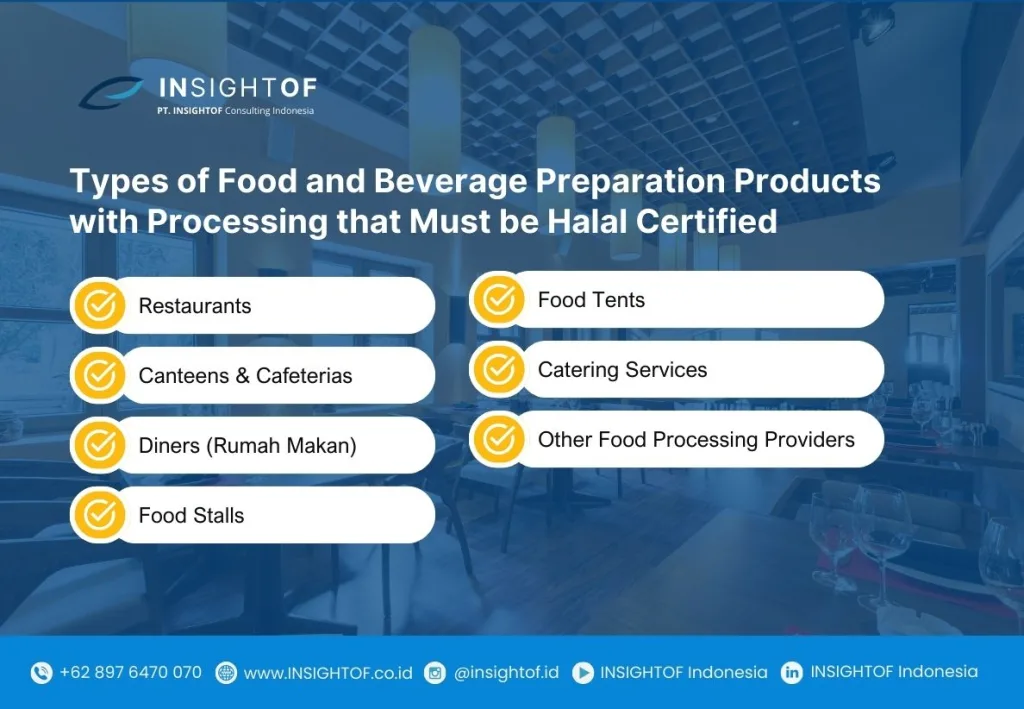
According to Ministerial Decree No. 748/2021, the following food service providers and processed food businesses must obtain halal certification:
- Restaurants (conventional, fast food, franchises).
- Canteens & Cafeterias (schools, offices, dormitories).
- Diners (Rumah Makan) – e.g., Padang restaurants.
- Food Stalls (warung nasi, Tegal stalls).
- Food Tents (Pecel Lele, fried rice tents).
- Catering Services – both long-term (dormitories, offshore rigs, airlines) and event-based (weddings, concerts).
- Other Food Processing Providers not covered above.
| Types of Products | Product Type Details | Example |
| Providing food and drinks with processing | Restaurant | Conventional restaurants, fast food restaurants, all you can eat restaurants, franchise restaurants, restaurants with branches, etc. |
| Canteens/cafeteria | School canteens, faculty/university canteens, office canteens, dormitory canteens, shopping center employee canteens, etc. | |
| Diner (Rumah Makan) | Padang Diners, buffet diners, fast food diners, etc. | |
| Food stalls | Home food stalls, Tegal stalls, Pemalang stalls, etc. | |
| Food tents | Lamongan food tent, Pecel Lele Food Tents, Fried Rice Food Tents, Satay Food Tents, Chicken Noodle Food Tents, etc. | |
| Catering/catering services | Temporary catering services (such as those providing food and drinks in certain facilities: hajj catering, dormitories, companies, public transportation, correctional institutions, etc.), catering services for certain events (such as those providing food and drinks for the general public based on certain events: weddings, celebrations, concerts, etc.) |
Failure to certify results in administrative sanctions. Imported products must also be halal certified and registered before marketing in Indonesia.
Key Requirements: The Halal Product Assurance System (SJPH)
Business actors must implement the SJPH, which consists of five core criteria:
- Commitment and Responsibility – top management must adopt halal policies, ensure consistent standards across all outlets, and invest in halal training.
- Materials – all raw, additive, and auxiliary materials must be halal and reported to BPJPH. Any changes must be declared.
- Halal Product Process (PPH) – includes separation of halal and non-halal facilities, compliance in production, storage, packaging, and distribution.
- Product – labeling, packaging, and serving must comply with halal standards.
- Monitoring & Evaluation – businesses must conduct internal halal audits at least once a year and submit reports to BPJPH every six months.
📌 Franchises must include halal compliance clauses in their franchise agreements, ensuring that franchisees cannot use the franchisor’s halal certificate unless they meet SJPH standards.
Halal Certification Process for Food
1. Preparation Phase
- Appointment of a Halal Supervisor.
- Preparation of SJPH manual and initial internal audit.
- Determination whether the business qualifies for Self-Declare (only for MSMEs) or Regular Path.
2. Certification Application
- Submission via BPJPH’s SIHALAL system.
- Verification by BPJPH (1 working day).
- Determination of LPH (inspection body).
3. Inspection and Audit
- LPH inspects facilities, processes, and materials (max. 15 days).
- If needed, laboratory testing is conducted.
4. Halal Determination
- MUI, Provincial/City MUI, or Aceh Ulama Council conducts a fatwa hearing.
- If delayed, the Halal Fatwa Committee issues the determination.
5. Certificate Issuance
- BPJPH issues the Halal Certificate and authorizes the use of the national halal logo (max. 1 day after decision).
Costs of Halal Certification for Food
- MSMEs: Often subsidized or eligible for free certification under government programs.
- Medium & Large Businesses: Pay certification fees, which vary depending on product types, number of SKUs, and inspection scope.
- Imported Products: Additional costs for documentation, recognition of foreign certificates, and translation of labels.
Special Rules for Imported Food Products
- Must be halal certified by BPJPH-recognized foreign halal bodies.
- Still required to be registered in Indonesia before distribution.
- Labels must be in Bahasa Indonesia, displaying the Indonesian national halal logo.
- Importers must submit a Letter of Authorization (LOA) and complete documents (Free Sale Certificate, composition list, labels, production flow).
After Certification: Business Obligations
Obtaining a halal certificate is not the end—businesses must:
- Maintain halal status throughout production, distribution, and serving.
- Separate halal from non-halal facilities and supply chains.
- Renew certificates if there are changes in materials or processes.
- Report SJPH implementation regularly to BPJPH.

Conclusion
Halal certification for food in Indonesia is not only a legal requirement but also a strategic advantage. From restaurants and catering services to imported packaged food, every business must comply with BPJPH regulations, SJPH implementation, and MUI fatwa determinations.
By understanding the process, costs, requirements, and post-certification obligations, businesses can secure consumer trust, avoid sanctions, and successfully tap into Indonesia’s vast halal food market.
l certification in Indonesia is more than just a legal formality—it’s a strategic advantage for businesses in food, drinks, cosmetics, and medical devices. By ensuring compliance with BPJPH and MUI guidelines, your products will not only meet Indonesian standards but also gain credibility in global markets.
If you’re planning to export cosmetics, medical devices, or food and beverages to Indonesia, starting your halal certification process early is crucial to avoid delays in distribution.
Do you need assistance registering your product in Indonesia?
Contact us today to start your registration process.



.svg/240px-YouTube_social_red_squircle_(2017).svg.png)