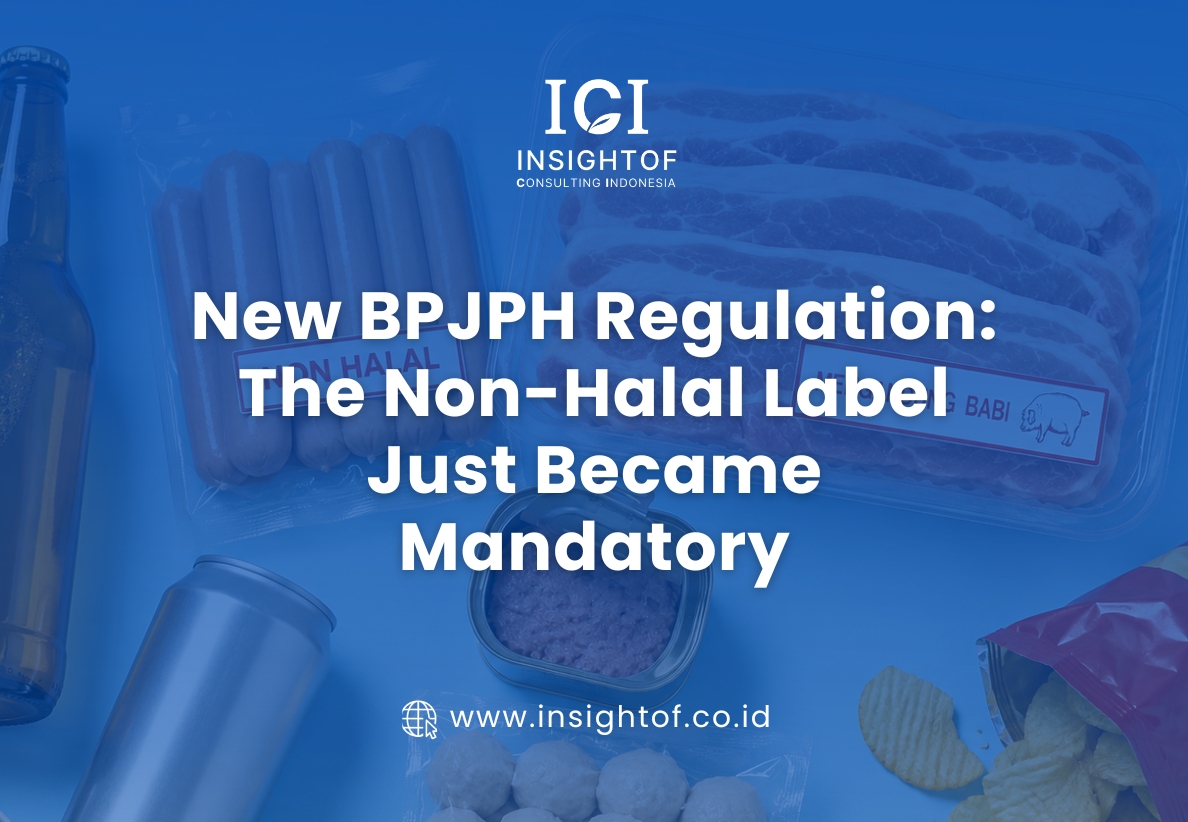
The Halal Product Assurance Agency (BPJPH) has issued Regulation No. 3 of 2026 on the Form and Procedure for Including Non-Halal Information (Peraturan BPJPH No. 3 Tahun 2026 tentang Bentuk dan Tata Cara Pencantuman Keterangan Tidak Halal), signed in Jakarta on 13 July 2026 and officially promulgated on 23 July 2026. This regulation implements Article 110(3) of Government Regulation No. 42 of 2024 on the Administration of Halal Product Assurance, and for the first time sets out a standardized, legally binding format for labeling products that are not halal-certified.
For business actors whose products fall outside halal certification, this is a significant compliance shift. Instead of an optional or informal disclosure, non-halal status must now be declared using a specific design, color code, and placement — with a 12-month transition period to adjust.
Products made from prohibited (non-halal) ingredients or processes are exempt from mandatory halal certification — but in exchange, they are now required to display a standardized Non-Halal Declaration on their packaging or product.
Legal Basis
BPJPH Regulation No. 3 of 2026 is grounded in the following legal instruments:
- Law No. 8 of 1999 on Consumer Protection
- Law No. 33 of 2014 on Halal Product Assurance, as amended by Law No. 6 of 2023
- Government Regulation No. 42 of 2024 on the Administration of Halal Product Assurance
- Presidential Regulation No. 153 of 2024 on the Halal Product Assurance Agency
- BPJPH Regulation No. 1 of 2024 on the Organization and Working Procedures of BPJPH
Who Needs to Comply?
Under Article 3, products derived from prohibited (haram) ingredients are excluded from the obligation to hold halal certification — but they must instead carry a Non-Halal Declaration. This applies to any product related to food, beverages, medicine, cosmetics, chemical products, biological products, genetically engineered products, and goods used or consumed by the public, where the ingredients or production process do not meet the Halal Assurance System (SJPH).
Criteria for a “Non-Halal” Classification
Article 4 sets out two categories of criteria that determine whether a product must carry the Non-Halal label: ingredient-based criteria and production-process-based criteria.
1. Ingredient-Based Criteria (Article 5)
| Category | Examples / Notes |
|---|---|
| Animal origin | Pork and dogs (including derivatives); land animals classified as haram, dangerous, or protected species; carrion; jallalah (animals fed on filth); milk and eggs from haram animals |
| Plant origin | Intoxicating or health-hazardous plant materials; use of non-halal solvents/extraction aids |
| Alcohol content | Alcohol from Khamr (intoxicating beverage) industries; fermented or non-fermented beverages with 0.5% ABV or higher; products with added Khamr |
| Microbial origin | Microorganisms grown on media derived from pork or other unclean (najis) sources without proper separation/purification per SJPH |
| Chemical, biological, or genetic engineering processes | Use of genes or materials from human tissue, haram animals, or unclean substances |
| Human body parts | Use of human hair or other body parts as an ingredient in food, drink, medicine, or cosmetics |
| Najis / mutanajis (unclean substances) | Light, moderate, and heavy-category unclean substances, and any material contaminated by them |
2. Production-Process-Based Criteria (Article 20)
A product may also require a Non-Halal label if its production, storage, packaging, distribution, sale, or serving process is contaminated by or shares facilities with non-halal materials or products — for example: slaughtering facilities and tools that don’t meet halal standards, shared cleaning facilities used for equipment that has contact with pork-derived materials, and sampling tools or containers that come into contact with pork or its derivatives without proper sterilization under SJPH.
The Two Official Label Formats
Article 21 and the regulation’s appendix define exactly two approved forms of Non-Halal Declaration:
A red rectangular box on a white background containing the words “MENGANDUNG BABI” (“Contains Pork”) in red, accompanied by a pig icon.
A red rectangular box on a white background containing the words “NON HALAL” in red.
If a product’s own packaging background is red, the label’s box, text, and background colors may be swapped for other high-contrast colors, as long as the label remains clearly legible.
The downloadable master artwork for the “NON HALAL” wordmark is available on BPJPH’s official website.
Placement Rules
Article 22–23 specify where and how the Non-Halal Declaration must be displayed:
- On the outermost packaging received by the consumer, and/or on a specific part or location on the product itself
- Positioned proportionally and placed where it is easiest to see and read
- Background images, colors, or designs must not obscure the size, shape, or color of the label
- The label must be durable — not easily erased, removed, or damaged
- Drugs and biological products (Article 24) — labeling follows existing pharmaceutical regulations, covering raw drug materials, OTC drugs, limited OTC drugs, prescription drugs, traditional/herbal medicines, health supplements, and quasi-drugs.
- Medical devices (Article 25) — labeling follows the applicable medical device regulations.
- Bulk products (Article 26) — the label must be placed on the container, dispenser, packaging, or another clearly visible marking method, and must be accompanied by supporting documentation from the material producer (production flow, composition, certificate of analysis, and/or a declaration statement).
- Trade names containing the word “babi” (pork) for prepared food and beverage products (Article 27) — these are considered to have already fulfilled the Non-Halal labeling obligation.
Transition Period
Products already circulating and traded in Indonesia before this regulation was promulgated (23 July 2026) must be brought into compliance with these labeling requirements within 12 months of the promulgation date — placing the compliance deadline around 23 July 2027.
Conclusion
BPJPH Regulation No. 3 of 2026 closes a long-standing gap in Indonesia’s halal assurance framework: it gives non-halal products a clear, standardized, and enforceable way to identify themselves, protecting consumer rights to accurate information while giving business actors legal certainty. Companies producing or importing food, beverages, cosmetics, pharmaceuticals, or household products that contain non-halal ingredients or go through non-compliant production processes should begin reviewing their packaging design, labeling artwork, and supporting documentation now, well ahead of the 12-month deadline.
Frequently Asked Questions
ICI Regulatory Support Services
INSIGHTOF Consulting Indonesia (ICI) helps businesses navigate exactly this kind of labeling and compliance transition:
Source reference: lphhidayatullah.id
Need Help Reviewing Your Product Labeling?
Our regulatory team can assess whether your product needs a Non-Halal Declaration and help you prepare compliant packaging before the deadline.
Contact the ICI Regulatory TeamAbout INSIGHTOF Consulting Indonesia (ICI)
ICI is a Jakarta-based regulatory consulting firm specializing in BPOM, Halal, and medical device approvals in Indonesia.
Website: www.insightof.co.id | Email: marketing@insightof.co.id | WhatsApp: +62 897 6470 070 | Phone: (021) 3825 0688
Instagram LinkedIn WhatsApp YouTube
Tags: #BPJPH #HalalIndonesia2026 #NonHalalLabel #HalalCertification #RegulatoryCompliance #ICI #INSIGHTOF