Table of Contents
- Introduction
- What the Decision Requires
- Legal Basis
- Who This Applies To — For Now
- How the Nutri-Level System Works
- The Four Levels, Explained
- Sweetener Rules Tied to Each Level
- Where the Label Must Appear
- Design Standards: Fonts, Colors, and Layout
- When Compliance Actually Becomes Mandatory
- What This Means for Beverage Businesses
- Conclusion
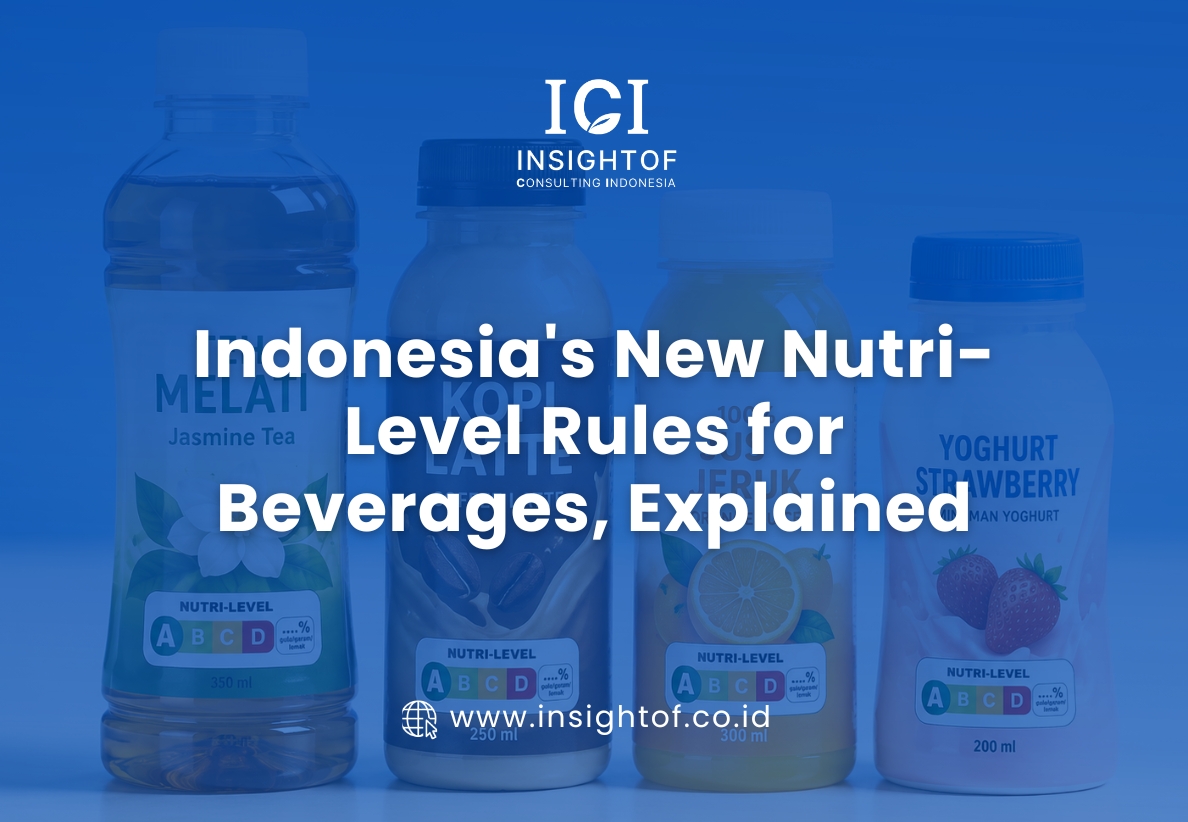
Indonesia’s Ministry of Health has introduced a new front-of-pack labeling system for ready-to-drink beverages. Under Decree No. HK.01.07/MENKES/301/2026, businesses producing or distributing ready-to-eat beverages can now display a “Nutri-Level” rating, a simple A-to-D scale that tells consumers, at a glance, how much sugar, salt, and saturated fat a drink contains.
The Minister of Health signed the decree in Jakarta on April 14, 2026. This article walks through what the decision covers, how the rating system works, and what beverage businesses need to know as this labeling framework moves toward becoming mandatory.
1. Introduction
Excess consumption of sugar, salt, and fat is a well-documented driver of non-communicable diseases, including obesity, hypertension, cardiovascular disease, stroke, and type 2 diabetes. The Ministry of Health cited exactly this concern as its reasoning for the decree: giving consumers a fast, visual way to compare beverages and make healthier choices.
Rather than requiring consumers to decode nutrition tables themselves, the Nutri-Level system condenses sugar, salt, and saturated fat content into a single, color-coded letter grade, similar in spirit to nutrition labeling systems already used in several other countries.
2. What the Decision Requires
The decree allows businesses that produce and/or distribute ready-to-eat beverages to display nutrition and health information using the Nutri-Level format. This information must appear across whatever “information media” the business uses to present its products to consumers, including menu boards, retail packaging, brochures, banners, flyers, leaflets, and menus shown inside commercial ordering apps.
The Nutri-Level rating itself is based on a company’s own declaration of its sugar, salt, and saturated fat content, but that declaration must be backed by testing from a government laboratory or another accredited laboratory. Self-declaration doesn’t mean self-verification; the underlying data needs to hold up to scrutiny.
3. Legal Basis
This decree implements Article 38, paragraph (5) of Health Ministerial Regulation No. 3 of 2026 on Disease Control. That regulation, in turn, sits within a broader legal structure covering food and health policy in Indonesia.
| Legal Reference | Role |
|---|---|
| Law No. 18 of 2012 | Food — the foundational food law in Indonesia |
| Law No. 17 of 2023 | Health — the current omnibus health law |
| Government Regulation No. 86 of 2019 (amended by GR No. 1/2026) | Food Safety — governs food safety standards nationally |
| Government Regulation No. 28 of 2024 | Implementing regulation for the 2023 Health Law |
| Health Ministerial Regulation No. 3 of 2026 | Disease Control — Article 38(5) directly mandates this Nutri-Level decree |
4. Who This Applies To — For Now
The decree specifically targets businesses that produce and/or distribute ready-to-eat processed food in the form of beverages, and it starts with large-scale businesses, as defined under existing business classification regulations. Smaller beverage operators aren’t excluded from using the system voluntarily, but the initial rollout focuses on large-scale players first.
5. How the Nutri-Level System Works
Nutri-Level ratings are calculated per 100 milliliters of beverage, based on three components: sugar content, salt (calculated from sodium content), and saturated fat. The rating that gets displayed corresponds to whichever of the three components sits in the highest, least favorable category.
Businesses calculate sugar content by summing all monosaccharides and disaccharides, excluding lactose. Where a product’s nutrition facts are listed “per serving” rather than “per 100 ml,” businesses need to convert the figures. For example, a beverage listing 19g of total sugar and 4g of lactose per 250ml converts to 15g of relevant sugar per 250ml, which scales to 6g per 100ml, placing it in the applicable band.
6. The Four Levels, Explained
Nutri-Level uses four tiers, each represented by a letter and a specific color:
| Nutrient (per 100 ml) | Level A | Level B | Level C | Level D |
|---|---|---|---|---|
| Sugar (g) | ≤ 1, no added sweetener | > 1 – 5 | > 5 – 10 | > 10 |
| Salt (mg) | ≤ 5 | > 5 – ≤ 120 | > 120 – ≤ 500 | > 500 |
| Saturated fat (g) | ≤ 0.7 | > 0.7 – 1.2 | > 1.2 – 2.8 | > 2.8 |
Level A represents the lowest sugar, salt, and fat content; each subsequent level represents progressively higher content, with Level D representing the highest. Beverages that naturally contain no sugar, salt, or fat at all are exempt from displaying a Nutri-Level rating entirely.
7. Sweetener Rules Tied to Each Level
The decree doesn’t just measure sugar content; it also restricts which sweeteners can be used at each level.
- Level A — cannot use any added sweetener, whether natural or artificial, including through direct addition or carryover from other ingredients
- Level B — may only use natural sweeteners
- Level C and Level D — may use either natural or artificial sweeteners, or a combination of both
8. Where the Label Must Appear
Nutri-Level information must be written out in full using the letters A, B, C, and D, with the applicable letter visually emphasized to show which category the product falls into. Alongside the letter, the label must also state the specific percentage of whichever nutrient, sugar, salt, or fat, has the highest content.
- 1Legibility: The Nutri-Level marking must be clearly readable wherever it appears.
- 2No Interference: It cannot touch or overlap the product’s brand name, and it cannot obscure other required information on the label.
- 3Percentage Disclosure: The label must always be paired with the percentage figure for the highest-content nutrient.
- 4Layout Options: Businesses can use a horizontal format, a vertical format, or a simplified icon version, as long as the core information stays intact.
9. Design Standards: Fonts, Colors, and Layout
The decree specifies exact typography and color requirements, leaving little room for creative interpretation.
- Typography — “NUTRI-LEVEL” text uses Arial Black; percentage figures for sugar, salt, and fat content use Arial Bold
- Level A — dark green, CMYK 100C 25M 100Y 0K
- Level B — light green, CMYK 55C 0M 100Y 0K
- Level C — yellow, CMYK 0C 30M 90Y 0K
- Level D — red, CMYK 20C 100M 100Y 10K
- Supporting colors — black (CMYK 0C 0M 0Y 100K) and white (CMYK 0C 0M 0Y 0K)
The decree’s official appendix includes both horizontal and vertical layout templates, along with a simplified icon version that pairs a single colored letter with its corresponding percentage, useful for space-constrained packaging like individual cup labels.
10. When Compliance Actually Becomes Mandatory
Here’s an important nuance: the decree itself took effect immediately upon signing on April 14, 2026, but that doesn’t mean Nutri-Level labeling is mandatory yet. Under the decree’s own terms, mandatory compliance only begins two years after the government separately establishes maximum permitted levels of sugar, salt, and fat in food, a threshold regulation that hasn’t been issued as of this decree’s signing.
11. What This Means for Beverage Businesses
Even though mandatory enforcement is still pending a separate regulation, large-scale beverage businesses have a real strategic reason to start early. Government and regional authorities are already directed under the decree to actively advocate for voluntary adoption, and early movers get more runway to test formulations, redesign packaging, and validate lab data before compliance becomes compulsory.
There’s also a market positioning angle. As Indonesian consumers grow more health-conscious, an A or B Nutri-Level rating can function as a genuine selling point, not merely a compliance requirement, similar to how “low sugar” or “reduced salt” claims already carry marketing weight in other markets.
12. Conclusion
Decree No. HK.01.07/MENKES/301/2026 introduces a structured, standardized way for Indonesian consumers to evaluate the sugar, salt, and fat content of ready-to-drink beverages at a glance. For now, it applies to large-scale beverage businesses on a currently voluntary basis, with mandatory compliance triggered two years after a separate sugar, salt, and fat threshold regulation takes effect.
Businesses in the beverage sector, particularly larger operators already in scope, should treat this as an emerging standard worth preparing for now: validating nutrient data through accredited labs, building compliant label designs, and monitoring for the threshold regulation that will start the mandatory compliance clock.
Frequently Asked Questions
Is Nutri-Level labeling mandatory right now?
Not yet. The decree allows businesses to adopt Nutri-Level labeling now, but mandatory compliance only begins two years after the government separately issues a regulation setting maximum sugar, salt, and fat thresholds, which has not been issued as of this decree.
Which businesses does this decree currently apply to?
It applies to businesses that produce and/or distribute ready-to-eat beverages, starting with large-scale businesses as defined under Indonesia’s existing business classification regulations.
How is a beverage’s Nutri-Level rating determined?
The rating is based on the business’s own declaration of sugar, salt, and saturated fat content per 100ml, supported by testing from a government laboratory or another accredited laboratory. The displayed level corresponds to whichever nutrient falls into the highest, least favorable category.
Can a Level C or D beverage use artificial sweeteners?
Yes. Level C and Level D beverages may use natural sweeteners, artificial sweeteners, or a combination of both. Level A cannot use any added sweetener, and Level B may only use natural sweeteners.
Where must the Nutri-Level label be displayed?
It can appear on menu lists, retail packaging, brochures, banners, flyers, leaflets, and menus within commercial ordering apps, provided it stays legible, doesn’t touch the brand name, and includes the percentage of the highest-content nutrient.
Preparing Your Beverage Products for Indonesia’s Nutrition Labeling Standards?
INSIGHTOF Consulting Indonesia helps F&B businesses navigate Indonesia’s evolving food and health regulations, from nutrition labeling to full product compliance.