Since 2016, Insightof has processed over 1,000 BPOM, Halal, and Medical Device certifications. Any product that complies with Indonesian regulations will be fully registered by our team.
10 Years Experience / Certification Consulting Expert / Based in Jakarta
“We have ten different products under the same factory — do we really need ten separate Halal certificates?”
This question is frequently raised by food and cosmetic manufacturers, especially exporters entering the Indonesian market for the first time. Many business actors assume that Halal certification is issued per company name or brand. In practice, Indonesian Halal regulations under BPJPH (Halal Product Assurance Agency) apply a much more structured approach.
Misunderstanding this concept can lead to serious compliance risks, including rejected applications, failed inspections, or products being considered uncertified despite already holding a Halal certificate.
 How Halal Certification Actually Works in Indonesia
 How Halal Certification Actually Works in Indonesia
In Indonesia, Halal certification is issued per production facility and per product scope, not per individual brand name.
This means the certification evaluates:
- The factory or production facility
- The Halal Product Process (PPH)
- The ingredients used
- The product scope (such as food, beverages, cosmetics, etc.)
If a company operates one factory within one product scope, multiple products can be covered under one Halal certificate, provided they are properly declared.
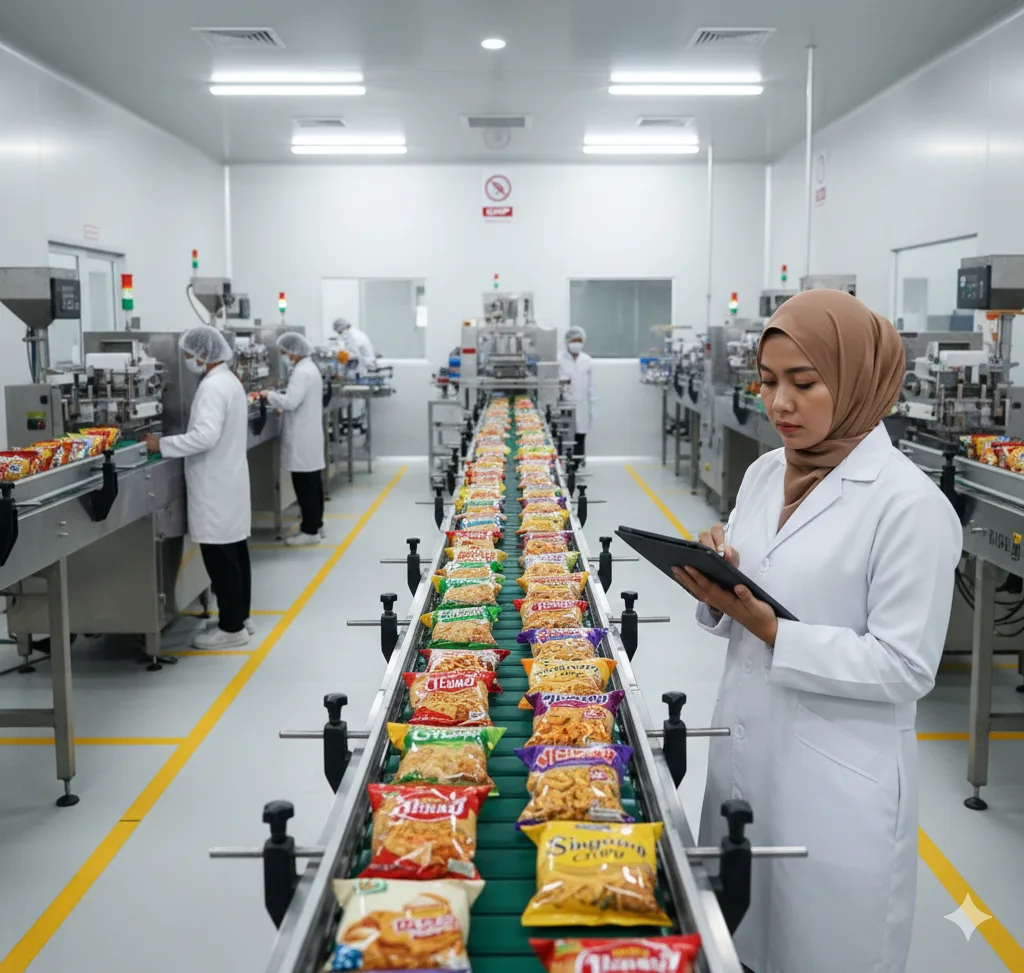
One Factory, Multiple Products — Yes, It Is Possible
For example:
- PT A operates a food manufacturing facility
- PT A produces 10 different food or snack products
- During the Halal registration process, PT A lists all 10 products under the food scope
Once approved:
- BPJPH issues one Halal certificate for the food scope
- The certificate appendix explicitly lists all 10 products
- All listed products are legally considered Halal-certified
In this case, one Halal certificate can be used for multiple products, as long as they:
- Are produced in the same facility
- Fall under the same product scope
- Are declared during the registration process
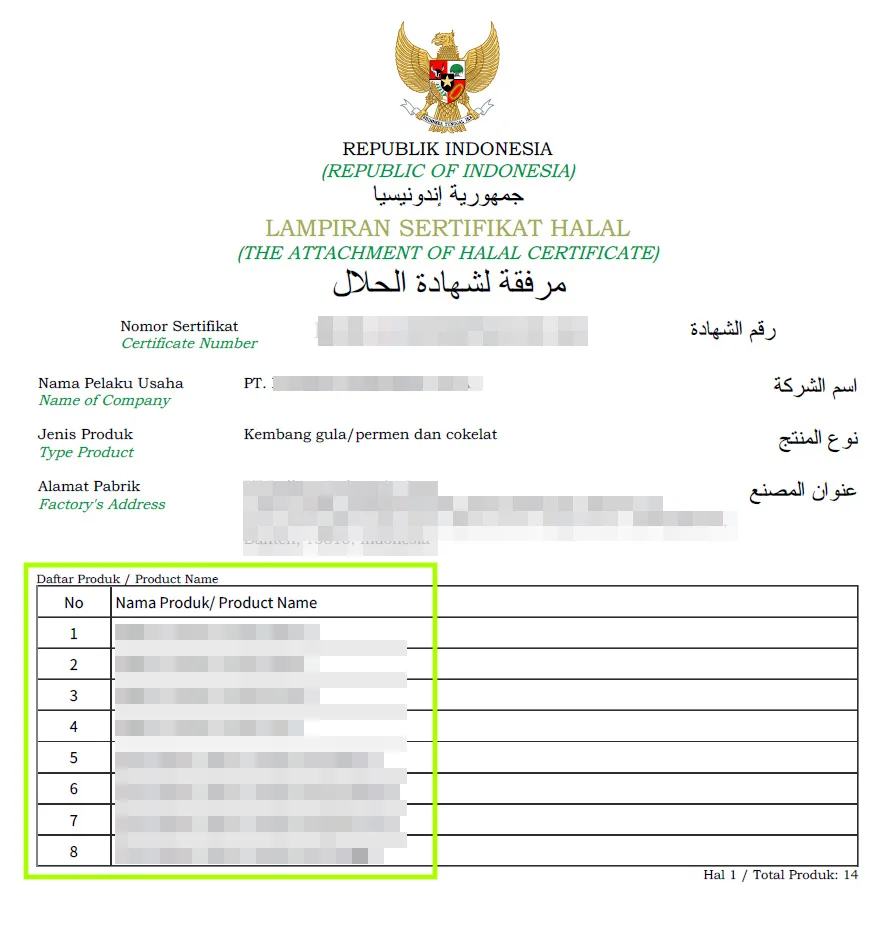
A Halal certificate is issued based on the Halal Product Process (PPH), which includes the location, place, and tools used for production. If a single facility produces 10 different snacks (all within the “food” category) using a compliant PPH, they can be grouped under one application and certificate application, provided every product name is explicitly listed
Indonesian regulations require business actors to list all products and ingredients during the application process. PP No. 42 of 2024 stipulates that the application must include the “name and type of Product” and a “list of Products and Ingredients used”
The Scope Rule: Food and Cosmetics Are Not the Same
Halal certificates are scope-specific.
If the same company:
- Produces food products, and
- Also manufactures cosmetics
Then:
- A separate Halal certificate is required for cosmetics
- The food certificate cannot be used for cosmetic products
Each category (scope) involves different risk profiles and ingredients. For example, the fatwas for cosmetics involve specific assessments regarding water permeability and the use of alcohol/ethanol, which differ from food standards. Therefore, a certificate issued for the “Food” scope does not cover “Cosmetics,” even if produced by the same company.
Regulations clearly distinguish between product types. PP No. 39 of 2021 and PP No. 42 of 2024 categorize products separately into goods (food, beverages, drugs, cosmetics, chemical products, etc.) and services
This is because each scope has different:
- Ingredient risk profiles
- Production processes
- Audit requirements
Each certificate will clearly state its scope and list only the products registered under that scope.
What If You Add New Products Later?
This is a critical compliance point.
If a company already holds a Halal certificate and later:
- Launches new food or snack variants, or
- Adds new products within the same scope
Those products are not automatically covered.
The business actor must submit a data amendment or product development application to BPJPH so the new items can be officially added to the existing certificate.
PP No. 42 of 2024 explicitly states that business actors who change the composition of ingredients or the PPH after receiving a certificate must update their Halal Certificate. The regulation clarifies that changes in composition include the “development of products” (such as new variants) within the product type already listed in the certificate. This update must be submitted via the electronic system (SIHALAL). Until the certificate is updated to include these new items, they are not covered.
| Certification Aspect | Rule for Multiple Products |
|---|---|
| Certification Basis | Issued per factory and per product scope |
| Product Listing | All product names must be explicitly listed |
| Different Scopes | Food and cosmetics require separate certificates |
| Adding Products | Requires data amendment / product development |
FAQ
Q: Can one Halal certificate be used for multiple products?
A: Yes. One certificate can cover multiple products if they are produced in the same facility and fall under the same product scope, provided all products are listed during registration.
Q: If I already have a food Halal certificate, can I use it for cosmetics?
A: No. Food and cosmetics are different scopes and require separate Halal certifications.
Q: What happens if I sell a product that is not listed on the certificate?
A: The product is considered uncertified and may be subject to administrative sanctions, including product withdrawal.
Our Service
Managing multiple products under Halal certification requires careful planning.
At ICI, we support clients through:
- Product Document Assessment: Reviewing product formulas, ingredients, suppliers, and supporting documents to ensure compliance with BPJPH requirements.
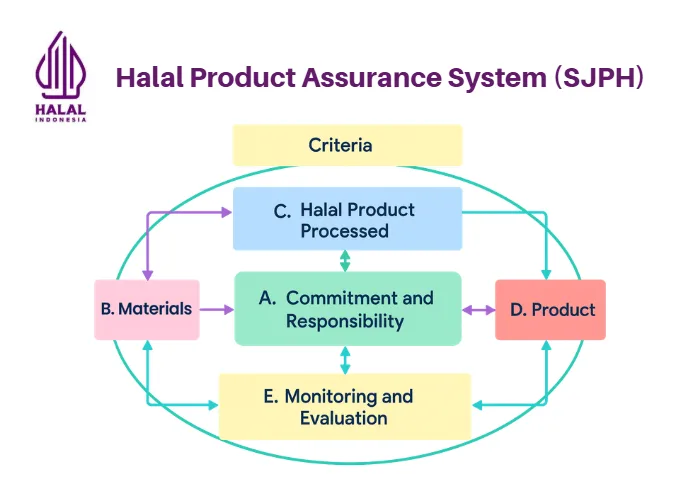
- SJPH Development: Preparing and structuring the Sistem Jaminan Produk Halal (SJPH) in accordance with Indonesian Halal regulations.
- Halal Training for Staff: Providing Halal awareness and SJPH implementation training for internal teams to ensure ongoing compliance at the production facility.
- Halal Certificate Issuance Support: Assisting throughout the Halal certification process until the Halal certificate is officially issued by BPJPH.
In Indonesia’s Halal system, certification is not about how many brands you own — it is about what you produce, where you produce it, and under which scope.
One factory can hold one certificate for multiple products, but only if the structure is set correctly from the beginning. Let INSIGHTOF review your product portfolio and ensure your Halal certification strategy is fully compliant.
#Insightof #PTICI #ICI #INSIGHTOF #HalalIndonesia #BPJPH #HalalCertificate #HalalMandatory2026 #HalalScope #ProductListing #SIHALAL #FoodHalal #CosmeticHalal #IndonesiaCompliance #HalalConsultant #JakartaBusiness #HalalRegistration #ImportIndonesia