If you plan to sell food, beverages, cosmetics, supplements, medical devices, or other regulated consumer products in Indonesia, understanding the halal certification process is no longer optional. BPJPH has confirmed that halal certification obligations have already taken effect for certain product groups, and businesses are expected to prepare the right submission route, documents, and internal halal controls before distribution. Source
This article explains the halal certification process in Indonesia in a practical step-by-step format. If you need the broader legal and strategic overview first, continue to our pillar page: Halal Certification Indonesia.
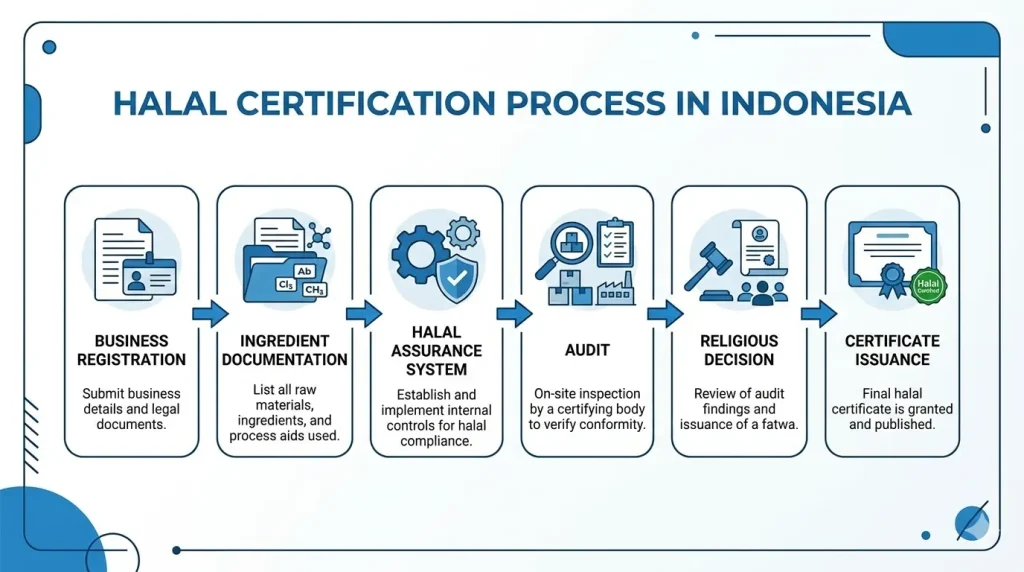
Table of Contents
- Introduction
- Who Handles Halal Certification in Indonesia?
- Regular vs Self Declare: Which Route Applies?
- Step 1: Prepare the Business and Internal Halal Setup
- Step 2: Create a SIHALAL Account
- Step 3: Prepare and Upload the Application Documents
- Step 4: BPJPH Verification, Fees, and STTD
- Step 5: Audit or Validation Process
- Step 6: Fatwa Session and Halal Determination
- Step 7: Certificate Issuance and Download
- Common Mistakes That Delay the Process
- Frequently Asked Questions
- Conclusion
- Related Articles
Quick takeaway: the practical flow usually starts with NIB preparation, SIHALAL account creation, document submission, BPJPH verification, audit or validation, fatwa session, and finally certificate issuance by BPJPH. Source
1. Introduction
Indonesia’s halal framework is built around the Halal Product Assurance system, and for many businesses, certification is now a compliance and market-access issue rather than simply a branding decision. BPJPH has stated that halal certification obligations apply to products entering, circulating, and traded in Indonesia according to the applicable phased implementation. Source
For businesses that want the complete regulatory overview, deadlines, and broader market-entry context, this support article should be read together with our pillar page: Halal Certification Indonesia.
2. Who Handles Halal Certification in Indonesia?
The halal certification process in Indonesia involves multiple institutions. BPJPH is the state body under the Ministry of Religious Affairs that issues halal certificates and administers the halal assurance system. In carrying out halal product assurance, BPJPH works with institutions including LPH (Halal Inspection Agency), MUI, and the Halal Product Fatwa Committee. Source
In practical terms, businesses should understand the roles clearly: BPJPH is the issuing authority, LPH handles inspection or audit functions, and the halal determination stage proceeds through the fatwa mechanism. This institutional sequence is one of the most important parts of the Indonesian halal process. Source
3. Regular vs Self Declare: Which Route Applies?
Indonesia generally uses two practical submission routes discussed in official service materials: Regular and Self Declare. The self-declare route is intended for certain Usaha Mikro dan Kecil with simple processes and halal, low-risk materials, while the regular route is used for broader business categories and more complex production conditions. Source
| Aspect | Self Declare | Regular |
|---|---|---|
| Typical business profile | Micro and small business with simple process. | Micro, small, medium, or large business with more complex process. |
| Material profile | Halal and low-risk raw materials. | Can involve halal materials with higher compliance risk or complexity. |
| Halal supervisor requirement | Must have a halal supervisor. | Must have a halal supervisor with certificate recognized by BPJPH. |
| Validation path | Verification and validation through the self-declare flow. | Inspection and audit through LPH. |
| Typical use | Simpler UMK applications. | Standard route for more formal or complex certification cases. |
BPJPH also states that SIHALAL has guidance for both the regular scheme and the self-declaration scheme, which confirms that businesses must choose the correct route from the beginning. Source
4. Step 1: Prepare the Business and Internal Halal Setup
Before opening the online application, businesses should first prepare the internal and legal foundation of the submission. Official service guidance for the regular route begins with the business having a NIB. For the regular route, the business also needs a Penyelia Halal with a certificate recognized by BPJPH. Source
The SIHALAL application guide also shows that businesses will later need to complete key profile fields such as responsible person, legal aspects, factory, outlet, and halal supervisor. Because of that, it is more efficient to prepare those items in advance before starting the filing. Source
Practical note: many delays happen before formal review even starts, simply because the business structure, NIB data, product list, or halal supervisor information is not yet ready when the SIHALAL application is opened.
5. Step 2: Create a SIHALAL Account
The official application platform is SIHALAL, accessible through ptsp.halal.go.id. The SIHALAL guide explains that applicants begin by creating an account, selecting the user type such as business actor or importer, then activating the account through email before login. Source Source
BPJPH has also publicly stated that SIHALAL is the updated digital service system used to make halal certification more accessible, faster, and more efficient, and that manuals are available for both regular and self-declare submissions. Source
6. Step 3: Prepare and Upload the Application Documents
After logging in, the SIHALAL guide shows that the applicant selects the certification menu and starts the application route needed, such as new, renewal, or development. The guide also indicates that the applicant must complete fields including the application letter number and date, service type, product type, trademark, market area, and selected LPH. Source
Businesses should also prepare the product list and supporting files in the accepted upload format. The guide states that required upload files are accepted in formats such as XLSX, PDF, and JPG, subject to the platform’s file size rules. Source
At the business-planning level, this is the stage where companies should make sure that product names, brand naming, manufacturing site details, and document consistency all match the intended halal filing structure. For the broader compliance framework, see: Halal Certification Indonesia.
7. Step 4: BPJPH Verification, Fees, and STTD
In the regular route, the next stage is formal verification. Official regional service guidance states that BPJPH verifies the conformity of the data and the completeness of the application documents. After that, LPH calculates and inputs the inspection fee in SIHALAL, the business makes payment through the designated mechanism, and BPJPH verifies the payment before issuing the STTD. Source
The SIHALAL guide also explains how the applicant can monitor application status and upload payment information when required. This means the applicant should not treat submission as a one-click process; active follow-up in the portal is part of the workflow. Source
8. Step 5: Audit or Validation Process
After the application clears verification and payment steps, the technical review stage begins. For the regular route, the official flow states that LPH conducts the audit and uploads the inspection report in SIHALAL. Source
For the self-declare route, the official flow instead highlights verification and validation by Pendamping PPH, followed by BPJPH document verification and the issuance of STTD before the file proceeds further. Source
- Regular: BPJPH verification → fee stage → STTD → LPH audit → fatwa process.
- Self Declare: application → Pendamping PPH verification/validation → BPJPH document verification → STTD → fatwa process.
9. Step 6: Fatwa Session and Halal Determination
Once the inspection or validation stage is completed, the application proceeds to the fatwa session. The official flow published through the Ministry of Religious Affairs regional service page shows that both the self-declare and regular process include a Sidang Fatwa oleh MUI before certificate issuance. Source
This aligns with BPJPH’s broader institutional explanation that halal product assurance is implemented in cooperation with MUI and the Halal Product Fatwa Committee. In other words, the fatwa stage is not a minor formality; it is one of the core legal decision points in the certification chain. Source
10. Step 7: Certificate Issuance and Download
After the fatwa stage is completed, BPJPH issues the Halal Certificate. The official service flow then shows that the business actor downloads the certificate from SIHALAL. This final step is the operational result of the process and becomes the basis for halal status in the Indonesian compliance framework. Source
BPJPH’s institutional page also confirms that one of BPJPH’s core authorities is to issue and revoke halal certificates and halal labels on products. Source
Operational takeaway: the certificate is not generated solely at the moment of filing. It is the end result of a structured process involving portal submission, verification, audit or validation, fatwa determination, and BPJPH issuance. Source
11. Common Mistakes That Delay the Process
In practice, businesses often lose time not because the framework is impossible to understand, but because the file is not prepared in the sequence expected by the system. Common issues include:
- Starting the application before the NIB and business profile are fully aligned
- Choosing the wrong route between regular and self-declare
- Entering inconsistent product, brand, or facility data in SIHALAL
- Not preparing the halal supervisor information early enough
- Treating the fatwa stage as an afterthought instead of a core process milestone
Most of these issues can be reduced by building the process backwards: first confirm the route, the products, and the documents, and only then begin submission. For broader planning, see: Halal Certification Indonesia.
12. Frequently Asked Questions
What is the first thing I need before applying for halal certification?
For the regular route, the official flow starts with the business having a NIB, then creating a SIHALAL account before the application is processed. Source
Where is the halal certification application submitted?
The submission is handled through the official SIHALAL platform at ptsp.halal.go.id. Source
What is the difference between regular and self-declare?
Self-declare is intended for certain micro and small businesses with simpler processes and halal, low-risk materials, while the regular route is broader and includes LPH audit stages. Source
Who are the main institutions in the process?
BPJPH administers and issues the certificate, LPH handles inspection functions, and the fatwa stage involves MUI within the broader halal assurance ecosystem. Source Source
13. Conclusion
The halal certification process in Indonesia follows a structured path: prepare the business and halal framework, create the SIHALAL account, submit the documents, pass BPJPH verification, complete the audit or validation stage, go through the fatwa process, and obtain the certificate from BPJPH. The sequence is clear, but the success of the application depends heavily on choosing the correct route and preparing the file properly from the beginning. Source
If you want the wider authority-level overview, mandatory framework, and strategic compliance roadmap, continue with our main guide: Halal Certification Indonesia.
If you want, we can also help review which halal certification route fits your product and business model before submission starts.
Read the Main Halal Certification Guide →