If you plan to sell processed food in Indonesia, one of the first things you need to understand is whether your product should be registered under BPOM RI MD or BPOM RI ML. This distinction is not just a labeling detail. It affects the registration route, the applicant structure, and the compliance pathway for your product in the Indonesian market. Under BPOM rules, processed food produced domestically or imported for retail sale generally must have an Izin Edar before distribution. Source
This article explains the difference between MD vs ML food registration Indonesia in a simple, practical format. If you need the wider regulatory overview, you can continue to our pillar page: Food and Beverage Registration Indonesia.
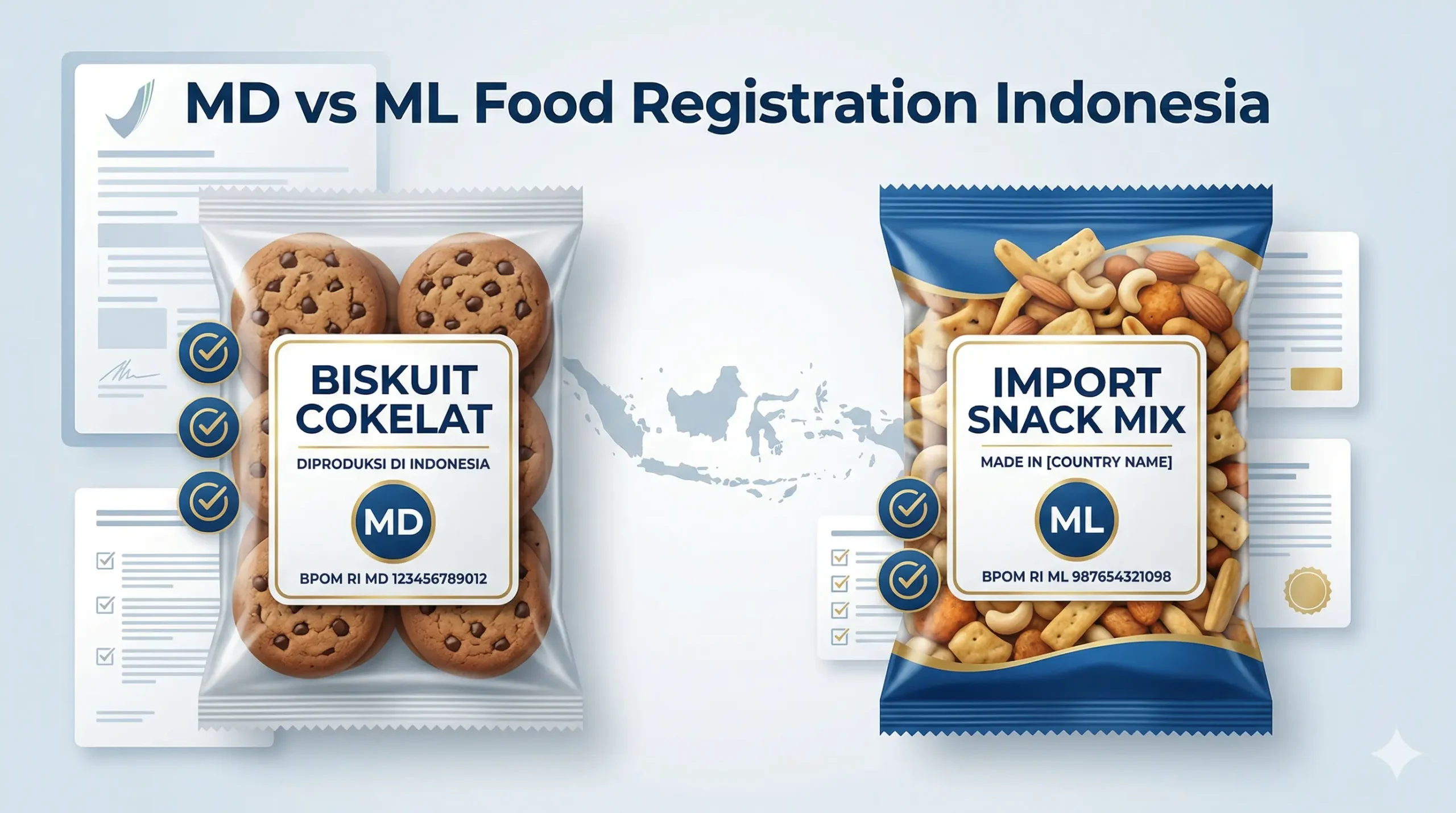
Table of Contents
- Introduction
- What Do MD and ML Mean?
- Why the Difference Matters
- MD vs ML at a Glance
- Who Can Apply for MD Registration?
- Who Can Apply for ML Registration?
- Domestic vs Imported Food: Key Compliance Impact
- Where the Code Appears on the Label
- Validity Period of MD and ML Registration
- Common Mistakes Businesses Make
- How to Determine the Right Route
- Frequently Asked Questions
- Conclusion
- Related Articles
Quick takeaway: MD is used for processed food manufactured in Indonesia, while ML is used for processed food manufactured outside Indonesia and imported into the country. Source
1. Introduction
Businesses entering Indonesia often focus first on packaging, pricing, and distribution. However, one of the most important compliance questions comes earlier: is the product registered as domestic processed food or imported processed food? BPOM distinguishes these two routes through different marketing authorization codes, namely MD and ML. This distinction helps define how the product is treated in the registration system and how it appears in the Indonesian market. Source
For businesses that are still planning their full market-entry strategy, this comparison article works best as a companion to our main guide: Food and Beverage Registration Indonesia.
2. What Do MD and ML Mean?
Under BPOM Regulation No. 23 of 2023, Pangan Olahan Dalam Negeri refers to processed food produced within the territory of the Republic of Indonesia, while Pangan Olahan Impor refers to processed food produced outside Indonesia and brought into the Indonesian territory. In practice, this is reflected in the registration number format: BPOM RI MD for domestic products and BPOM RI ML for imported products. Source
So, if the food is manufactured in Indonesia, it usually follows the MD route. If the food is manufactured overseas and then entered into Indonesia for sale, it follows the ML route.
3. Why the Difference Matters
The MD vs ML distinction matters because it affects who the registrant is, what documents are needed, and how the product dossier is structured. Choosing the wrong route can slow down the application, create inconsistencies in the submission, and trigger avoidable clarifications from BPOM.
For imported products especially, businesses often underestimate the importance of the local Indonesian entity. Our main article explains that foreign brands typically need the right local structure or local partner before registration can move efficiently in Indonesia. Source
4. MD vs ML at a Glance
| Aspect | BPOM RI MD | BPOM RI ML |
|---|---|---|
| Meaning | Processed food produced in Indonesia. | Processed food produced outside Indonesia and imported. |
| Product origin | Domestic manufacturing. | Overseas manufacturing. |
| Typical applicant | Producer, or business actor handling the domestic product registration. | Importer or distributor handling the imported product registration. |
| Code format on approval | BPOM RI MD + digits. | BPOM RI ML + digits. |
| General business use | Local factory or domestic production setup. | Foreign brand entering Indonesia through import. |
This high-level distinction is directly reflected in BPOM’s legal framework and label requirements. Source
5. Who Can Apply for MD Registration?
BPOM states that processed food registration is carried out by Pelaku Usaha, which can include a producer, importer, or distributor. For a domestic processed food product, the MD pathway is generally associated with food produced in Indonesia, so the producer becomes the central party in the registration structure. Source
In practical business terms, MD registration is commonly relevant to Indonesian manufacturers or companies operating local production facilities. If your product is made inside Indonesia, MD is usually the route to assess first.
6. Who Can Apply for ML Registration?
For imported processed food, the ML route is generally used. BPOM’s framework allows registration by business actors such as importers or distributors, which is why imported product registration is typically handled through the Indonesian side of the commercial structure rather than directly by an overseas manufacturer alone. Source
As explained in the broader market-entry guide, imported registrations are usually tied to the local importer or distributor arrangement in Indonesia. Source
7. Domestic vs Imported Food: Key Compliance Impact
Although both MD and ML are forms of BPOM food registration, the supporting documentation and administrative setup can differ because the business model is different. Domestic products focus on the Indonesian production route, while imported products focus on the foreign manufacturing source and the Indonesian import structure.
- MD route: usually linked to local manufacturing setup in Indonesia.
- ML route: usually linked to imported products entering Indonesia through a local importer or distributor.
- Both routes: still require legal compliance before retail distribution.
BPOM requires processed food produced domestically or imported for trade in retail packaging to hold an Izin Edar. Source
8. Where the Code Appears on the Label
BPOM rules require the registration number to be shown on the processed food label. For domestic products, the number must begin with BPOM RI MD followed by digits. For imported products, the number must begin with BPOM RI ML followed by digits. The regulation also states that the registration number on the label must be easy to read and not easily fade. Source
Practical note: The MD or ML code is not just an internal filing category. It becomes part of the visible BPOM registration information on the product label. Source
9. Validity Period of MD and ML Registration
One important point businesses often ask is whether MD and ML have different validity periods. Under BPOM Regulation No. 23 of 2023, the Izin Edar is valid for 5 years and may be extended through re-registration. This applies to the processed food registration approval generally, so the core validity principle is the same for MD and ML. Source
10. Common Mistakes Businesses Make
In practice, businesses often face delays not because MD and ML are difficult to understand conceptually, but because the commercial structure and product origin are not aligned correctly at the time of submission. Common issues include:
- Choosing the wrong registration route for the product origin
- Using an applicant structure that does not match the intended business model
- Treating the MD or ML code as a simple label issue instead of a registration pathway issue
- Preparing product materials before confirming whether the product is domestic or imported for BPOM purposes
These issues can often be reduced by clarifying the supply chain, manufacturing location, and local Indonesian business role before the application starts.
11. How to Determine the Right Route
A simple starting question is this: Where is the product manufactured? If the processed food is produced in Indonesia, the MD route is typically the relevant path. If it is produced outside Indonesia and then imported into Indonesia, the ML route is typically the relevant path. Source
If you are still mapping the bigger regulatory process, the best next step is to review the full registration overview here: Food and Beverage Registration Indonesia.
Official registration platform
BPOM uses its official e-registration platform for processed food submissions through the e-Registration portal. This is the core online entry point for the registration workflow. Source
12. Frequently Asked Questions
What is the main difference between MD and ML?
MD is used for processed food produced in Indonesia, while ML is used for processed food produced outside Indonesia and imported into the country. Source
Does every processed food need MD or ML registration?
BPOM states that processed food produced domestically or imported for trade in retail packaging generally must have an Izin Edar. Businesses should assess the applicable route based on the product and distribution model. Source
Can a foreign manufacturer use MD?
If the product is manufactured outside Indonesia, the route is not MD. Imported processed food falls under the ML framework. Source
Where do I see the MD or ML number?
The registration number must appear on the processed food label, beginning with BPOM RI MD or BPOM RI ML followed by digits, and it must be readable and durable. Source
How long is BPOM food registration valid?
The BPOM food registration approval is valid for five years and can be extended through re-registration. Source
13. Conclusion
Understanding MD vs ML food registration Indonesia is one of the most important early steps in food compliance planning. The distinction is straightforward in principle: MD is for domestically produced processed food, while ML is for imported processed food. But from a business perspective, the choice affects who registers the product, how the dossier is prepared, and how the product enters the market legally.
If you are reviewing your wider compliance and market-entry strategy, continue with our main guide: Food and Beverage Registration Indonesia.
If you want, we can also help you review whether your product should follow the MD or ML pathway before registration starts.
Read the Main Food & Beverage Registration Guide →