If you’re a foreign business, importer, or brand looking to enter the Indonesian market, one question comes up immediately: how do you get halal certification in Indonesia?
Indonesia is the world’s largest Muslim-majority country, with over 230 million Muslim consumers. Halal certification is not just a market advantage here — it is legally mandatory under Indonesian law for most product categories.
This guide walks you through everything you need to know: the legal framework, which products are required, the complete step-by-step registration process, required documents, timelines, and costs — all in plain English for foreign businesses.
Why Halal Certification Is Mandatory in Indonesia
Under Law No. 33 of 2014 on Halal Product Assurance, and further strengthened by Government Regulation (GR) No. 42 of 2024, all products manufactured, imported, circulated, or traded in Indonesia must carry a halal certificate — unless they explicitly contain haram (forbidden) ingredients and are clearly labeled as such.
This applies to both local and foreign businesses selling in the Indonesian market.
Failing to comply can result in:
- Written administrative warnings
- Administrative fines
- Revocation of the halal certificate
- Forced withdrawal of goods from circulation
Beyond legal compliance, halal certification also delivers real business value:
| Market Access | Required to distribute across all major retail, online, and export channels in Indonesia. |
| Consumer Trust | 230M+ Muslim consumers actively check for the halal logo before purchasing. |
| Global Recognition | Indonesian halal certificates are increasingly accepted in international Muslim markets. |
| Brand Credibility | Signals quality, transparency, and regulatory compliance to buyers and distributors. |
Which Products Require Halal Certification in Indonesia?
Based on Law No. 33 of 2014, Government Regulation No. 42 of 2024 (PP 42/2024), and Ministry of Religious Affairs Decree No. 748 of 2021 (MORA Decree 748/2021), halal certification is mandatory for a wide range of products and services. Below is the full detailed breakdown.
The product examples listed in each category below are illustrative only — they are drawn from official Indonesian regulations to help you identify which category your product belongs to. The halal certification obligation applies to the entire product category, not just the specific items named. If your product type is not explicitly listed, it does not mean you are exempt. When in doubt, consult a halal certification expert to confirm your compliance obligations.
1. Food Products
All food products sold, manufactured, or imported in Indonesia are required to have halal certification. This covers over 1,200 product types across 18 sub-categories. The table below lists common examples — but is not exhaustive. If your product falls within a food sub-category, it is subject to the halal certification requirement regardless of whether it is specifically listed here.
| Subcategory | Examples (not limited to) |
|---|---|
| Milk & Dairy Analogues | Fermented milk, yogurt, kefir, cheese, processed cheese, cream, whey, butter, dairy spreads, soy milk, oat milk, almond milk |
| Fats, Oils & Oil Emulsions | Palm oil, sunflower oil, canola oil, margarine, shortening, vegetable ghee, mayonnaise base, lard alternatives |
| Edible Ice & Frozen Desserts | Ice cream, popsicle/ice lolly, sherbet, sorbet, frozen yogurt, gelato |
| Processed Fruits & Vegetables | Canned fruits & vegetables, fruit jam, jelly, marmalade, fruit paste, pickles, dried fruit, fruit leather, tomato paste, frozen vegetables with coatings or additives |
| Confectionery, Candy & Chocolate | Chocolate bars & coating, cocoa powder, candy, lollipop, chewing gum, bubble gum, marshmallow, caramel, toffee, nougat, jelly candy, gummy bears |
| Cereal & Cereal Products | Wheat flour, rice flour, corn flour, starch (corn/tapioca/potato), instant noodles, dried pasta, spaghetti, vermicelli, breakfast cereals, rolled oats, granola, rice crackers, rice cakes |
| Bakery Products | Bread, rolls, buns, toast, croissants, cakes, cookies, wafers, pastries, doughnuts, muffins, pancake mix, traditional Indonesian cakes (onde-onde, klepon, dadar gulung, etc.) |
| Meat & Meat Products | Sausages, frankfurters, salami, nuggets, meatballs (bakso), corned beef, meat floss (abon), canned meat, smoked meat, burger patties, frozen meat products, fresh carcasses |
| Fish & Fishery Products | Frozen fish fillets, canned fish (tuna, sardines, mackerel), fish balls, fish cake (otak-otak), shrimp paste (terasi), fish sauce, dried salted fish, crab/shrimp crackers, processed squid, mollusks, crustaceans |
| Processed Egg & Egg Products | Salted eggs, egg powder (whole/white/yolk), liquid eggs, century eggs |
| Sugar, Sweeteners & Honey | Granulated sugar, brown sugar, palm sugar (gula merah), fruit-flavored syrup, molasses, honey, aspartame, sucralose, stevia-based sweeteners |
| Salt, Spice, Soup, Sauce & Protein Products | Table salt, seasoning powder, bouillon/stock cubes, instant soup, chili sauce, soy sauce (kecap), oyster sauce, fish sauce, vinegar, mustard, ketchup, salad dressing, mayonnaise, curry paste, yeast extract, protein hydrolysates |
| Special Nutritional Food | Infant formula (0–6 months), follow-on formula (6–12 months), toddler formula (1–3 years), children’s growth formula, clinical/medical nutrition food, sports nutrition food, weight management food, diabetic food |
| Ready-to-Eat Snacks | Potato chips, cassava chips, corn snacks, popcorn, rice crackers, prawn crackers (kerupuk), biscuits, wafers, salted peanuts, roasted seeds, trail mix, seaweed snacks |
| Ready-to-Eat Meals (Packaged) | Instant rice meals, instant noodle dishes, frozen ready-meals, canned curry/stew, frozen dumplings (siomay, dimsum), microwaveable meals |
| Food & Beverage Service Providers | Restaurants, cafes, coffee shops, canteens, school/hospital cafeterias, food stalls (warung makan), street food vendors, catering companies, cloud kitchens, food delivery services, hotel food service |
| Food Additives | Antioxidants, emulsifiers (lecithin, mono/diglycerides), stabilizers, thickeners, preservatives, colorants (natural & synthetic), flavor enhancers (MSG, yeast extract), acidity regulators, anti-caking agents, humectants, foaming agents, glazing agents, flour improvers, bulking agents |
| Bakery Ingredients & Auxiliary Materials | Baking powder, baking soda, active dry yeast, instant yeast, vanilla extract, vanillin, glazing agents, flour whiteners, raising agents, swallow’s nests (sarang burung walet), bread improvers |
2. Beverages
All processed or packaged beverage products sold, manufactured, or imported in Indonesia are required to have halal certification. The examples below represent common product types — if your product is a processed beverage, it is covered under this requirement regardless of whether it appears in this list.
| Subcategory | Examples (not limited to) |
|---|---|
| Drinking Water | Mineral water, purified drinking water, demineralized water, sparkling mineral water, alkaline water, bottled water |
| Fruit & Vegetable Juices | Fresh fruit juice, 100% juice, juice concentrates, nectars, fruit-vegetable blended juice, cold-pressed juice, smoothies |
| Flavored & Processed Beverages | Carbonated soft drinks (cola, soda, flavored water), ready-to-drink tea (green, black, herbal), ready-to-drink coffee, isotonic/sports drinks, energy drinks, jelly drinks, packaged coconut water, flavored water |
| Coffee & Tea Preparations | Instant coffee, 3-in-1 coffee mix, ground coffee (packaged), tea bags, instant tea mix, herbal tea, matcha powder, coffee/tea concentrate |
| Milk-Based Beverages | UHT milk, flavored milk (chocolate, strawberry), condensed milk, evaporated milk, yogurt drinks, fermented milk drinks (yakult-type), milkshake mix |
| Traditional Indonesian Beverages | Bandrek, Bajigur, Wedang Jahe, Cendol (packaged), Es Campur (packaged), Cincau drinks, Jamu (functional herbal drinks) |
3. Pharmaceuticals & Medicines
All pharmaceutical products, traditional medicines, health supplements, and medicinal substances sold or distributed in Indonesia are required to have halal certification. The examples below are illustrative — any product within the pharmaceutical and medicine category falls under this obligation.
| Subcategory | Examples (not limited to) |
|---|---|
| Traditional Medicines (Obat Tradisional / Jamu) | Herbal medicines, phytopharmaceuticals, standardized herbal extracts, traditional Chinese medicines, Ayurvedic preparations |
| Health Supplements | Vitamins (A, B-complex, C, D, E, K), minerals (calcium, iron, zinc, magnesium), amino acid supplements, omega-3/fish oil capsules, probiotics, collagen supplements, spirulina, royal jelly, propolis, enzyme supplements |
| Quasi Medicines (Obat Kuasi) | Antiseptic products (wound wash, gargle), throat lozenges, digestive aids, medicated plasters, topical pain relief, medicated lip care |
| OTC Drugs — Green Label (Obat Bebas) | Pain relievers, antipyretics, antacids, antihistamines, anti-diarrheal, cough syrups, cold medicine, antiseptics, topical antifungals, OTC eye drops |
| Restricted OTC Drugs — Blue Label (Obat Bebas Terbatas) | Stronger cold/flu medication, anti-nausea, anti-vertigo, mild topical steroids, stronger antifungals, mild sleeping aids |
| Prescription Drugs (Obat Keras, excl. narcotics/psychotropics) | Antibiotics, antihypertensives, diabetes medications, anti-cholesterol drugs, antivirals, hormone therapy, chemotherapy adjuncts (deadline: October 2034) |
| Pharmaceutical Substances | Active Pharmaceutical Ingredients (APIs), tablet binders, capsule shells (gelatin alternatives), coating agents, excipients and solvents used in drug manufacturing |
4. Cosmetics & Personal Care Products
All cosmetics and personal care products sold, manufactured, or imported in Indonesia are required to have halal certification. The examples below cover common product types — if your product is a cosmetic or personal care item, it is subject to this requirement regardless of whether it is specifically named here.
| Subcategory | Examples (not limited to) |
|---|---|
| Skin Care | Face wash, micellar water, toner, essence, serum, moisturizer, face cream, eye cream, face mask (sheet/clay/peel-off), scrub/exfoliator, body lotion, body butter, hand cream, foot cream, BB cream, CC cream, spot treatment |
| Sunscreen & Tanning Products | Sunscreen (SPF lotions & sprays), sunblock, after-sun lotion, self-tanning products, bronzer |
| Makeup / Color Cosmetics | Foundation, concealer, primer, setting powder, blush, bronzer, highlighter, eye shadow, eyeliner, eyebrow pencil/gel, mascara, false eyelash adhesive, lipstick, lip gloss, lip liner, lip balm, nail polish |
| Hair Care | Shampoo, conditioner, hair mask, hair oil, hair serum, leave-in conditioner, hair dye/colorant, hair bleach, hair relaxer, hair perming solution, dry shampoo, hair styling gel, pomade, hair wax, hair mousse |
| Shaving & Hair Removal | Shaving cream, shaving gel, aftershave lotion, depilatory cream, waxing products |
| Oral Care | Toothpaste, toothpowder, mouthwash/gargle, teeth-whitening products, dental floss with coating, tongue cleaner with coating |
| Nail Care | Nail polish, nail gel, nail hardener, nail remover, cuticle cream |
| Fragrance & Deodorant | Perfume (EDP, EDT), body spray, deodorant, antiperspirant, cologne |
| Baby & Child Care | Baby lotion, baby powder, baby shampoo, baby wash, diaper rash cream, baby oil, children’s toothpaste |
5. Chemical Products
All chemical products used in or related to food, beverages, medicines, and cosmetics in Indonesia are required to have halal certification. The categories below are examples — if your chemical product is used in any of these industries, it is covered.
| Subcategory | Examples (not limited to) |
|---|---|
| Processing Aids | Bleaching agents, catalysts, solvents used in food/pharma/cosmetic manufacturing |
| Flavor & Fragrance Chemicals | Synthetic flavor compounds, aroma chemicals, fragrance concentrates |
| Surfactants | Surface active agents used in food, cosmetic, and pharmaceutical applications |
| Food-Contact & Manufacturing Chemicals | Food-grade chemicals, cleaning agents used in halal production facilities, food-contact lubricants |
6. Biological Products
All biological products related to food, beverages, medicines, and cosmetics are required to have halal certification in Indonesia. The product types listed below are examples from the official regulation.
| Product Type | Examples (not limited to) |
|---|---|
| Enzymes | Food-grade and pharmaceutical-grade enzymes (e.g., rennet, lipase, protease) |
| Monoclonal Antibodies | Therapeutic monoclonal antibodies used in medicines and diagnostics |
| Hormones | Insulin, growth hormone, and other therapeutic hormones |
| Stem Cell Products | Stem cell-derived ingredients used in cosmetics or medicine |
| Gene Therapy Products | Gene therapy formulations for pharmaceutical use |
| Vaccines | Vaccines requiring halal-compliant production media and excipients |
| Blood Products | Albumin, immunoglobulins, clotting factors, and blood derivatives |
| Recombinant DNA Products | rDNA-derived proteins used in food, beverages, or medicine |
| Immunosera | Antitoxins and immune serums for medical use |
| Microbial Cultures | Starter cultures and probiotics used in food or pharmaceutical production |
7. Genetically Engineered / GMO Products
All genetically engineered products related to food, beverages, medicines, and cosmetics are required to have halal certification in Indonesia. The examples below reflect the product types defined in the official regulation.
| Product Type | Examples (not limited to) |
|---|---|
| Recombinant DNA Technology Products | GMO-derived food ingredients, GMO-derived pharmaceutical proteins |
| Hybridoma Technology Products | Monoclonal antibodies and cell-fusion products for medical/food use |
| Stem Cell-Derived Products | Cosmetic actives and pharmaceutical ingredients derived from stem cell technology |
8. Consumer Goods (Barang Gunaan)
⚠️ Important: For consumer goods, halal certification is required specifically for items derived from or containing animal-based materials such as leather, gelatin, bone, animal fat, silk, or wool.
| Sub-Category | Examples (not limited to) |
|---|---|
| Clothing & Wearables (Sandang) | Leather jackets, suede clothing, silk garments, wool/cashmere sweaters, down-filled jackets, leather shoes, leather belts, leather bags, leather wallets, animal-skin accessories |
| Head Coverings (Penutup Kepala) | Hats & caps with animal-derived lining, wool beret, leather-banded hats, hijab/veil, animal-hair hairpieces, leather-trimmed helmets |
| Accessories (Aksesoris) | Leather watch straps, bone/horn-framed eyeglasses, leather-bound jewelry, animal-material brooches, pearl accessories, feather accessories |
| Household Health Supplies (Perbekalan Kesehatan Rumah Tangga) | Sanitary napkins/menstrual pads, baby diapers (if containing animal-derived components), adult diapers, wound dressings, cotton pads, medical gauze, adhesive bandages |
| Household Equipment (Peralatan Rumah Tangga) | Cookware with animal-derived coatings, tableware with bone-derived glaze, leather-upholstered furniture, animal-hair paintbrushes, bone-handled knives, leather oven mitts |
| Worship Equipment (Perlengkapan Peribadatan) | Prayer mats (sajadah), prayer beads (tasbih), sarong (sarung), prayer garment (mukena), kopiah/peci (if animal-derived), leather-bound Quran covers |
| Product Packaging (Kemasan Produk) | Gelatin capsule shells, plastic packaging with animal-derived plasticizers, paper packaging with animal-derived adhesives/coatings, collagen-based food casing |
| Stationery & Office Supplies (Alat Tulis & Perlengkapan Kantor) | Inks derived from animal sources, animal-derived glue/adhesive, leather-bound notebooks, animal-hair paintbrushes, calligraphy brushes |
9. Medical Devices (Alat Kesehatan)
| Class | Risk Level | Deadline | Examples (not limited to) |
|---|---|---|---|
| Class A | Low Risk | Oct 17, 2026 | Adhesive bandages with gelatin coating, wound dressings with animal-derived components, disposable gloves with animal-derived powder, diagnostic kits with animal-derived reagents, bone-derived orthopedic supports, animal-gelatin-coated swabs |
| Class B | Moderate Risk | Oct 17, 2029 | Hypodermic needles with animal-derived coating, syringes with animal-derived lubricants, catheters with animal-derived components, collagen-based wound care, heparin-coated medical tubing, gelatin-coated capsule devices |
| Class C | High Risk | Oct 17, 2034 | Surgical implants containing animal tissue (bovine/porcine-derived), heart valves from animal tissue, bone grafts of animal origin, biological meshes, collagen-based sutures, animal-tissue-derived scaffolds, pacemaker leads with animal-derived insulation |
10. Related Services
All service businesses that handle, process, store, distribute, or serve halal-regulated products are required to hold halal certification for their services. The table below lists common service types covered under this requirement.
| Service Type | Examples |
|---|---|
| Slaughtering | RPH (cattle/goat slaughterhouse), RPU (poultry processing unit), ritual slaughter services |
| Processing | Food manufacturing facilities, pharmaceutical contract manufacturers, cosmetic OEM factories |
| Storage | Cold storage warehouses, dry goods warehouses, pharmaceutical storage facilities |
| Packaging | Contract packaging companies, food packaging services |
| Distribution | Halal freight (land/sea/air), cold chain logistics, third-party logistics providers |
| Selling | Retail outlets, supermarkets, e-commerce platforms, franchise food outlets |
| Serving | Restaurant table service, canteen service, airline catering, hospital food service, event catering |
❌ Exemptions — Products That Do NOT Need Halal Certification
| Exemption Type | Examples |
|---|---|
| Explicitly haram products (must be labeled non-halal) | Pork & pork-derived products, alcoholic beverages, products containing blood |
| “Halal Positive List” — naturally halal, unprocessed materials | Fresh fruits & vegetables, unprocessed cereals/tubers/nuts, fresh seaweed, fresh unprocessed milk, fresh eggs, natural water, pure inorganic chemicals from mining/purification (containing no haram substances) |
Step-by-Step: How to Create a Halal Certificate in Indonesia
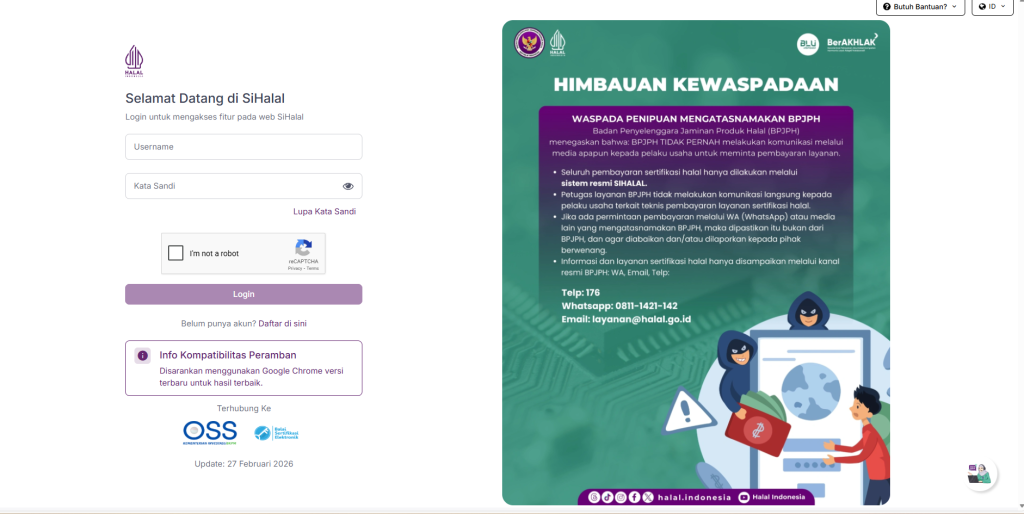
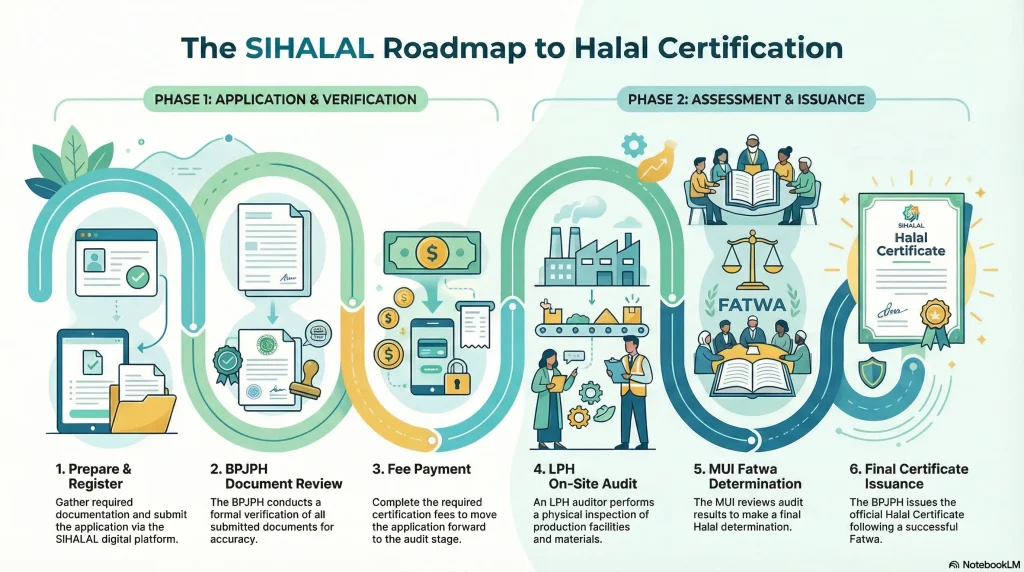
The official process is managed by BPJPH (Badan Penyelenggara Jaminan Produk Halal) through the SIHALAL online platform at sihalal.halal.go.id.
Step 1 — Prepare Your Business and Product Documentation
Before registering, gather the following:
- NIB (Nomor Induk Berusaha) — Indonesian Business Identification Number. Foreign companies need a local legal entity or authorized representative to obtain this.
- Full product list with ingredient/raw material details
- Production process flowchart (Proses Produksi Halal / PPH)
- SJPH Manual — Sistem Jaminan Produk Halal (Halal Product Assurance System). A written management document describing how your company ensures halal compliance throughout all stages of production.
- Appointment of an Internal Halal Supervisor (Penyelia Halal) — a qualified Muslim employee responsible for overseeing all halal processes within the company
💡 Tip: The SJPH Manual is the most critical — and most commonly incomplete — document in halal applications. Having this professionally prepared by a consultant significantly reduces processing delays.
Step 2 — Register on SIHALAL and Submit Your Application
Go to sihalal.halal.go.id and:
- Create a company account
- Fill in your business profile and product information
- Upload all required documents
- Submit the application to BPJPH
Step 3 — Document Verification by BPJPH
BPJPH reviews your submission for completeness and accuracy. If anything is missing, you will be notified to provide additional documents within a set timeframe.
Step 4 — Payment of Certification Fees
Once documents pass verification, BPJPH issues a payment invoice. You must pay within 7 working days to avoid application cancellation.
Certification fees vary based on:
| Factor | Impact on Cost |
|---|---|
| Business size | Micro/small businesses pay less; large enterprises pay more |
| Inspection scope | On-site audit complexity and travel requirements |
| Testing needs | Laboratory testing of specific ingredients |
Step 5 — Appointment of LPH (Halal Inspection Body)
After payment, BPJPH assigns — or you may choose — an LPH (Lembaga Pemeriksa Halal): an accredited halal inspection body authorized to audit your production facility and processes.
Step 6 — On-Site Halal Audit by LPH
LPH auditors conduct a physical inspection of your facility, covering:
- Raw material sourcing and ingredient traceability
- Production process (cross-contamination prevention, equipment cleaning procedures)
- Storage and warehousing
- Packaging and labeling
- Distribution management
The audit report is compiled and submitted to MUI for religious review.
Step 7 — Fatwa Session by MUI (Majelis Ulama Indonesia)
The MUI’s Halal Fatwa Committee reviews the LPH audit report and issues a Ketetapan Halal (Halal Determination) — the official religious endorsement confirming your product meets Islamic halal standards.
Step 8 — Halal Certificate Issued by BPJPH
Based on MUI’s determination, BPJPH officially issues your Halal Certificate (Sertifikat Halal). This typically happens within 1 working day after MUI’s decision.
🔁 Under GR No. 42/2024, your halal certificate is now valid indefinitely — as long as your product ingredients and production process remain unchanged. This replaced the previous 4-year validity requirement.
Frequently Asked Questions
Q: Can a foreign company apply for halal certification in Indonesia?
Yes. A foreign company must either establish a legal entity in Indonesia (e.g., PT PMA — a foreign-owned company) or appoint an authorized local representative. The application is then submitted via SIHALAL.
Q: How long is an Indonesian halal certificate valid?
Halal certificates are now valid indefinitely, as long as there is no change to product ingredients or production process. This is a major improvement from the previous 4-year validity.
Q: What is SIHALAL?
SIHALAL is BPJPH’s official online platform for all halal certification applications and halal status tracking. Access it at sihalal.halal.go.id.
Q: What is the SJPH Manual, and why is it so important?
The SJPH (Sistem Jaminan Produk Halal) is a written management system that documents how your company ensures halal compliance across sourcing, production, storage, and distribution. It is one of the most critical documents in the application — and the most common cause of delays when poorly prepared.
Q: Is halal certification required for cosmetics?
Yes. All cosmetics and personal care products (skincare, makeup, hair care, oral care, etc.) must be halal certified by October 17, 2026.
Q: Does my food packaging need halal certification too?
Yes, if the packaging materials contain animal-derived components (e.g., gelatin-based capsule shells, coatings made with animal fats). Packaging services are also covered under the halal services regulation.
Q: Are natural/fresh products exempt?
Yes. Fresh, unprocessed fruits, vegetables, eggs, milk, water, and certain natural raw materials fall on the “Halal Positive List” and are exempt from certification — as long as they undergo no processing with additives.
How INSIGHTOF Can Help You Get Halal Certified
Navigating Indonesia’s halal certification process involves multiple government agencies (BPJPH, LPH, MUI), complex documentation requirements, and tight deadlines — especially with the October 2026 deadline fast approaching.
At INSIGHTOF Consulting Indonesia, we have helped 200+ local and international clients across food, beverages, cosmetics, and medical devices successfully obtain halal certificates. Our Jakarta-based team handles the entire process on your behalf:
- ✅ SJPH Manual preparation
- ✅ SIHALAL account setup and full application filing
- ✅ LPH coordination and pre-audit preparation
- ✅ Authorized representative services for foreign companies without a local entity
- ✅ End-to-end monitoring until certificate issuance
📞 Ready to start?
Contact us at marketing@insightof.co.id | WhatsApp: +62 897 6470 070
Start Your Registration Process Today
If you are planning to register cosmetics, food, supplements, medical devices, or require halal certification, INSIGHTOF Consulting Indonesia is ready to assist you with structured, professional regulatory support.
Contact our team today to discuss your product category and compliance requirements.