1. Introduction
Did you know that certain cosmetic products can invalidate Wudhu (ablution) or Ghusl, even when they are already Halal-certified?
This is a critical issue that many cosmetic brands overlook when entering the Indonesian market. The risk is not only related to the religious validity of worship for Muslim consumers, but also to the potential rejection of your Halal certification application by BPJPH (Halal Product Assurance Organizing Agency).
For Muslim consumers, the validity of prayer (Shalat) depends on valid purification. If water cannot reach the skin due to a cosmetic layer, the purification process becomes invalid. As a result, the worship performed afterward is also considered invalid.
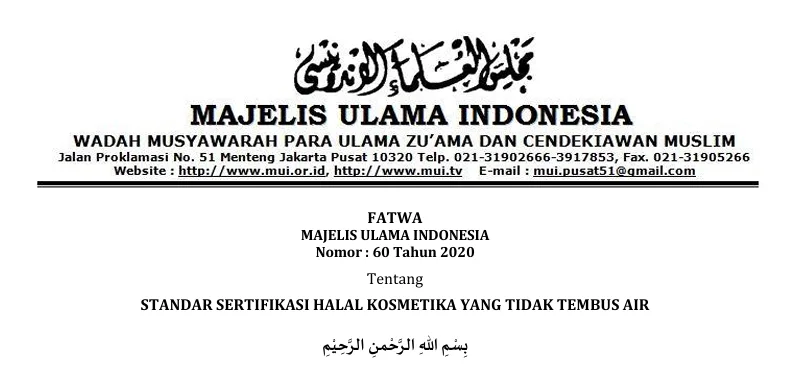
Therefore, understanding regulations related to waterproof and non–water-permeable cosmetics is essential for any brand operating in Indonesia. This article explains the key points of MUI Fatwa No. 60 of 2020 to help your brand stay compliant and avoid regulatory issues.
2. About INSIGHTOF Consulting Indonesia (PT. ICI)
ICI is your strategic partner in navigating Indonesia’s complex regulatory landscape, including Kemenkes, BPOM, and Halal certification requirements.
With experience supporting over 1,000 successful registrations for local and international brands, we ensure that your documentation is accurate, formulations are compliant, and market entry is smooth. ICI bridges the gap between technical regulations and practical business execution.

3. Understanding MUI Fatwa No. 60 of 2020
Cosmetic regulation in Indonesia goes beyond ingredient compliance. It also evaluates how a product interacts with the skin. Below is a structured explanation of the key principles.
3.1 Waterproof vs. Non–Water-Permeable: What’s the Difference?
A common misunderstanding lies in terminology.
- Waterproof is a marketing claim indicating resistance to water or moisture.
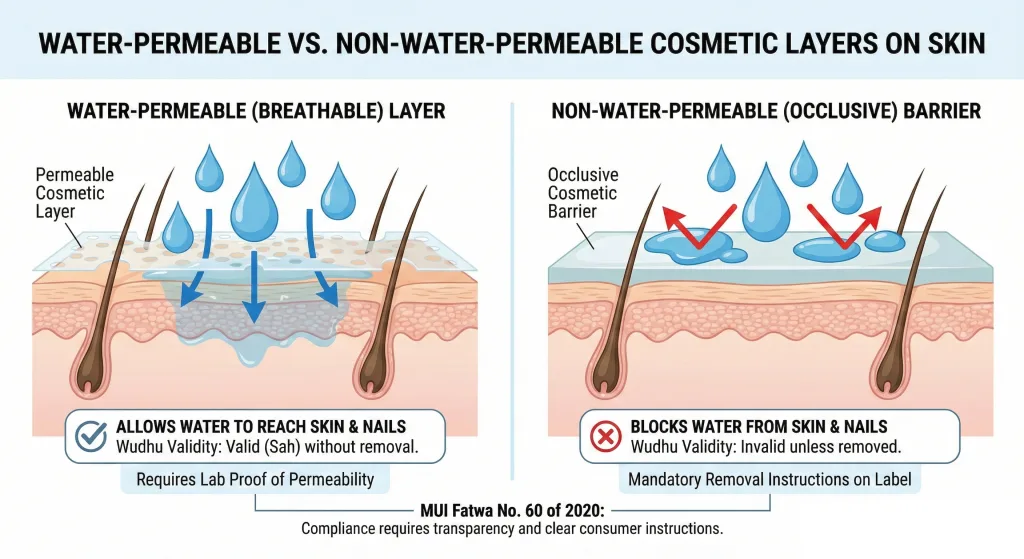
- Non–water-permeable is a Halal regulatory concept referring to whether a product forms a physical barrier that prevents water from reaching the skin or nails.
A product labeled as waterproof is not automatically prohibited. During the Halal audit process, the LPH auditor will assess whether the product creates an occlusive layer that blocks water contact with the skin or nails.
3.2 Impact on Wudhu (Ablution)
If a cosmetic product forms a barrier that prevents water from reaching the skin, Wudhu is considered invalid, and any prayer performed afterward is also invalid.
This applies particularly to products such as:
- Long-wear foundations
- Waterproof mascara and eyeliner
- Nail polish (kuteks)
- Matte lipsticks containing film-forming agents

3.3 Conditions for Halal Certification
According to MUI Fatwa No. 60 of 2020, non–water-permeable cosmetics can still be Halal-certified, provided specific conditions are met.
In addition to being free from haram ingredients (such as pork derivatives), the product must clearly communicate usage limitations to consumers.
3.4 Mandatory Labeling Requirements
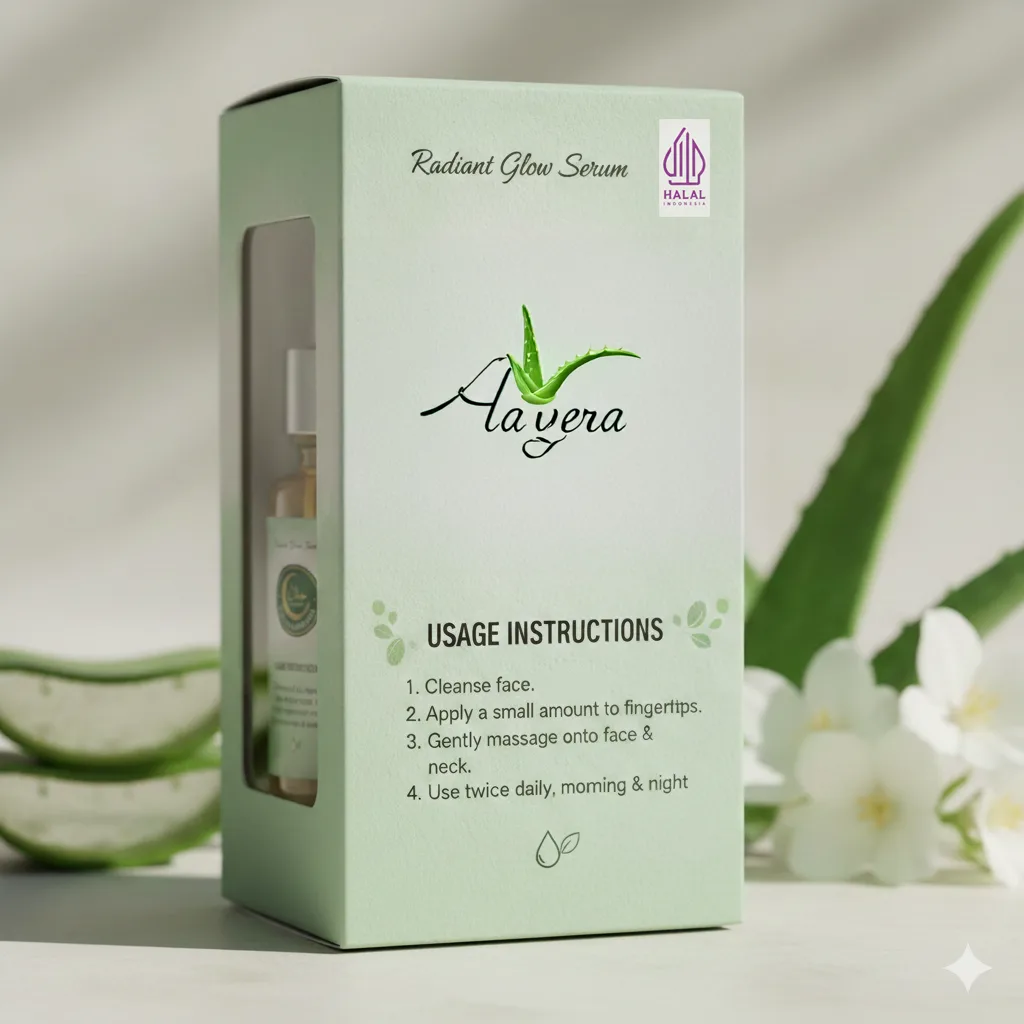
For high-coverage or non–water-permeable products, manufacturers must include the following information on the packaging:
- Disclosure of Product Characteristics
A clear statement explaining that the product is non–water-permeable. - Cleaning / Removal Instructions
Clear guidance instructing Muslim consumers to remove the product completely before performing Wudhu or Ghusl.
3.5 Summary of Halal Requirements by Product Type
| Product Characteristic | Water Interaction | Halal Certification Requirement | Wudhu Validity |
|---|---|---|---|
| Water-Permeable (Breathable) | Water reaches skin/nails | Standard Halal requirements + permeability test | Valid (Sah) without removal |
| Non–Water-Permeable (Occlusive) | Water blocked | Standard Halal requirements + mandatory removal instructions | Invalid unless removed |
| Absorbed Products (serums, creams) | Absorbed into skin | Standard Halal requirements | Valid (Sah) |
3.6 Technical Proof of Water Permeability
For products claiming to be “Wudhu-Friendly” (commonly seen in nail polish), laboratory evidence is required. A water permeability test must demonstrate that water molecules can pass through the cosmetic layer within a reasonable time frame to cleanse the skin underneath.
4. FAQ: Cosmetic Halal Certification
Q: Is waterproof mascara automatically haram?
A: No. If the ingredients are Halal, it can be certified. However, the label must instruct users to remove it before Wudhu.
Q: What if removal instructions are missing from the label?
A: The Halal certification application may be rejected or delayed due to non-compliance with MUI Fatwa No. 60 of 2020.
Q: Does “Wudhu-Friendly” mean Halal?
A: Not always. “Wudhu-Friendly” refers to water permeability. Halal certification also requires compliant ingredients and manufacturing processes.
Q: Are imported cosmetics exempt?
A: No. All cosmetics circulating in Indonesia—local or imported—must comply with mandatory Halal certification by October 2026.
5. Why Choose ICI?
Navigating chemical formulations and religious fatwas simultaneously can be complex. ICI offers complete regulatory support:
✔ Ingredient Review – Screening critical ingredients such as collagen, glycerin, and alcohol
✔ Permeability Strategy – Advising whether lab testing or label adjustments are required
✔ Label Compliance – Drafting and reviewing mandatory usage and removal instructions
✔ End-to-End Registration – From BPOM notification to BPJPH Halal Certificate issuance
6. Conclusion
Halal certification for cosmetics is not only about ingredients—it also concerns whether a product interferes with religious purification practices.
For non–water-permeable cosmetics, transparency is mandatory. Brands must clearly inform consumers and provide removal instructions. Failure to comply may result in certification rejection and market delays.
Don’t let technical misunderstandings hinder your product launch. Ensure your cosmetics are compliant, consumer-safe, and legally certified for the Indonesian market.
Do you need assistance registering your product in Indonesia?
Contact us today to start your registration process.



.svg/240px-YouTube_social_red_squircle_(2017).svg.png)