Halal Certification for Medical Devices: Why is it Important?
Reading Time: 5 minutes
Indonesia’s healthcare industry is growing rapidly, driving a heightened focus on the safety and quality of medical devices. For Muslim consumers, a product’s standard goes beyond sterility and efficacy—it must also comply with Sharia principles to be considered permissible for use. This critical intersection of medical standards and religious adherence makes Halal Certification for Medical Devices an increasingly important, and soon to be mandatory, topic for manufacturers and distributors entering the Indonesian market.
Introduction to INSIGHTOF: Your Regulatory Affairs Expert
Navigating the dual mandates of the Ministry of Health (Kemenkes) for product registration (Izin Edar) and the Halal Product Assurance Organizing Agency (BPJPH) for Halal certification can be complex. At INSIGHTOF Consulting Indonesia, we specialize in simplifying these intricate regulatory pathways.
Our services include end-to-end guidance for both Medical Device (Alkes) registration with Kemenkes and Halal certification through the BPJPH ecosystem (involving LPH and MUI). We ensure your compliance is achieved efficiently, securely, and in full alignment with the latest Indonesian regulations.
✅ INSIGHTOF offers specialized support for navigating Halal regulatory compliance for medical devices.
Core Principles and Regulatory Framework
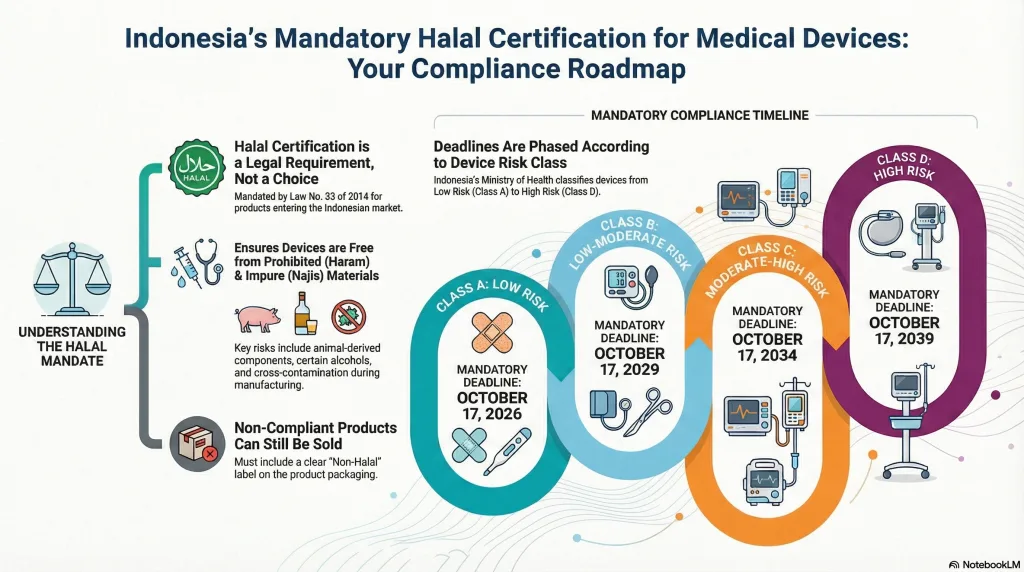
The implementation of mandatory Halal certification for products entering Indonesia is established not merely as a market preference but as a legal requirement, affirmed by Law No. 33 of 2014 concerning Halal Product Assurance (JPH Law) and further detailed in Government Regulation (PP) No. 42 of 2024.
The goal of Halal assurance is to ensure that medical devices are free from Haram (prohibited) and Najis (impure) components throughout the entire supply chain and manufacturing process.
1. Medical Device Classification by Kemenkes
The Ministry of Health classifies medical devices based on risk, which directly influences their registration and subsequent Halal compliance timeline.
Class
Risk Level
Examples
Class A
Low Risk
Film viewer, surgical instruments, examination gloves, oxygen mask
Class B
Low-Moderate Risk
Blood pressure cuff, steam sterilizer
Class C
Moderate-High Risk
Patient monitor, X-ray machine
Class D
High Risk
Heart stent, pacemaker
2. Principles of Halal Product Assurance System (SJPH)
For medical device manufacturers, particularly those whose products come into contact with the human body, the implementation of a Halal Product Assurance System (SJPH) is mandatory. This system must govern the entire production cycle, from raw material sourcing to final packaging.
Key focus areas in Halal certification for medical devices, particularly regarding materials and facilities, include:
Materials Source: Materials derived from animals must originate from a Halal animal, and the slaughter must comply with Islamic law. For example, collagen used in surgical sutures or implants often requires careful verification, as it may be derived from pigs or non-Halal sources.
Alcohol/Ethanol: Alcohol sourced from intoxicating beverages (Khamr) is considered Haram. Synthetic alcohol derived from petroleum, however, is generally permissible and not considered Najis.
Contamination (Najis): All tools and production areas that have contacted non-Halal materials must be removed or thoroughly cleaned (purification process) before being used for Halal products. This is especially relevant for devices that are inserted into or directly contact the human body (e.g., surgical sutures, artificial heart valves).
3. Mandatory Halal Certification Timeline
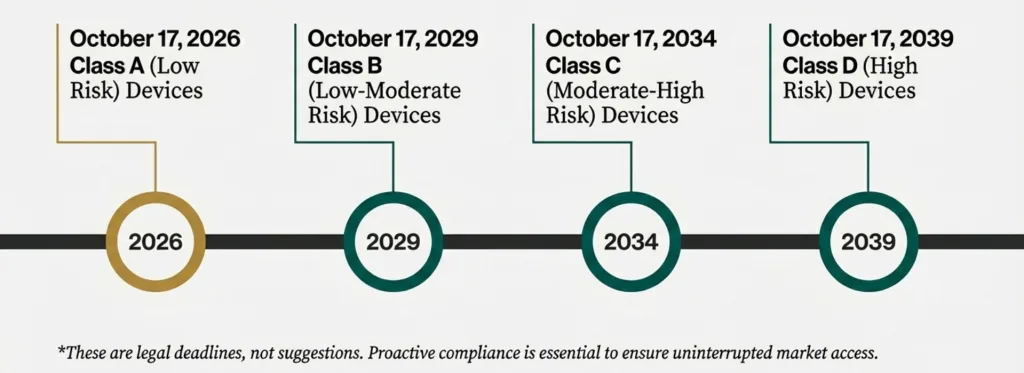
Indonesia has established a phased timeline for mandatory Halal certification, giving the industry time to adapt. This is a legal deadline, not a suggestion.
Medical Device Class
Risk Level
Mandatory Halal Certification Deadline
Class A
Low Risk
October 17, 2026
Class B
Low-Moderate Risk
October 17, 2029
Class C
Moderate-High Risk
October 17, 2034
Class D
High Risk
October 17, 2039
Products that use non-Halal ingredients or materials that are not yet sourced from Halal materials are still permitted to be distributed, provided they include a clear “non-Halal” label on the product packaging.
Innovation in Halal-Compliant Materials
The requirement for Halal certification has spurred innovation, especially for high-risk implantable devices and materials derived from animal sources.
Implants: While some implants historically used animal-derived materials, alternatives such as materials made from Halal-slaughtered bovine bone or inert, biocompatible pure metals (like titanium or niobium, are increasingly common.
Surgical Sutures: Sutures, which are inserted directly into the body, must be Halal-compliant. Alternatives to potentially non-Halal collagen sources include synthetic polymers (like Polylactide/PLA) or Halal-certified collagen.
Sterilization and Cleaning: Prior to sterilization, instruments must be thoroughly cleaned using specialized detergents or enzymes to remove impurities (Najis) like blood or tissue residue. It is mandatory to confirm that these cleaning agents or enzymes (such as protease and lipase) are not sourced from pigs or other forbidden materials. The final sterilization process often involves methods like autoclaving, Ethylene Oxide (EtO) gas, or Gamma/Electron Beam radiation.
FAQ Section: Addressing Your Concerns
Based on our consulting experience, here are the most frequently asked questions regarding Halal certification for medical devices.
Q: Our medical device is sterile. Does it still require Halal certification?
A: Yes, absolute compliance is mandated for all classes of medical devices by their respective deadlines. Halal certification covers the entire life cycle, including the source of raw materials, cleaning agents (detergents/enzymes), manufacturing process, and storage, ensuring freedom from Najis and Haram substances even before final sterilization.
Q: Can we still distribute our product if it contains non-Halal components?
A: Yes, a product that is subject to mandatory Halal certification but contains non-Halal ingredients may still be distributed, provided that the product packaging clearly includes a “Non-Halal” label.
Q: What is the main Halal risk point for high-risk implants?
A: The primary risk is often related to animal-derived materials such as collagen, gelatin, or bone-grafting materials, which must be verified as sourced from Halal-slaughtered animals or confirmed pure (Najis-free) according to Islamic law.
Q: Who is the final authority that issues the Halal Decree for medical devices?
A: The Indonesian Ulema Council (MUI) determines the Halal status of the product through the Halal Fatwa Session, based on the audit conducted by an LPH. Following this Fatwa, the BPJPH issues the official Halal Certificate.
Company Recommendation and Service Proposal
The Indonesian government’s commitment to mandatory Halal certification for medical devices establishes a clear and irreversible regulatory trajectory. For manufacturers and distributors, understanding and preparing for the phased deadlines (starting in October 2026 for Class A devices) is crucial for securing long-term market access.
The path requires simultaneous compliance with:
Kemenkes (Ministry of Health): For the Izin Edar (Marketing Authorization/NIE) and adherence to quality standards (e.g., ISO 13485, product safety).
BPJPH/LPH/MUI: For Halal Certification based on material sourcing, process (PPH), and factory sanitation (SJPH).
INSIGHTOF Consulting Indonesia bridges the gap between these requirements. Our dedicated team of Regulatory Affairs specialists will:
✔ Audit your material supply chain to identify potential Haram/Najis risks (e.g., in collagen, cleaning agents, excipients).
✔ Develop and implement a compliant Halal Product Assurance System (SJPH) customized for medical device manufacturing.
✔ Manage the entire certification process, coordinating the audit by the appointed LPH and the Fatwa session by MUI to secure your final BPJPH Halal Certificate.
✔ Ensure integrated compliance, guaranteeing that your Halal status aligns seamlessly with your ongoing Kemenkes Izin Edar obligations.
Don’t wait for your product’s deadline. Start the comprehensive Halal compliance process today to ensure uninterrupted market operations.
Conclusion
Halal certification for medical devices in Indonesia is vital not only for adhering to a legal mandate but also for building trust and opening access to one of the world’s largest Muslim consumer markets. The key to success is an early, integrated strategy that addresses material sourcing, manufacturing purity, and the final regulatory submission.
Partner with INSIGHTOF to transform the complex Halal certification requirement into a competitive advantage.
Ready to secure your Halal certification and competitive edge in the Indonesian market? Contact INSIGHTOF today for a free regulatory gap analysis.