Entering the Indonesian beauty market involves more than just aesthetics or efficacy, primarily, it requires trust and compliance. As a consultant who frequently meets with global cosmetic brands, I often hear the same concern: “Is Halal certification really mandatory for my skincare line?” We always answer with a resounding yes. With the implementation of the Halal Product Assurance law, Indonesia established a new standard where “Halal” acts as a synonym for “Quality” and “Safety” for Muslim consumers. Consequently, understanding these regulations serves as the first step to capturing the heart of the Indonesian market.
 About INSIGHTOF Consulting Indonesia
 About INSIGHTOF Consulting Indonesia
INSIGHTOF Consulting Indonesia partners with you to navigate the intricate regulatory landscape of Indonesia. Specifically, we specialize in assisting international and local companies with product registration, including BPOM notifications and Halal certification. Our team ensures your cosmetic products meet all technical and administrative requirements. Therefore, you can focus entirely on growing your brand while we handle the compliance.
Key Aspects of Halal Certification for Cosmetics
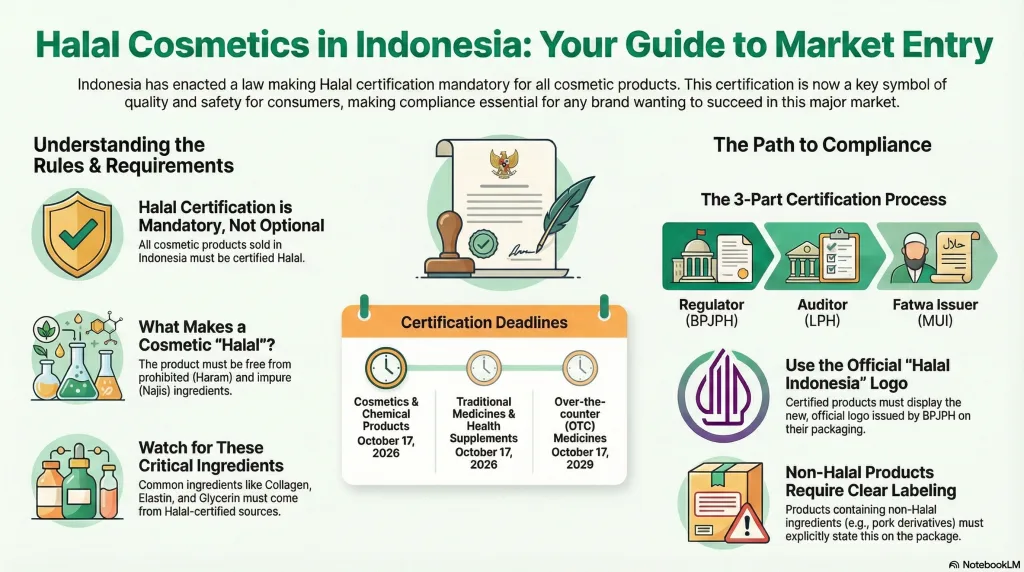
1. Mandatory Certification Timeline for Cosmetics
The Indonesian government established a phased timeline for mandatory Halal certification. Currently, the cosmetic industry faces a critical transition period. According to government regulations, manufacturers must certify all cosmetics circulating in Indonesia by a specific deadline.
| Product Category | Certification Deadline |
| Cosmetics, Chemical Products, and Genetically Engineered Products | Oct 17, 2026 |
| Traditional Medicines and Health Supplements | Oct 17, 2026 |
| Over-the-counter (OTC) Medicines | Oct 17, 2029 |
Although the deadline seems distant, the certification process often takes considerable time. Thus, early preparation remains essential to avoid market disruptions.
2. Understanding Critical Ingredients in Cosmetics
In the cosmetic industry, complex chemical names often blur the line between Halal and Haram. Fundamentally, regulators consider a product Halal only if it remains free from prohibited ingredients (Haram) and impurities (Najis).
For instance, you must closely monitor these common critical ingredients:
- Collagen & Elastin: Manufacturers often derive these from animal sources. If you source them from pigs or non-halal slaughtered animals, the law classifies them as Haram.
- Glycerin (E422): Companies use this in soaps and moisturizers. Its Halal status depends entirely on whether the manufacturer derives it from plants or animals.
- Alcohol / Ethanol: Formulators use this in perfumes and toners. Fortunately, regulations permit Ethanol if the industry does not derive it from the liquor industry (khamr) and it remains medically safe.
- Placenta: However, the regulations strictly prohibit human or animal placenta.
3. The Application Process
The Halal certification process in Indonesia involves three key institutions: BPJPH (Regulator), LPH (Auditor), and MUI (Fatwa Issuer). For most cosmetic companies, especially medium to large enterprises, the Regular Path serves as the required route.
- Registration: First, submit your application via the SIHALAL system managed by BPJPH.
- Audit Selection: Next, choose an accredited Halal Inspection Agency (LPH) to conduct the audit.
- Audit & Testing: Subsequently, the LPH auditor inspects your production facility and tests materials. For cosmetics, this step ensures no cross-contamination with Haram substances occurs.
- Fatwa: Then, the MUI Fatwa Commission reviews the audit results and declares the Halal status.
- Issuance: Finally, BPJPH issues the Halal Certificate.
4. Labeling Requirements
After obtaining certification, your product packaging must comply with specific labeling rules.
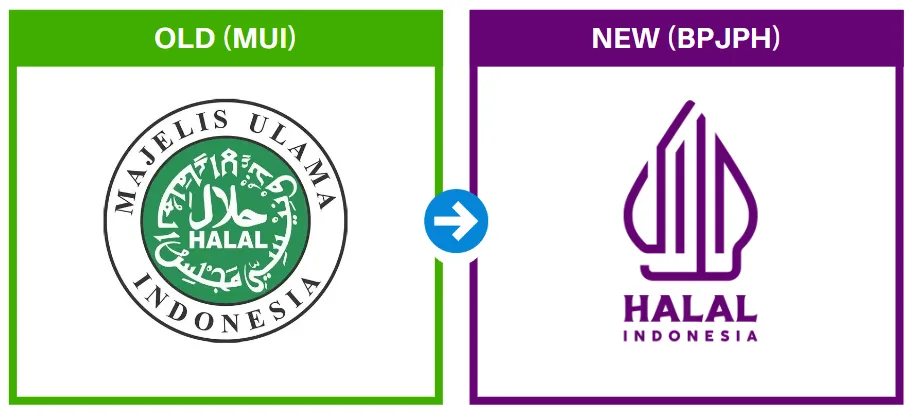
- Halal Label: You must display the official “Halal Indonesia” logo issued by BPJPH. Notably, authorities are phasing out the old MUI logo.
- Non-Halal Information: Conversely, if your product contains prohibited ingredients (e.g., pig-derived collagen), the law legally obligates you to state “Contains Pork” or display a pig symbol in red on the packaging. You cannot hide this information.
Frequently Asked Questions (FAQ)
Q: Can I use the same production line for Halal and non-Halal cosmetics?
A: No. Regulations require that you separate facilities. You cannot use the same equipment for Halal products if it previously contacted pork derivatives, even after cleaning21.
Q: Is ethanol allowed in Halal cosmetics?
A: Yes, regulations allow it. Specifically, the rules permit Ethanol from non-khamr sources (like industrial fermentation) for external use, provided it does not harm health22.
Q: My product is imported. Do I still need to certify it in Indonesia?
A: Yes. Indeed, all products entering and trading in Indonesia require Halal certification23. You can register foreign Halal certificates if a Mutual Recognition Agreement (MRA) exists with BPJPH; otherwise, a direct audit becomes necessary.
Why Partner with INSIGHTOF?
✔ Cosmetic Specialists: We possess extensive experience registering cosmetic products with both BPOM and Halal authorities, which allows us to understand the specific ingredient nuances of the beauty industry24.
✔ Comprehensive Service: Furthermore, we manage the entire lifecycle, from ingredient screening (Gap Analysis) to final certificate issuance and labeling advice25.
✔ Hassle-Free Process: Our team handles the complex coordination between BPJPH, LPH, and your manufacturing team, ensuring a smooth audit process26.
Ultimately, Halal certification represents more than a regulatory hurdle; it acts as a gateway to the massive Indonesian consumer base that values purity and safety. With the 2026 deadline approaching for cosmetics, now is the time to audit your supply chain and start the application process27.
Secure your market position today. Ensure your cosmetic products remain compliant and trusted by millions.
Ready to certify your beauty brand?
Contact INSIGHTOF Consulting Indonesia for a professional assessment of your Halal readiness.
#HalalCosmetics #HalalCertification #BPJPH #HalalIndonesia #CosmeticRegulation #IndonesiaBeautyMarket #LPH #MUIFatwa #SkincareIndonesia #HalalCompliance #RegulatoryAffairs #IngredientSafety #ImportCosmetics #BeautyIndustry #INSIGHTOF