Imagine spending thousands on beautifully printed packaging, only to have your BPOM submission rejected because of a labeling mistake—or worse, facing a market recall due to a minor typo. In Indonesia, food labeling is not just about branding; it is a legal requirement governed by BPOM Regulation No. 31 of 2018 and its amendment No. 20 of 2021.
At INSIGHTOF Consulting, we help businesses navigate complex regulatory challenges—from BPOM registration to Halal certification—ensuring your product enters the Indonesian market smoothly and legally. This article explains what a fully compliant food label must include so your brand stays safe and trusted.
1. Fundamental Principles of Food Labeling in Indonesia
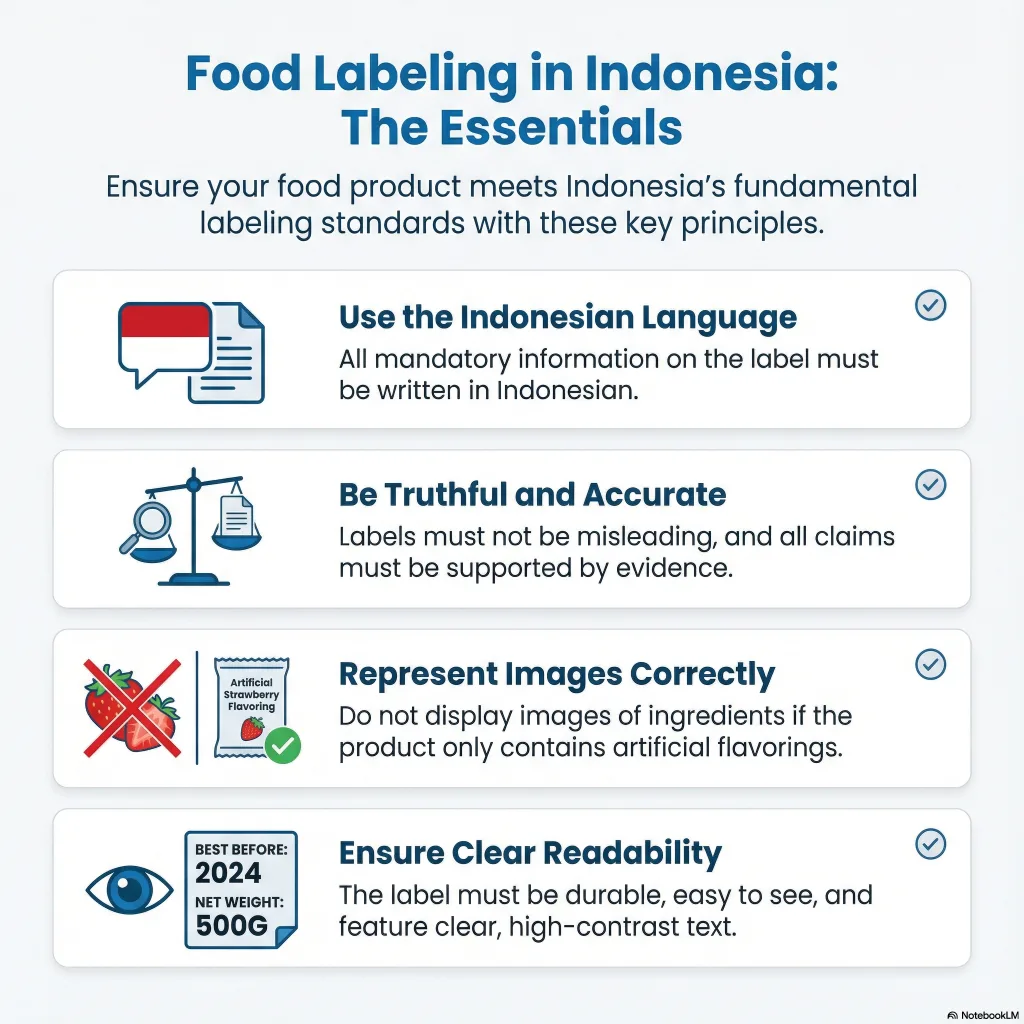
Before looking at specific label elements, businesses must understand the core principles applied to all processed food products:
 Language Requirement
 Language Requirement
All mandatory information must be written in Indonesian. Foreign languages may only be used if:
• No Indonesian equivalent exists, or
• It appears alongside Indonesian text.
Honesty and Accuracy
Labels must be truthful and not misleading. All claims must be supported with evidence.
Use of Images
You cannot display images of ingredients (such as meat, fruit, or milk) if the product only contains artificial flavorings. If an ingredient image is shown, its percentage must be stated in the composition list.
Label Placement & Readability
BPOM also regulates label readability:
- it must not easily fade or be erased
- the label must be placed in an area that is easy to see
- the text must be clear, high-contrast, and easy to read
- the information must not be covered by packaging folds
2. The 7 Mandatory Elements on the Main Display Panel
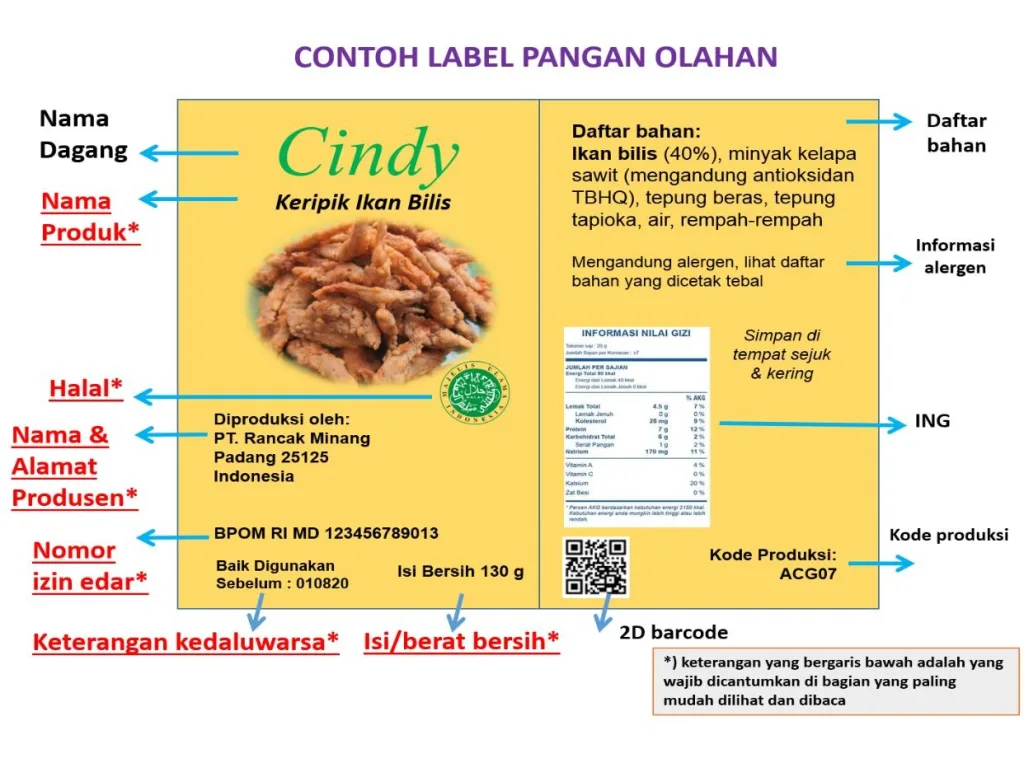
The front of the packaging—or Main Display Panel—is the most important part of your product label. Missing any of these elements may result in BPOM rejection.
Mandatory Elements Required by BPOM
| No | Mandatory Element | Description |
|---|---|---|
| 1 | Processed Food Type Name (Nama Jenis) | Product identity according to BPOM category, e.g., Cocoa Powder or Biscuits. |
| 2 | Trade Name (Nama Dagang) | Your brand name. It must not be misleading or socially inappropriate. |
| 3 | Net Weight (Berat Bersih) | Must use metric units (g, kg, ml, L). For solids in liquid, include Drained Weight (Bobot Tuntas). |
| 4 | Producer/Importer Details | Include name, city, postal code, and country, preceded by Produced by or Imported by. |
| 5 | Halal Logo | If Halal certified by BPJPH, the official Halal Indonesia logo must appear on the front. |
| 6 | Expiry Date | Use “Baik digunakan sebelum” or appropriate date format depending on shelf-life requirement. |
| 7 | BPOM Registration Number | Use BPOM MD (local) or ML (imported) followed by 15 digits. |
3. Mandatory Technical Information for Side/Back Panels
Beyond the front panel, BPOM requires additional technical information:
Ingredients List (Composition)
• Listed in descending order
• Allergens must be bolded
• Certain allergens must be clearly stated (milk, wheat, soy, nuts, etc.)
Nutrition Facts
Most processed foods must include a Nutrition Facts panel including:
• Energy
• Fat
• Protein
• Sugar
• Sodium
(Some exemptions apply, such as coffee powder and bottled water.)
Serving & Storage Instructions
Provide:
• Preparation method
• Proper storage guidance
Production Code / Batch Number
Critical for traceability & recall safety.
2D Barcode
A QR code issued by BPOM for verification via BPOM Mobile.
Country of Origin for Imported Foods
For imported products, label must also state:
• Negara asal produk (Country of Origin)
4. Halal Logo Compliance: A Critical Legal Integration
Many businesses mistakenly separate BPOM licensing and Halal compliance. In reality, both must align perfectly.
Key Halal Compliance Rules:
• If Halal certified, product must use official BPJPH “Halal Indonesia” logo
• Logo must be on the front panel
• Cannot be modified, distorted, recolored, or redesigned
• Must be clear and readable
• Ensure certificate approval before mass printing
Incorrect logo positioning or certificate mismatch can trigger compliance issues.
5. Best Before vs Use By
This is often misunderstood and extremely important legally.
Baik Digunakan Sebelum (Best Before)
Digunakan untuk produk dengan stabilitas baik dan tidak langsung berbahaya setelah tanggal lewat (misalnya biskuit, minuman kemasan, dll).
Gunakan Sebelum / Use By
Digunakan untuk produk sangat mudah rusak, misalnya:
• produk dingin
• fresh products
• produk risiko tinggi
Jika lewat tanggal → berpotensi membahayakan kesehatan.
6. Warning & Special Statements
Certain products require additional warning statements, for example:
• products containing artificial sweeteners
• caffeinated drinks
• baby food / special nutrition foods
• high-risk category foods
This ensures consumer safety and compliance.
Frequently Asked Questions (FAQ)
Can imported products use only English?
No. Indonesian language is mandatory.
Where must the Halal logo be placed?
On the front panel.
Is Nutrition Facts required for all foods?
Yes, with some limited exemptions.
Can I print packaging before getting BPOM number?
Highly risky and not recommended.
Why Choose INSIGHTOF Consulting?
Navigating BPOM and Halal regulations can be overwhelming. INSIGHTOF Consulting Indonesia ensures full compliance and smooth approval.
✔ Food and Beverage Registration
✔ Halal Certification management
✔ Updated regulatory guidance aligned with latest laws
✔ End-to-end registration support
Food labeling in Indonesia is a precise combination of marketing, compliance, and consumer protection. Understanding mandatory BPOM elements, Halal compliance, expiry terminology, warning statements, and technical requirements helps businesses avoid rejection, delays, and costly recalls.
For expert assistance reviewing your label or managing BPOM registration, contact INSIGHTOF Consulting—your trusted partner for regulatory success in Indonesia.