1. Thermometer as a Medical Device
Thermometers are essential tools in healthcare and home use for measuring body temperature — a key Thermometers are essential household tools for monitoring body temperature, especially when someone is sick at home. Despite their simple appearance, they are officially classified as medical devices in Indonesia because they are used to detect fever or temperature changes — both key indicators of health conditions.
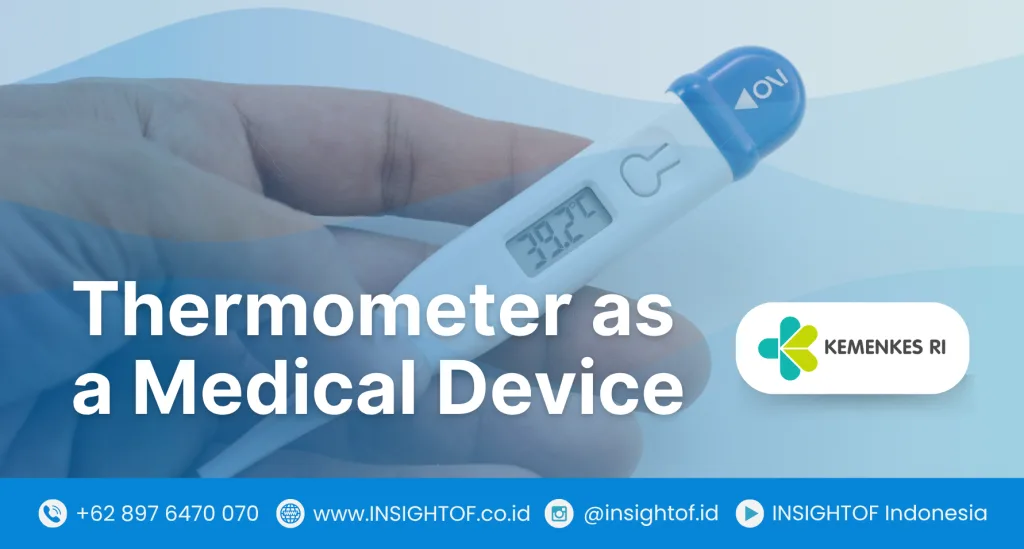
According to the Ministry of Health of the Republic of Indonesia (Kemenkes RI), thermometers used to measure human body temperature are categorized as non-electromedical or electromedical medical devices, depending on their type. Most home-use thermometers fall under Class B (moderate risk) due to their direct diagnostic function.
1. Glass or Mercury Thermometers
💡Traditional, non-electronic thermometers that use mercury or alcohol inside a glass tube.
Category: Non-electromedical
Risk Class: Class B
Common Use: Underarm or oral temperature check
2. Electronic Thermometers (Probe Type)
💡 Digital thermometers that use a temperature sensor and display results on an LCD screen.
Category: Electromedical (with measuring function)
Risk Class: Class B
Common Use: Oral, axillary, or rectal temperature measurement
3. Infrared Thermometers (Forehead or Ear Type)
💡 Non-contact thermometers that use infrared sensors — quick and hygienic, especially for infants or clinics.
Category: Electromedical
Risk Class: Class B
Common Use: Forehead or ear temperature screening
⚠️ Note: This is the most common classification. Depending on the product’s specific features, materials, or functions, the classification may vary.
Each category must comply with Indonesian medical device quality and safety standards and can only be distributed after obtaining an official Distribution License Number (Nomor Izin Edar – NIE) from the Ministry of Health.
However, industrial or laboratory thermometers not intended for human use are not classified as medical devices and therefore do not require registration under the Ministry of Health.
2. Medical Device Registration Process in Indonesia
The registration of thermometers is done through Regalkes (Registrasi Alat Kesehatan & PKRT Online) — the official online platform managed by the Ministry of Health.
Main Steps:
- Determine Device Classification
Identify the correct risk class based on the thermometer type (Class A or B). - Prepare Technical Documentation
Required documents include:- Product specifications and labeling information
- Test reports and quality certificates
- ISO 13485 certificate (for the manufacturer)
- Declaration of conformity and safety documentation
- Product photos and manuals (in Bahasa Indonesia)
- Submit via Regalkes Online System
Upload all documents through https://regalkes.kemkes.go.id/ and complete the PNBP (non-tax state revenue) payment. - Evaluation and Approval
The Ministry of Health reviews the submission. Once approved, the product receives a Distribution License Number (NIE), allowing it to be legally marketed in Indonesia.
3. Halal Certification Requirement for Thermometers
Under Law No. 33 of 2014 on Halal Product Assurance and Government Regulation No. 39 of 2021, all medical devices distributed in Indonesia must eventually be certified halal.
For thermometers, the requirement depends on their classification:
| Medical Device Class | Mandatory Halal Certification Deadline |
|---|---|
| Class A (low risk) | October 17, 2026 |
| Class B (medium risk) | October 17, 2029 |
| Class C (high risk) | October 17, 2034 |
| Class D (very high risk) | October 17, 2039 |
This ensures that all materials and processes — including lubricants, coatings, or probe covers — are free from non-halal substances.
4. Halal Certification Process for Thermometers
The Halal Product Assurance Agency (BPJPH), under the Ministry of Religious Affairs, oversees halal certification in collaboration with accredited Halal Inspection Bodies (LPH).
Key Stages:
- Material Assessment: Review of raw materials, sensors, or plastic components to ensure they do not contain or contact non-halal substances.
- Process Evaluation: Verification that production, calibration, and packaging processes are free from cross-contamination.
- Facility Audit: Inspection to confirm the implementation of a Halal Assurance System (SJPH).
- Certification: BPJPH issues a Halal Certificate after successful audit and verification.

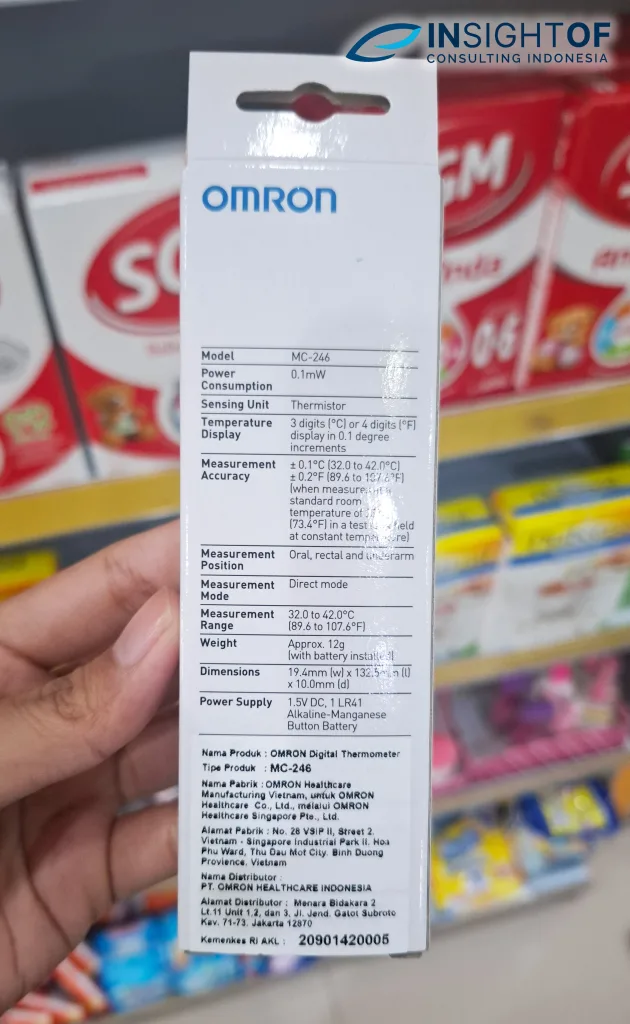
6. Product Labeling Requirements for Thermometers
In accordance with Minister of Health Regulation No. 62 of 2017, all medical devices distributed in Indonesia must include accurate, clear, and traceable labeling in both English and Bahasa Indonesia.
Label must include:
- Product name and model
- Manufacturer’s name and address
- Importer/distributor information
- Country of origin
- KEMENKES RI Distribution License Number (NIE)
- Usage instructions and safety warnings
- Halal logo (if applicable)
Example:
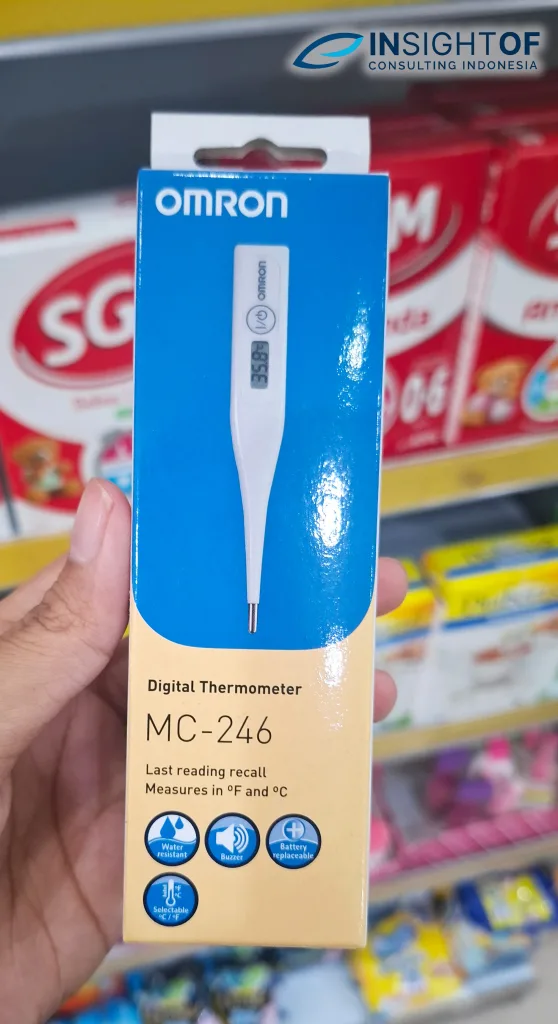
Product Name: INSIGHT Infrared Thermometer
Manufacturer: ABC MedTech Co., Ltd., Korea
Distributor: PT Medika Insight Indonesia
KEMENKES RI: AKL 1234567890123
How INSIGHTOF Consulting Indonesia Can Help
INSIGHTOF Consulting Indonesia provides complete support for medical device registration and halal certification in Indonesia, including:
- Medical Device Registration with the Ministry of Health (Kemenkes RI)
- Halal Certification Guidance with BPJPH and LPH
- Technical document preparation and translation assistance
- Importer and local representative setup for foreign manufacturers
👉 Contact us today to ensure your thermometers are legally registered and fully compliant with Indonesian regulations.
Do you need assistance registering your product in Indonesia?
Contact us today to start your registration process.



.svg/240px-YouTube_social_red_squircle_(2017).svg.png)