Many companies assume that once they secure Halal certification or meet international standards such as ISO 13485 or CE marking, they can immediately begin exporting to Indonesia. However, Indonesia has its own medical device regulatory system, and without completing this process, foreign manufacturers cannot legally import or distribute products in the market.
Recently, a Korean client who had already obtained Halal certification asked:
“We already passed Halal certification, but our products still cannot be exported to Indonesia. Is there another certification we need?”
The answer is yes—to sell medical devices in Indonesia, companies must undergo a registration process with the Ministry of Health (Kementerian Kesehatan, Kemenkes).
To guide companies entering Indonesia for the first time, we have outlined the 9 key steps of medical device registration.
The 9-Step Medical Device Registration Process
1. Risk Classification
The first step is to classify the device based on its risk level under Minister of Health Regulation No. 62 of 2017.
| Class | Risk Level | Examples |
|---|---|---|
| 1A | Low | Bandages, stethoscopes |
| 2B | Low-Medium | Surgical masks, IV tubing |
| 2C | Medium-High | Blood pressure monitors, diagnostic kits |
| 3D | High | Pacemakers, implants |
📌 Note: Higher risk devices require longer review periods and more supporting evidence.

2. Category Classification
Devices are further divided into five technical categories:
- Electromedical Radiation – X-ray, CT scan, radiotherapy devices
- Electromedical Non-Radiation – ECG, ultrasound, infusion pumps
- Non-Electromedical Sterile – Implants, surgical instruments
- Non-Electromedical Non-Sterile – Bandages, wheelchairs
- In-Vitro Diagnostic (IVD) – COVID-19 test kits, blood analysis reagents
Correct classification is critical, as it determines the registration route and technical requirements.
3. Market Entry Options
Foreign manufacturers cannot register products directly. They must choose one of these:
- Establish a Local Entity (PT PMA) – Requires investment and physical presence
- Appoint a Distributor – Must hold IDAK + CDAKB licenses
- Appoint a Local Representative (RO) – Independent agent holding licenses who registers products on behalf of the manufacturer
⚠️ Important: Only the appointed RO/distributor can legally import and sell the registered products.
4. Distributor License (IDAK)
The IDAK (Izin Distribusi Alat Kesehatan) is a mandatory license for distribution.
- Issued by: Kemenkes (Ministry of Health)
- Requirements: NIB (Business Identification Number), warehouse facility, qualified Technical Person in Charge (Apoteker or health professional)
- Validity: 5 years
Without IDAK, no company can apply for product registration.
5. Good Distribution Practice License (CDAKB)
CDAKB ensures compliance with Good Distribution Practice (GDP) standards in storage, handling, and distribution.
- Requires site audit by Kemenkes
- Covers warehouse, documentation system, and quality management
- Issued after IDAK approval
- Validity: 5 years, subject to surveillance audit

6. Technical Documentation
Documentation requirements are aligned with international standards but may be stricter in Indonesia.
Key documents include:
- ISO 13485 or GMP certificate
- Certificate of Free Sale (CFS) from country of origin
- Clinical Evaluation Report (mandatory even for some low-risk devices)
- IEC 60601 report for electromedical devices
- Letter of Authorization (LOA) appointing RO
- Product label & Instructions for Use (must be in Indonesian language)
👉 Unlike in some countries, even low-risk devices in Indonesia often require clinical data submission.
7. Applications are filed through the REGALKES portal (regalkes.kemkes.go.id).
- Fees payable only via local Indonesian bank accounts
- Timeline & Fees (Government official fees):
| Class | Review Timeline | Gov. Fee (IDR) | Approx. USD |
|---|---|---|---|
| 1A | 45 working days | 1,500,000 | $90 |
| 2B/2C | 90 working days | 3,000,000 | $180 |
| 3D | 120 working days | 5,000,000 | $300 |
Additional charges apply for variation (modification) or renewal.
8. Technical Review & Supplementation
During review, the regulator often issues a supplement request for missing or unclear documents.
- Applicants usually have one opportunity to submit corrections
- Rejections can occur if errors remain after supplementation
- Common issues: incomplete translations, incorrect device classification, missing certificates
📌 Practical tip: Work with an experienced local representative to reduce the risk of repeated supplementation.
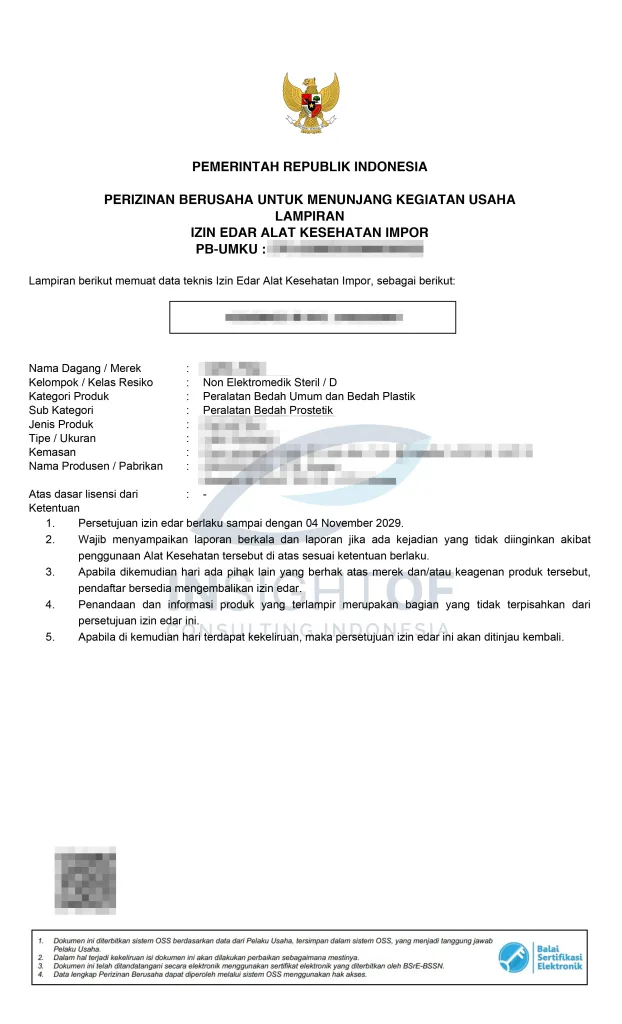
9. Final Approval & Distribution License (Izin Edar / NIE)
Once approved, the Ministry of Health issues the Nomor Izin Edar (NIE) – the official distribution license.
- Format: e-Certificate downloadable from REGALKES
- Validity: 5 years
- Required for customs clearance and importation
Conclusion
The Indonesian medical device registration process is complex but manageable when approached systematically. By understanding classification, licensing, and documentation requirements, foreign companies can significantly reduce delays and costs.
Since 2016, INSIGHTOF Consulting has guided hundreds of companies in successfully entering the Indonesian market.
✅ Our support includes:
- IDAK & CDAKB application
- Local Representative services
- Medical device registration via REGALKES
- Post-market compliance, renewal, and variation handling
📞 Contact us today to discuss how INSIGHTOF can support your entry into Indonesia’s fast-growing medical device sector.
Do you need assistance registering your product in Indonesia?
Contact us today to start your registration process.



.svg/240px-YouTube_social_red_squircle_(2017).svg.png)