Table of Contents
- Is Halal Certification Mandatory in Indonesia?
- Who Needs Halal Certification?
- Regulatory Authorities Involved
- Halal Certification Process in Indonesia
- Timeline: How Long Does Halal Certification Take?
- Cost of Halal Certification in Indonesia
- Halal Certification for Specific Industries
- Foreign Company Pathway
- Common Compliance Mistakes
- Strategic Approach for 2026 Compliance
- Frequently Asked Question
- Why work with ICI
- Conclusion
Introduction: Why Halal Certification in Indonesia Is Now Mandatory
Indonesia is the world’s largest Muslim-majority country. Since the implementation of the mandatory halal law, businesses can no longer treat halal certification as a marketing advantage — it is a regulatory requirement.
Under the supervision of Badan Penyelenggara Jaminan Produk Halal, halal compliance is now progressively mandatory across multiple sectors, including cosmetics, food, pharmaceuticals, and medical devices.
For foreign companies exporting to Indonesia, halal certification is not simply a religious label — it is a market access requirement.
This guide explains:
- Whether halal certification is mandatory
- Who must apply
- The step-by-step process
- Timeline and cost expectations
- How foreign companies can comply efficiently
- Common regulatory mistakes to avoid
1. Is Halal Certification Mandatory in Indonesia?
Yes — but implementation is phased.
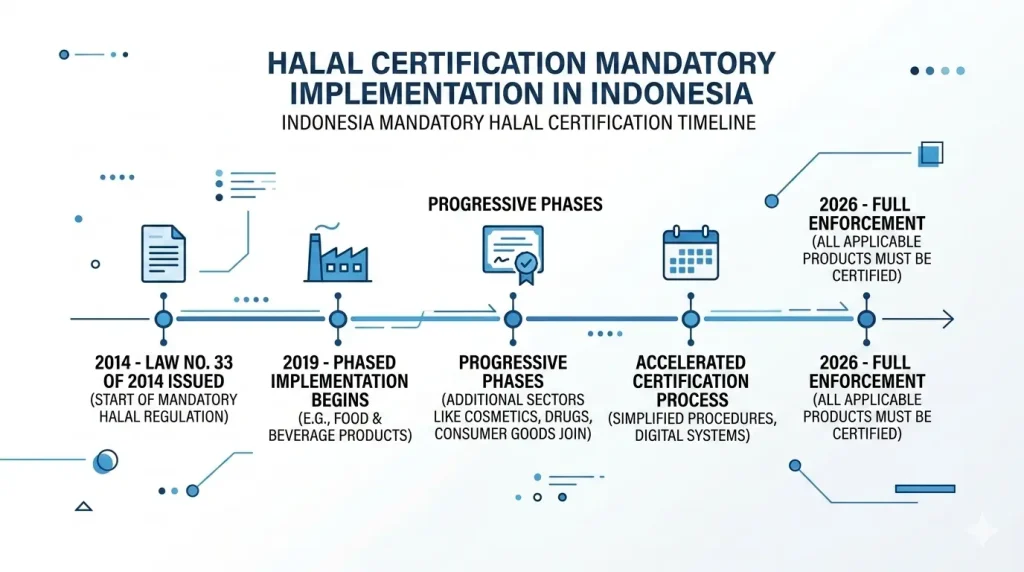
The mandatory requirement originates from Indonesia’s Halal Product Assurance Law, which gradually requires products entering, circulating, and traded in Indonesia to be halal certified.
1.1 Currently Impacted Sectors
Currently impacted sectors include:
| Sector | Mandatory Deadline |
|---|---|
| Food & beverages (medium/large businesses) | Oct 17, 2024 ✅ Already enforced |
| Slaughtered animal products & services | Oct 17, 2024 ✅ Already enforced |
| Food & beverages (small businesses & imports) | Oct 17, 2026 🔴 Urgent |
| Cosmetics & personal care | Oct 17, 2026 🔴 Urgent |
| Natural drugs, quasi-drugs, health supplements | Oct 17, 2026 🔴 Urgent |
| Chemical & biological products | Oct 17, 2026 🔴 Urgent |
| Consumer goods (fashion, accessories, crafts, leather) | Oct 17, 2026 🔴 Urgent |
| Class A medical devices | Oct 17, 2026 🔴 Urgent |
| Over-the-counter drugs, Class B medical devices | Oct 17, 2029 🟡 |
| Prescription drugs, Class C medical devices | Oct 17, 2034 🟡 |
1.2 Consequences of Non-Compliance
Failure to comply may result in:
- Administrative sanctions
- Product withdrawal
- Import restrictions
- Distribution barriers
For businesses planning long-term expansion into Indonesia, early preparation is critical.
2. Who Needs Halal Certification?
Halal certification applies to:
2.1 Local Manufacturers
Any company producing goods within Indonesia whose products fall within a mandatory halal category must obtain certification directly from BPJPH. This includes:
- Businesses operating under Indonesian legal entities (PT, CV, UD)
- Large and medium-scale food and beverage producers
- Cosmetic manufacturers
- Pharmaceutical companies
- Consumer goods producers
2.2 Importers and Local Distributors
Companies that import finished products into Indonesia are legally responsible for ensuring those products have valid halal certification before they enter circulation. This is the most critical obligation for the October 17, 2026 deadline, which was explicitly extended from the original 2024 deadline for imported food and beverage products.
2.3 Foreign Brand Owners
Whether they manufacture in their home country, in a third country, or through contract manufacturers — must ensure their products are halal certified before those products are distributed in Indonesia.
2.4 Why Foreign Companies Cannot Apply Directly
Foreign companies cannot submit a halal certification application to BPJPH independently. All applications must be filed by:
- A licensed Indonesian importer (the importer of record)
- An authorized local representative in Indonesia with a valid business license (NIB)
This creates a structural dependency: the foreign manufacturer must establish a compliant local partnership before any certification process can begin. Choosing the right local representative is therefore a strategic decision, not merely an administrative one.
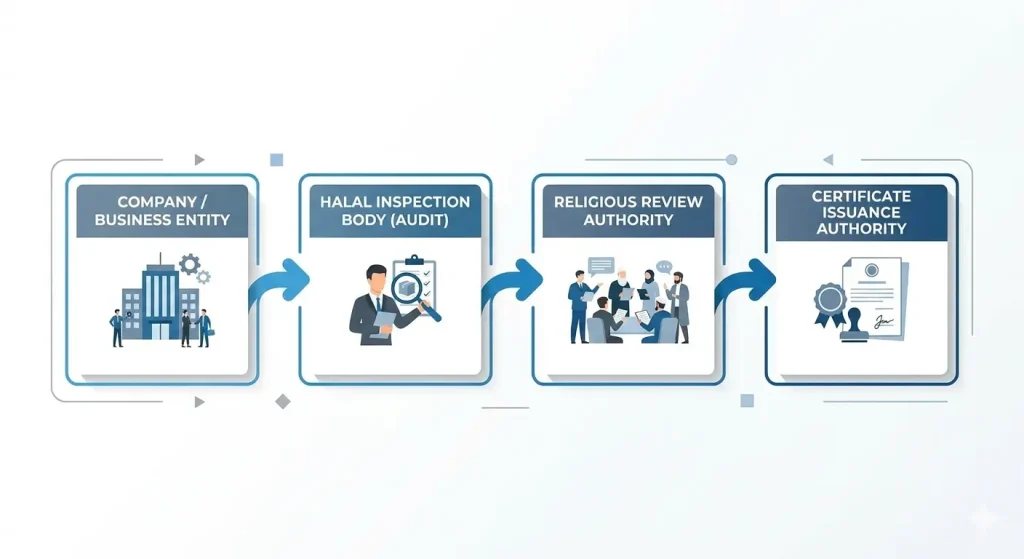
3. Regulatory Authorities Involved
Understanding the institutional structure is essential.
3.1 BPJPH – Badan Penyelenggara Jaminan Produk Halal
BPJPH is the central government body established under UU No. 33/2014 and operating under the Ministry of Religious Affairs (Kementerian Agama). It is the only authority empowered to issue, manage, and revoke Indonesia’s official Halal Certificates.
3.2 MUI – Majelis Ulama Indonesia
The Indonesian Ulema Council (MUI) provides the religious validation at the core of the halal certification process. It is not a government body — it is an independent Islamic scholarly council — but its role is Issues halal fatwa after audit and verification.
3.3 Technical Product Authority (If Applicable)
For regulated sectors like cosmetics or medical devices, coordination with Badan Pengawas Obat dan Makanan or Ministry of Health may also be required.
The process is multi-layered — which is why structured document preparation is essential.
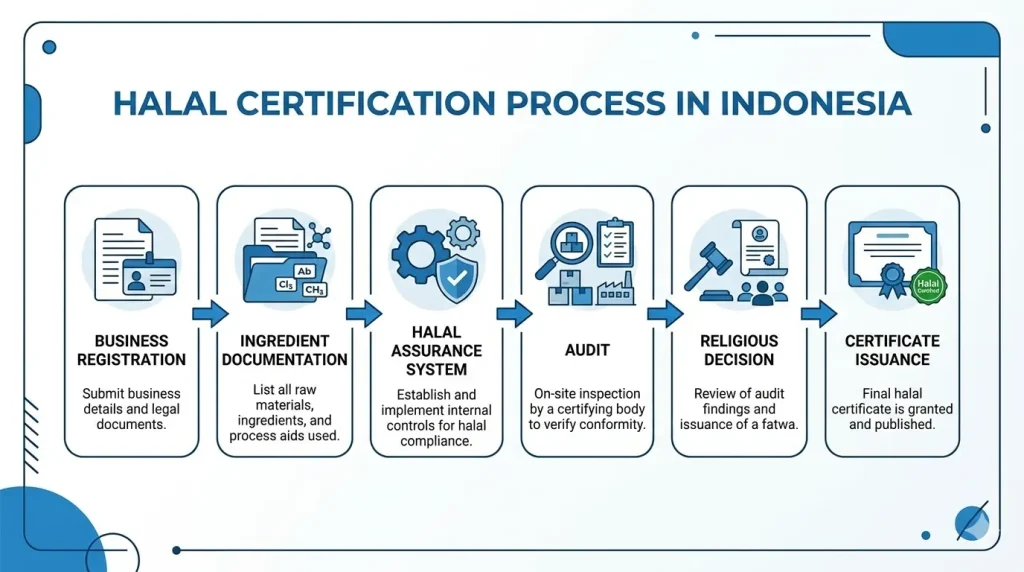
4. Halal Certification Process (Step-by-Step Overview)
Below is a simplified overview of the certification flow:
Step 1: Business Registration
Company must be legally registered in Indonesia.
Step 2: Product & Ingredient Review
All ingredients must be evaluated, including:
- Raw materials
- Additives
- Processing aids
- Packaging components (if relevant)
Step 3: Halal System Implementation
Company must implement a Halal Assurance System.
Step 4: Audit by Halal Inspection Body
On-site or document audit depending on product type.
Step 5: Fatwa Session
Religious decision-making session.
Step 6: Certificate Issuance
This structured approach reduces delays and rejection risks.
5. Timeline: How Long Does It Take?
5.1 Standard Processing Time (1–3 Months)
The average halal certification timeline in Indonesia ranges from:
⏳ 2 to 6 months
5.2 Key Factors That Affect the Timeline
However, this depends on:
- Ingredient traceability
- Overseas supplier cooperation
- Audit scheduling
- Document completeness
- Product complexity
Foreign companies often experience delays due to incomplete supplier documentation.
Proactive preparation significantly reduces processing time.
6. Cost Structure Overview
6.1 What Determines the Cost
Halal certification costs vary depending on:
- Product category
- Number of SKUs
- Audit scope
- Laboratory testing (if required)
6.2 Typical Cost Components
Costs generally include:
- Government certification fee
- Audit fee
- Consultant fee (if applicable)
- Translation & legalization costs (for foreign documents)
Transparent budgeting avoids unexpected regulatory setbacks.
7. Halal Certification for Specific Industries
Halal Certification for Cosmetics
Mandatory deadline: All cosmetics marketed in Indonesia must be halal certified by October 17, 2026, as confirmed by BPJPH Deputy Head Afriansyah Noor and reinforced by PP No. 42/2024.
Cosmetic products are subject to ingredient scrutiny, especially:
- Collagen
- Keratin
- Glycerin
- Fermented materials
- Animal-derived extracts
Shared manufacturing facilities can also trigger additional compliance review.
For imported cosmetics, halal certification must align with product registration.
Halal Certification for Medical Devices
Although many assume medical devices are exempt, products containing:
- Gel
- Biological materials
- Chemical compounds
may fall under halal requirement.
Under PP No. 42/2024 and Perpres No. 6/2023, medical devices are explicitly included in the mandatory halal certification roadmap, with phased deadlines based on risk classification.
8. Foreign Company Pathway: SHLN vs Full Certification
Foreign companies may qualify for recognition of overseas halal certification if:
- The foreign halal body is recognized by Indonesia
- Product composition matches registered documentation
However, not all foreign certificates are automatically accepted.
Strategic regulatory mapping is required before assuming eligibility.
9. Common Mistakes Companies Make
🚫 Assuming halal is voluntary
🚫 Submitting incomplete ingredient declarations
🚫 Ignoring processing aids
🚫 Delaying supplier communication
🚫 Registering product before halal planning
These mistakes often lead to:
- Audit failure
- Certificate suspension
- Market delay
10. Strategic Approach for 2026 Compliance
With enforcement tightening, companies should:
- Conduct internal halal gap assessment
- Secure supplier documentation early
- Align halal certification with import licensing
- Avoid last-minute compliance rush
Regulatory planning should begin before product launch — not after.
11. Frequently Asked Questions (FAQ)
Q1: Is halal certification required for all products in Indonesia?
Not yet all products, but the requirement is expanding in phases. By October 2026, the vast majority of food, beverage, cosmetic, supplement, and consumer goods categories will require mandatory halal certification.
Q2: What is SIHALAL?
SIHALAL is the official online platform managed by BPJPH for submitting and managing halal certification applications. Access it at ptsp.halal.go.id.
Q3: How long is the halal certificate valid?
Under GR No. 42/2024, halal certificates are valid for 4 years (as implemented), provided there are no changes to ingredients or production processes.
Q4: Does “No Pork, No Lard” mean a product is halal certified? No. This statement does not constitute halal certification. Halal certification evaluates the entire production chain — sourcing, processing, handling, and presentation — not just the absence of pork or lard
12. Why Work With ICI?
Halal certification in Indonesia involves:
- Regulatory navigation
- Multi-agency coordination
- Technical ingredient assessment
- Structured documentation
- Risk mitigation
An experienced consultant ensures:
✔ Faster approval
✔ Reduced rejection risk
✔ Clear compliance roadmap
✔ Alignment with sector regulations
13. Conclusion
Halal certification in Indonesia is no longer a branding tool — it is a regulatory gateway to market access.
For foreign and local companies alike, early planning, structured documentation, and regulatory strategy determine whether certification becomes a smooth process or a costly delay.
Start Your Registration Process Today
If you are planning to register cosmetics, food, supplements, medical devices, or require halal certification, INSIGHTOF Consulting Indonesia is ready to assist you with structured, professional regulatory support.
Contact our team today to discuss your product category and compliance requirements.