Since 2016, INSIGHTOF has supported more than 1,000 BPOM, Halal, and Medical Device certifications for local and international brands. Based in Jakarta, we specialize in helping companies achieve full regulatory compliance for the Indonesian market.
10 Years Experience / Certification Consulting Expert / Based in Jakarta
‘We already have BPOM notification for our perfume—isn’t that enough to sell in Indonesia?’
In recent consultations, this is the most frequent misunderstanding I encounter. Many companies believe that once they have their [NIE] (Nomor Izin Edar/Distribution License) from BPOM, they are fully set. However, with the upcoming 2024–2026 mandatory Halal deadlines, fragrance and cosmetic companies are facing a new reality. If your perfume contains alcohol or complex aromatic compounds and lacks Halal certification, you may face significant distribution hurdles or even a total ban on ‘Halal-friendly’ claims in the very near future.
Definition and Scope of Fragrance Products
Under Indonesian law, cosmetics are defined by BPOM regulations as substances intended for use on external parts of the body to clean, fragrance, or enhance appearance. Fragrance products fall under this definition and are therefore regulated as cosmetics.
Specific categories of fragrance products include:
- Alcohol-Based Fragrances: Eau de Parfum (EDP), Eau de Toilette (EDT), Eau de Cologne, and body mists.
- Oil-Based & Concentrates: Perfume oils, attars, and concentrated fragrance compounds.
- Solid & Cream Perfumes: Wax-based or balm fragrances.
- Aftershaves: Scented liquids or gels used after grooming
The Mandate for Halal Certification
Under Government Regulation No. 39 of 2021, products that enter, circulate, and are traded in Indonesia must be halal certified. This mandate applies to cosmetics, including fragrance or perfurme products.
Mandatory Halal certification for cosmetics products, including perfume products, will be fully enforced starting October 17, 2026.
ThisThis requirement applies to:
- Locally manufactured perfumes.
- Imported luxury and mass-market fragrances.
- Fragrance houses supplying raw compounds to local manufacturers.
After this deadline, products without a Halal certificate or a “Non-Halal” declaration face administrative sanctions, including potential withdrawal from the Indonesian market. While 2026 feels far away, the complexities of fragrance chemistry mean that certification—including raw material tracing—typically takes 6 to 12 months.
Critical Compliance Issues for Fragrances
Fragrance formulations are notoriously complex, often containing dozens or even hundreds of individual components. Two main issues dominate the Halal audit process:
1. The Source of Alcohol (Ethanol)
The most common question in perfume certification is about alcohol. In Halal regulation:
- Khamr-derived alcohol (from the liquor industry) is strictly prohibited (haram and najis).
- Synthetic or fermented alcohol (from non-liquor industries like sugarcane or cassava) is generally permitted, provided it meets purity standards and is not denatured with prohibited substances.
- Denaturants: The chemicals used to make alcohol undrinkable must also be checked for Halal compliance.
2. Complex Ingredients and Fixatives
Perfumes often use animal-derived ingredients as fixatives to make the scent last longer.
Glycerin and Solvents: These are often used as carriers and must be proven to be plant-based or Halal-certified animal-derived.
Civet, Musk, and Ambergris: While synthetic versions are common today, any natural animal-derived fixative must be scrutinized. If the source is an animal prohibited in Islam or not slaughtered according to Sharia, the product cannot be certified.
The Halal Certification Workflow
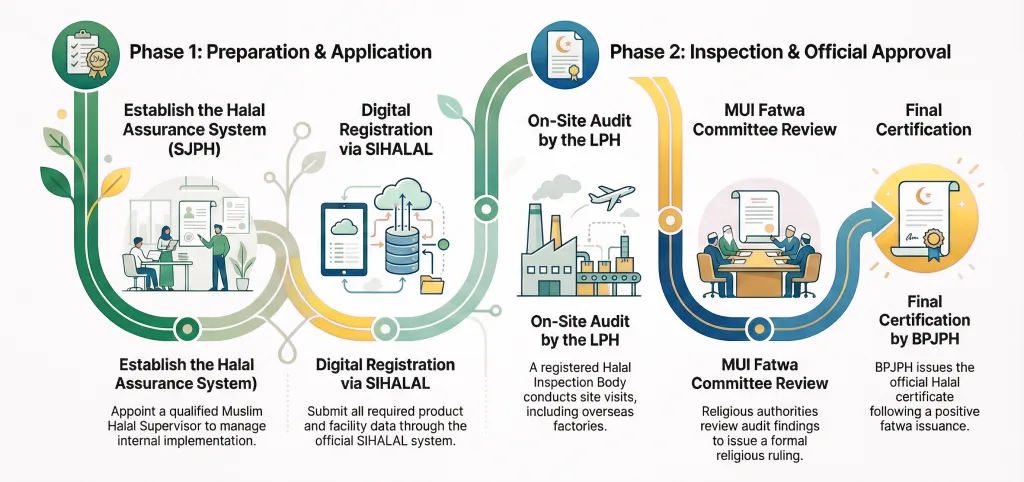
Halal certification involves multiple authorities and a structured process:
- Preparation
Implementation of the Halal Assurance System (SJPH) and appointment of a qualified Muslim Halal Supervisor. - Registration
Submission of product and facility data through the SIHALAL system. - Audit
On-site inspection by a registered Halal Inspection Body (LPH), including overseas factory visits where applicable. - Fatwa Issuance
Review and religious ruling by the MUI Fatwa Committee. - Certification
Official Halal certificate issued by BPJPH.
Frequently Asked Questions
Q: Can we use synthetic musk or animal-derived ingredients in our perfume?
A: Yes, but with strict conditions. Synthetic musk is generally safe, but any animal-derived ingredient must come from Halal-slaughtered animals and be free from pig-derived [Porcine] DNA. We recommend a full ingredient pre-audit to avoid rejection during the LPH inspection.
Q: Is Halal certification required if our perfume is 100% synthetic?
A: Yes, it is mandatory. Even if the ingredients are synthetic, the production line, solvents (like ethanol), and packaging materials must be certified to ensure no cross-contamination occurred during the manufacturing process.
Q: Can “Alcohol-Free” perfumes still fail Halal certification?
A: Yes. Even without alcohol, a perfume can fail if it uses non-Halal animal fixatives, contaminated equipment, or prohibited stabilizers.
Q: Do we need to disclose our “Secret” fragrance formula to the auditors?
A: Business actors applying for certification are obligated to provide information “correctly, clearly, and honestly” regarding the list of products and materials used. They must provide information and data to the Auditor during the inspection. While trade secrets are respected, the Halal status of every chemical component must be verified through certificates or technical specifications.
ICI Halal Compliance Services
Navigating Indonesian bureaucracy is complex. At INSIGHTOF, we provide a ‘One-Stop Solution’ for fragrance brands:
- [Halal Pre-Assessment]: Checking your formula against BPJPH standards before you apply.
- [SJPH Manual Preparation]: Drafting the mandatory Halal Assurance System documents.
- [LPH Audit Support]: On-site (or remote) coordination during inspections.
Preparing for 2026 starts today. With the right strategy, compliance does not need to disrupt your market presence.
Website: www.insightof.co.id
Email: marketing@insightof.co.id
Tags: #ICI #INSIGHTOF #HalalPerfume #FragranceCompliance #HalalIndonesia2026 #BPJPH #PerfumeIndustry #HalalCosmetics